TEKS Math 8.3.C
The Standard
use an algebraic representation to explain the effect of a given positive rational scale factor applied to two-dimensional figures on a coordinate plane with the origin as the center of dilation
Texas Essential Knowledge and Skills for Mathematics
Teacher's field guide
What This Standard Means
What Students Need to Do
- Students represent a dilation from the origin with the rule (x, y) → (kx, ky), where k is a positive rational number. They use the rule to explain how the coordinates, side lengths, size, and orientation change.
What Mastery Looks Like
- A student writes the rule (x, y) → (kx, ky) and uses it to find every image coordinate. The student explains that lengths change by k while angle measures and shape stay the same.
Common Misconceptions
- Students may multiply only one coordinate or add the scale factor instead of multiplying. They may also think a factor between 0 and 1 creates a reflection or changes angle measures.
How to Assess It
- Give students triangle A(2, 1), B(4, 1), C(2, 3) and scale factor 1/2. Ask for the rule, image coordinates, and one sentence describing the change.
Lesson moves
Ways to Teach It
Plot a triangle on graph paper, then multiply each coordinate by 3/2 and connect the image points with a different color.
Ask students to explain in writing why a scale factor of 1/4 shrinks a figure without moving the center of dilation.
Run a card sort matching original coordinates, scale factors, algebraic rules, and image coordinates.
Use a digital photo grid to model enlarging or reducing an image, then connect pixel coordinates to the rule (x, y) → (kx, ky).
Free download
Printable 8.3.C Worksheet
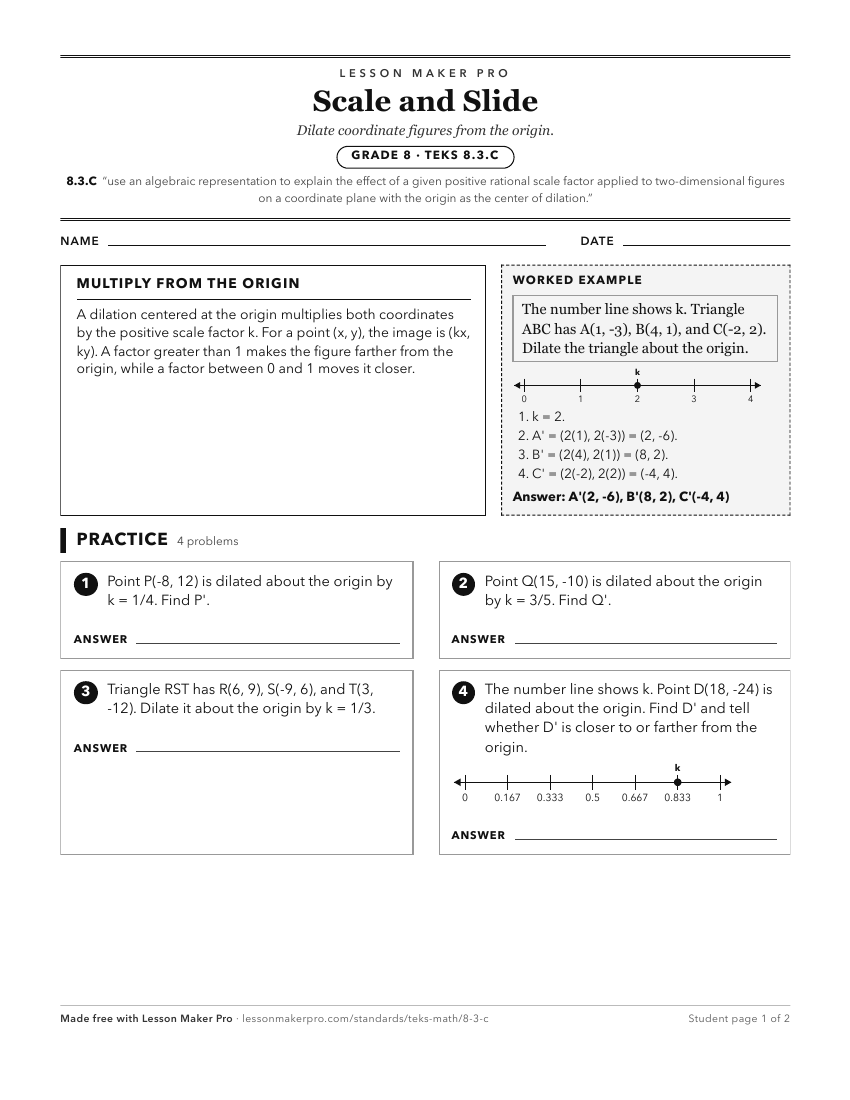
A ready-to-print activity worksheet aligned to 8.3.C, with an answer key for the teacher on its own page. No account needed.
PDF, US Letter, prints cleanly in black and white.
Download the worksheetKeep exploring
Related Standards
- 8.3.B
compare and contrast the attributes of a shape and its dilation(s) on a coordinate plane
- 8.3
The student applies mathematical process standards to use proportional relationships to describe dilations
- 8.10.C
explain the effect of translations, reflections over the x- or y-axis, and rotations limited to 90°, 180°, 270°, and 360° as applied to two-dimensional shapes o...
- 8.3.A
generalize that the ratio of corresponding sides of similar shapes are proportional, including a shape and its dilation
Turn this exact standard into a lesson
Grade, subject, topic, and the complete standard are prefilled. Create one free, no account needed.
Also for this standard:Make a WorksheetMake a QuizMake a Sub Lesson