TEKS Math 7.8.C
The Standard
use models to determine the approximate formulas for the circumference and area of a circle and connect the models to the actual formulas
Texas Essential Knowledge and Skills for Mathematics
Teacher's field guide
What This Standard Means
What Students Need to Do
- Students measure circles and compare circumference with diameter to estimate π. They cut a circle into sectors, rearrange the pieces, and connect the new shape to the area formula.
What Mastery Looks Like
- Students can use measurements to show that circumference divided by diameter is about π. They can explain how rearranged circle sectors form a shape with area about πr². Their estimates use the correct measurements and units.
Common Misconceptions
- Students may confuse radius with diameter or switch the circumference and area formulas. They may treat π as exactly 3.14 or use square units for circumference and linear units for area.
How to Assess It
- Exit ticket: A circle has a diameter of 10 cm. Use a model-based explanation to estimate its circumference and area, then label each answer with units.
Lesson moves
Ways to Teach It
Have students measure lids with string and rulers, calculate circumference divided by diameter, and use the class results to estimate π.
Ask students to explain why rearranged circle sectors resemble a parallelogram with base about πr and height r.
Give pairs matching cards with circle models, measurements, formulas, and estimates, then require a spoken justification for each set.
Use a bicycle wheel's diameter to estimate distance traveled in 100 rotations, then explain why the circumference formula fits.
Free download
Printable 7.8.C Worksheet
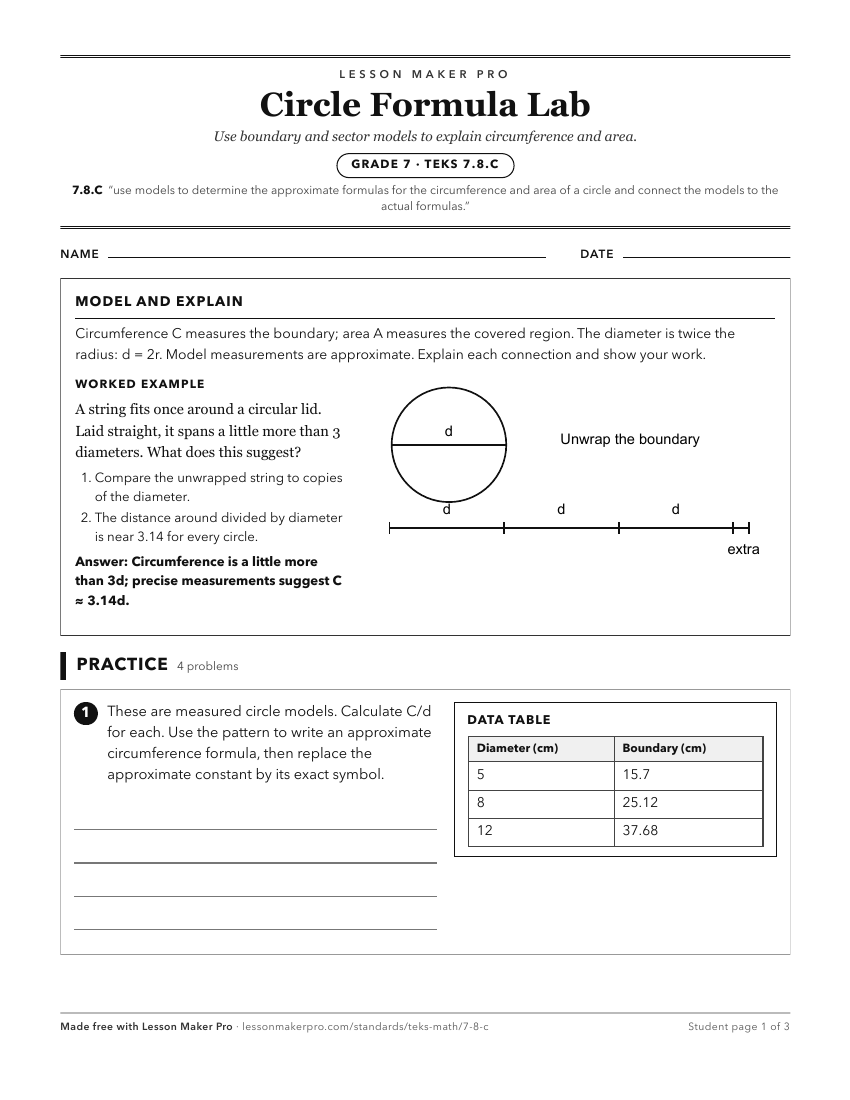
A ready-to-print activity worksheet aligned to 7.8.C, with an answer key for the teacher on its own page. No account needed.
PDF, US Letter, prints cleanly in black and white.
Download the worksheetKeep exploring
Related Standards
- 4.5.C
use models to determine the formulas for the perimeter of a rectangle (l + w + l + w or 2l + 2w), including the special form for perimeter of a square (4s) and ...
- 7.9.B
determine the circumference and area of circles
- 8.6.B
model the relationship between the volume of a cylinder and a cone having both congruent bases and heights and connect that relationship to the formulas
- 8.6.C
use models and diagrams to explain the Pythagorean theorem
Turn this exact standard into a lesson
Grade, subject, topic, and the complete standard are prefilled. Create one free, no account needed.
Also for this standard:Make a WorksheetMake a QuizMake a Sub Lesson