TEKS Math 8.6.C
The Standard
use models and diagrams to explain the Pythagorean theorem
Texas Essential Knowledge and Skills for Mathematics
Teacher's field guide
What This Standard Means
What Students Need to Do
- Students build or study squares attached to the sides of a right triangle. They use the square areas to explain why the two leg areas combine to equal the hypotenuse area.
What Mastery Looks Like
- Students label the legs and hypotenuse correctly. They use a diagram to connect the areas of the three squares and explain the relationship with an equation.
Common Misconceptions
- Students may choose a leg as the hypotenuse or use the relationship with triangles that are not right triangles. They may confuse side lengths with square areas or forget to take the square root when finding a missing side.
How to Assess It
- Give students a right triangle with legs 6 and 8. Ask them to draw squares on each side and explain why the hypotenuse is 10.
Lesson moves
Ways to Teach It
On grid paper, draw a 3-4-5 triangle, build squares on each side, and count the unit squares in each region.
Display a labeled right triangle and ask students to explain in writing why the hypotenuse square has the greatest area.
Play a card match using right triangle diagrams, square areas, equations, and missing side lengths.
Measure a rectangular tabletop, predict its diagonal length using the side measurements, then check the prediction with a tape measure.
Free download
Printable 8.6.C Worksheet
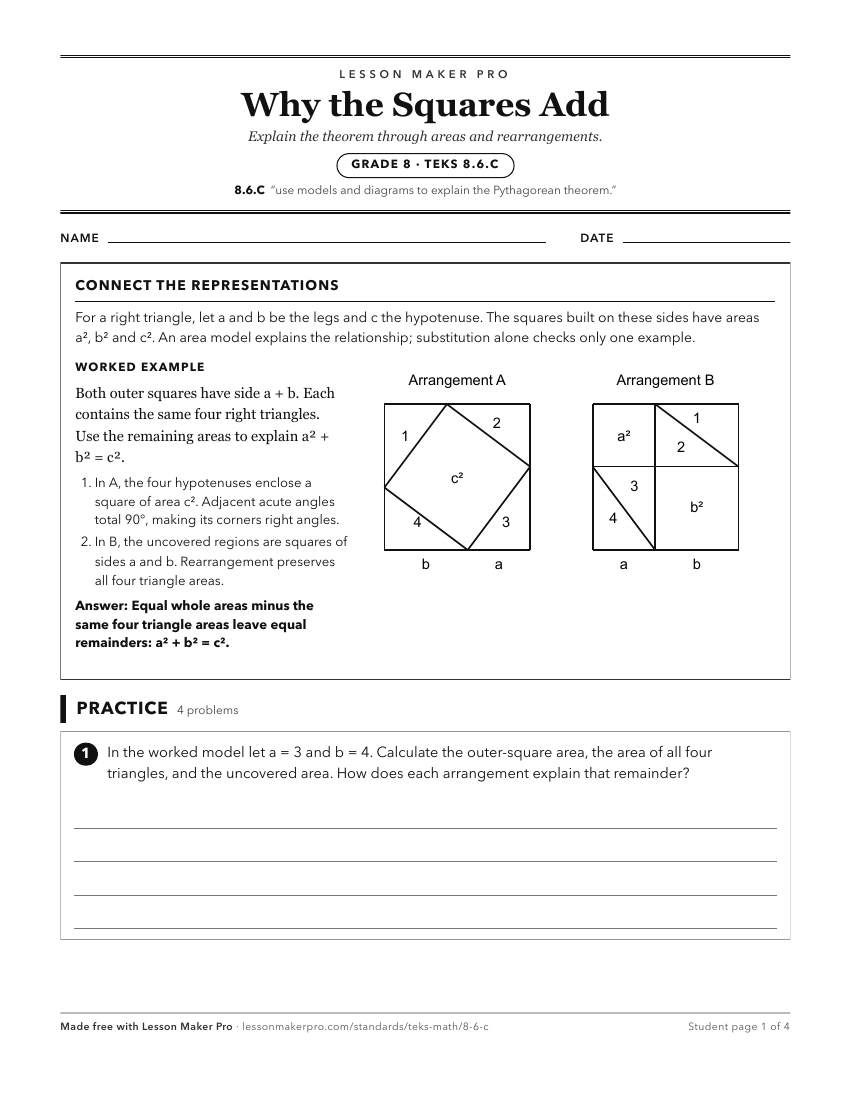
A ready-to-print activity worksheet aligned to 8.6.C, with an answer key for the teacher on its own page. No account needed.
PDF, US Letter, prints cleanly in black and white.
Download the worksheetKeep exploring
Related Standards
- 8.7.C
use the Pythagorean Theorem and its converse to solve problems
- 6.8.B
model area formulas for parallelograms, trapezoids, and triangles by decomposing and rearranging parts of these shapes
- 6.10.A
model and solve one-variable, one-step equations and inequalities that represent problems, including geometric concepts
- 7.8.C
use models to determine the approximate formulas for the circumference and area of a circle and connect the models to the actual formulas
Turn this exact standard into a lesson
Grade, subject, topic, and the complete standard are prefilled. Create one free, no account needed.
Also for this standard:Make a WorksheetMake a QuizMake a Sub Lesson