TEKS Math 8.7.C
The Standard
use the Pythagorean Theorem and its converse to solve problems
Texas Essential Knowledge and Skills for Mathematics
Teacher's field guide
What This Standard Means
What Students Need to Do
- Students use the two shorter sides of a right triangle to find the longest side, or use one leg and the hypotenuse to find another leg. They also test three side lengths to decide whether a triangle is right.
What Mastery Looks Like
- Students correctly identify the hypotenuse, set up the equation, and find a missing side. Given three side lengths, they compare the squares and justify whether the triangle is right.
Common Misconceptions
- Students may treat either leg as the hypotenuse or forget that the hypotenuse is opposite the right angle. They may add side lengths instead of squares, skip the square root, or assume every triangle is right.
How to Assess It
- Exit ticket: Find the hypotenuse of a triangle with legs 8 and 11. Then decide whether side lengths 9, 12, and 15 form a right triangle, showing both calculations.
Lesson moves
Ways to Teach It
Have students build 3-4-5 and 5-5-8 triangles with straws, then test each triangle using squared side lengths.
Ask, “How can side lengths prove a triangle is right without measuring an angle?” Students write a claim supported by calculations.
Run a card sort matching triangle diagrams, missing-side equations, solutions, and labels of right or not right.
Find the diagonal brace length needed for a rectangular gate measuring 6 feet by 8 feet.
Free download
Printable 8.7.C Worksheet
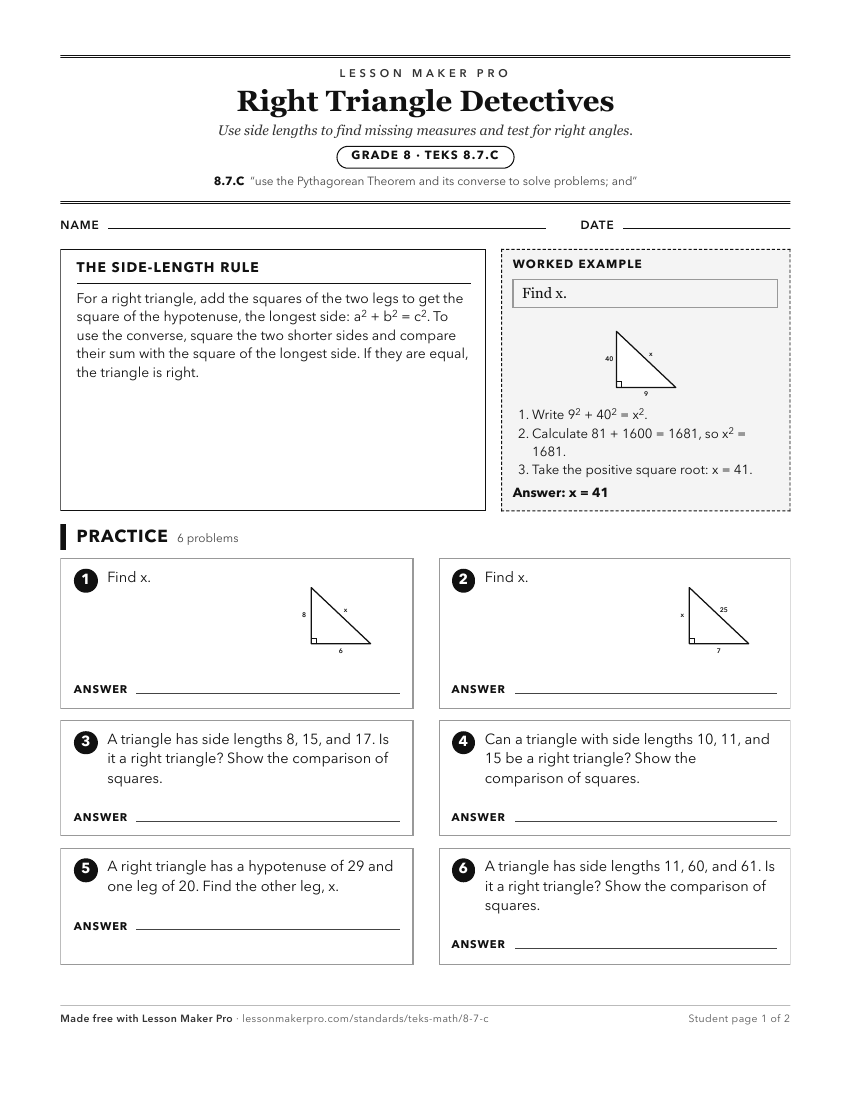
A ready-to-print activity worksheet aligned to 8.7.C, with an answer key for the teacher on its own page. No account needed.
PDF, US Letter, prints cleanly in black and white.
Download the worksheetKeep exploring
Related Standards
- 8.7.D
determine the distance between two points on a coordinate plane using the Pythagorean Theorem
- 7.11.C
write and solve equations using geometry concepts, including the sum of the angles in a triangle, and angle relationships
- 7.9.A
solve problems involving the volume of rectangular prisms, triangular prisms, rectangular pyramids, and triangular pyramids
- 8.6.C
use models and diagrams to explain the Pythagorean theorem
Turn this exact standard into a lesson
Grade, subject, topic, and the complete standard are prefilled. Create one free, no account needed.
Also for this standard:Make a WorksheetMake a QuizMake a Sub Lesson