TEKS Math 8.7.D
The Standard
determine the distance between two points on a coordinate plane using the Pythagorean Theorem
Texas Essential Knowledge and Skills for Mathematics
Teacher's field guide
What This Standard Means
What Students Need to Do
- Students find the horizontal and vertical changes between two plotted points. They use those values as right-triangle legs, calculate the hypotenuse, and label the result in units.
What Mastery Looks Like
- Students correctly identify the horizontal and vertical leg lengths, including when coordinates are negative. They apply the Pythagorean Theorem and report the distance as an exact square root or reasonable decimal when requested.
Common Misconceptions
- Students may subtract coordinates in the wrong order or mishandle negative values. They may add the leg lengths, forget to square them, or stop before taking the square root.
How to Assess It
- Exit ticket: Find the distance between (-2, 1) and (4, 9). Draw and label the right triangle, then show each calculation.
Lesson moves
Ways to Teach It
Plot (-3, -2) and (5, 4) on graph paper, draw the horizontal and vertical legs, then measure to check the calculated distance.
Ask: Why do coordinate differences become the legs of a right triangle? Students explain with a labeled sketch and one sentence.
Play Distance Match: students pair coordinate cards with right-triangle leg lengths and distance cards, then justify each match.
Use a city grid map to find the straight-line distance between two landmarks when each grid unit represents 100 meters.
Free download
Printable 8.7.D Worksheet
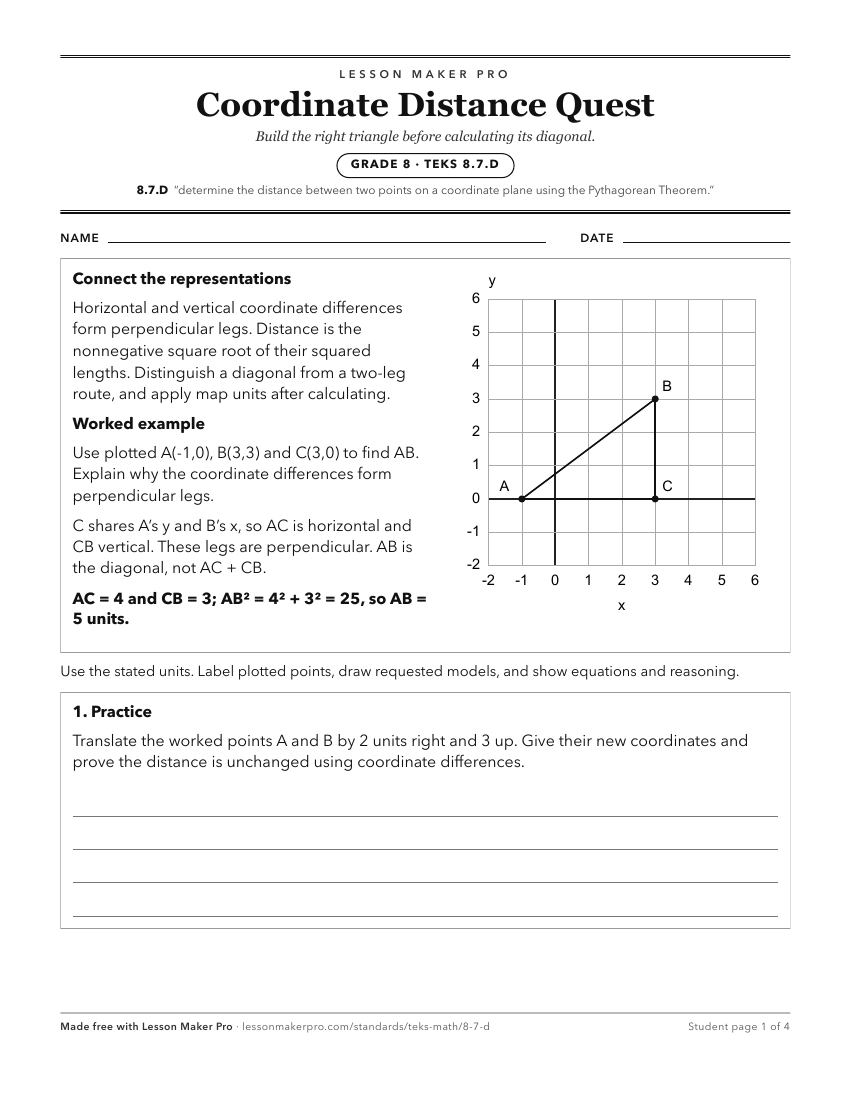
A ready-to-print activity worksheet aligned to 8.7.D, with an answer key for the teacher on its own page. No account needed.
PDF, US Letter, prints cleanly in black and white.
Download the worksheetKeep exploring
Related Standards
- 8.7.C
use the Pythagorean Theorem and its converse to solve problems
- 6.11
The student applies mathematical process standards to use coordinate geometry to identify locations on a plane. The student is expected to graph points in all f...
- 8.4.A
use similar right triangles to develop an understanding that slope, m, given as the rate comparing the change in y-values to the change in x-values, (y2 - y1) /...
- 8.6.C
use models and diagrams to explain the Pythagorean theorem
Turn this exact standard into a lesson
Grade, subject, topic, and the complete standard are prefilled. Create one free, no account needed.
Also for this standard:Make a WorksheetMake a QuizMake a Sub Lesson