TEKS Math 6.10.A
The Standard
model and solve one-variable, one-step equations and inequalities that represent problems, including geometric concepts
Texas Essential Knowledge and Skills for Mathematics
Teacher's field guide
What This Standard Means
What Students Need to Do
- Students turn short situations, including area, perimeter, and angle problems, into mathematical statements with one unknown. They use inverse operations to find the unknown and explain what the result means in context.
What Mastery Looks Like
- Students define the unknown, choose the correct operation and symbol, and write a matching mathematical statement. They isolate the variable and check the result in the original situation. For inequalities, they show all possible values on a number line or describe them in words.
Common Misconceptions
- Students may apply an inverse operation to only one side, or choose the wrong inverse operation. They often use an equal sign for phrases like "at most" or "at least." Some give only the boundary number for an inequality instead of the full solution set.
How to Assess It
- Give this two-part exit ticket: A rectangle has area 54 square inches and length 6 inches; write and solve an equation for its width. Two adjacent angles total at most 120°, and one measures 47°; write and solve an inequality for the other angle.
Lesson moves
Ways to Teach It
Build x + 7 = 19 with algebra tiles, then remove seven tiles from both sides to find x.
Ask students to explain how the phrases “at least” and “at most” change the mathematical symbol and possible answers.
Run a card sort matching situation cards, equations or inequalities, solutions, and number line graphs.
Use a room plan to find an unknown side length from area, then set a spending limit for flooring materials.
Free download
Printable 6.10.A Worksheet
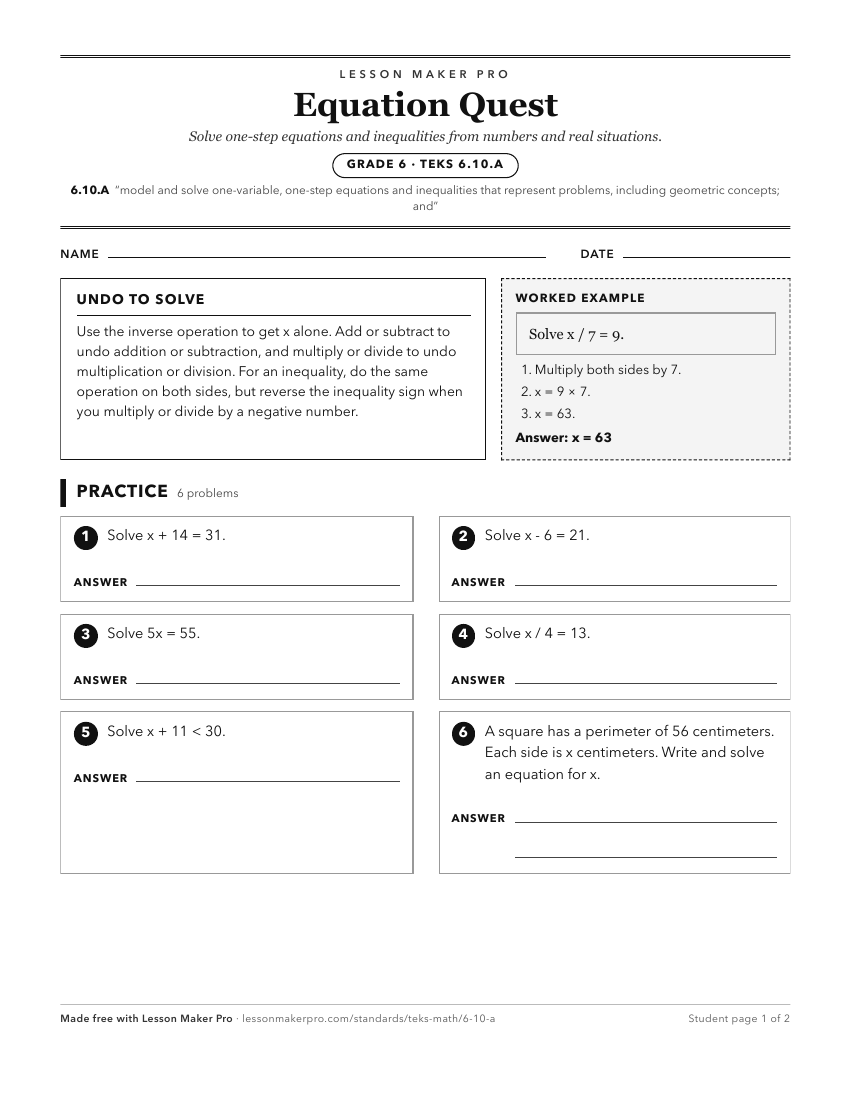
A ready-to-print activity worksheet aligned to 6.10.A, with an answer key for the teacher on its own page. No account needed.
PDF, US Letter, prints cleanly in black and white.
Download the worksheetKeep exploring
Related Standards
- 7.11.A
model and solve one-variable, two-step equations and inequalities
- 6.9.B
represent solutions for one-variable, one-step equations and inequalities on number lines
- 7.10.B
represent solutions for one-variable, two-step equations and inequalities on number lines
- 6.9.C
write corresponding real-world problems given one-variable, one-step equations or inequalities
Turn this exact standard into a lesson
Grade, subject, topic, and the complete standard are prefilled. Create one free, no account needed.
Also for this standard:Make a WorksheetMake a QuizMake a Sub Lesson