TEKS Math 6.9.B
The Standard
represent solutions for one-variable, one-step equations and inequalities on number lines
Texas Essential Knowledge and Skills for Mathematics
Teacher's field guide
What This Standard Means
What Students Need to Do
- Students find the value that makes a simple equation true and mark it as one point. For an inequality, they mark the boundary, choose an open or closed circle, and shade all valid values.
What Mastery Looks Like
- Students graph an equation with one point. They graph an inequality with the correct boundary symbol and shade in the correct direction.
Common Misconceptions
- Students may use a closed circle for strict inequalities or an open circle when the boundary is included. They may shade in the wrong direction or graph an equation as a ray instead of one point.
How to Assess It
- Give this exit ticket: Solve x + 4 = 9 and x − 2 ≤ 3, then graph each answer on a number line.
Lesson moves
Ways to Teach It
Make a floor number line with tape, then have students stand on or beside the boundary and stretch yarn toward all valid values.
Ask students to compare x = 3, x < 3, and x ≤ 3, then explain how and why the graphs differ.
Play a card match game using expression cards, solution cards, and number line graph cards.
Use x + 4 ≤ 12 to model how many more pounds a bag can hold, then graph the possible added weights.
Free download
Printable 6.9.B Worksheet
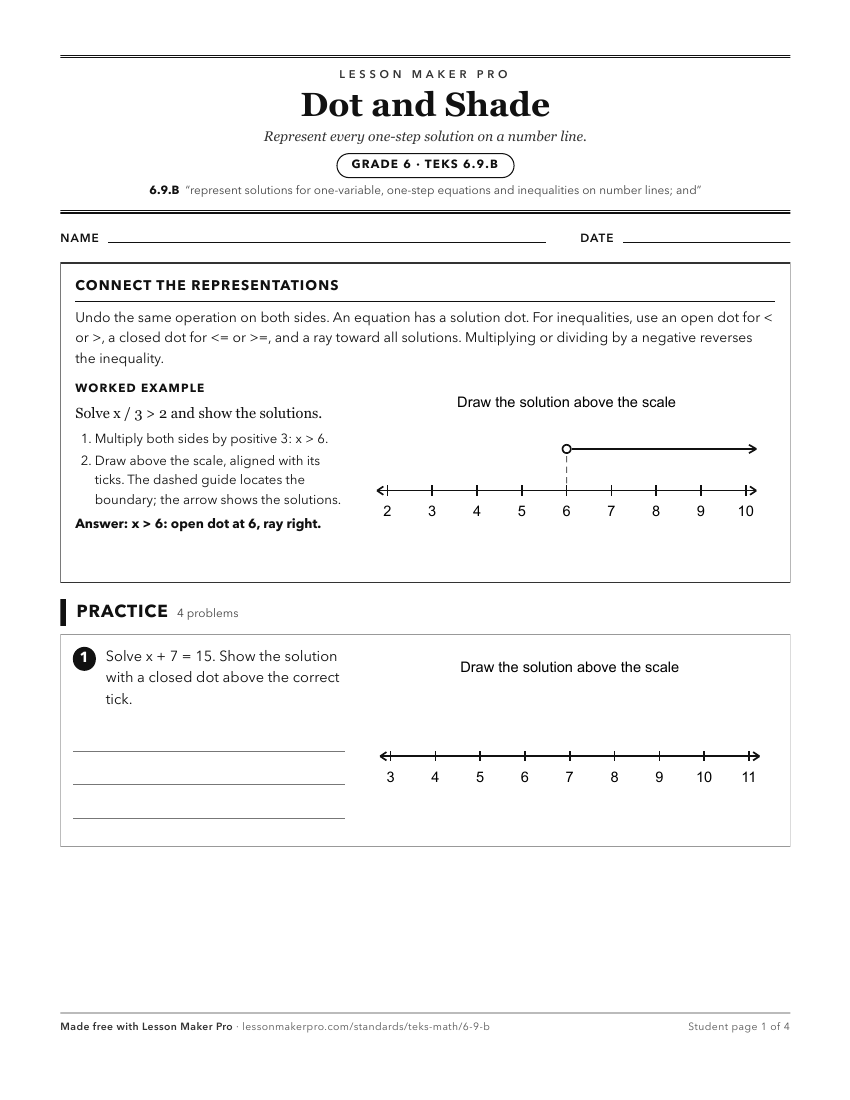
A ready-to-print activity worksheet aligned to 6.9.B, with an answer key for the teacher on its own page. No account needed.
PDF, US Letter, prints cleanly in black and white.
Download the worksheetKeep exploring
Related Standards
- 7.11.A
model and solve one-variable, two-step equations and inequalities
- 6.10.A
model and solve one-variable, one-step equations and inequalities that represent problems, including geometric concepts
- 6.9.A
write one-variable, one-step equations and inequalities to represent constraints or conditions within problems
- 7.10.B
represent solutions for one-variable, two-step equations and inequalities on number lines
Turn this exact standard into a lesson
Grade, subject, topic, and the complete standard are prefilled. Create one free, no account needed.
Also for this standard:Make a WorksheetMake a QuizMake a Sub Lesson