TEKS Math 6.9.A
The Standard
write one-variable, one-step equations and inequalities to represent constraints or conditions within problems
Texas Essential Knowledge and Skills for Mathematics
Teacher's field guide
What This Standard Means
What Students Need to Do
- Students identify the unknown quantity and name it with a variable. They translate a stated relationship or limit into a one-step equation or inequality using the correct operation and comparison symbol.
What Mastery Looks Like
- Given a short situation, a student writes a statement such as x - 6 = 14 or 3x ≤ 24 and explains what x represents. The operation, numbers, and symbol match words such as exactly, at least, and no more than.
Common Misconceptions
- Students often use an equals sign whenever two numbers appear, even when the situation gives a limit. They may confuse “at least” with < or “no more than” with >. They may also reverse subtraction or use addition when a cost per item calls for multiplication.
How to Assess It
- Exit ticket: Maya had some stickers, gave away 7, and now has 18. A bus holds at most 48 people and already has 31 aboard. Write a variable statement for each situation.
Lesson moves
Ways to Teach It
Give pairs counters and situation cards. Students model each condition, then write the matching equation or inequality on mini whiteboards.
Ask, “How do exactly 20, at least 20, and no more than 20 change the symbol?” Students write and defend three statements.
Run a matching relay with context cards, variable statements, and equations or inequalities. Teams explain each match before scoring a point.
Give students a $30 party budget with an $8 cake cost. They write an inequality for how much remains for snacks.
Free download
Printable 6.9.A Worksheet
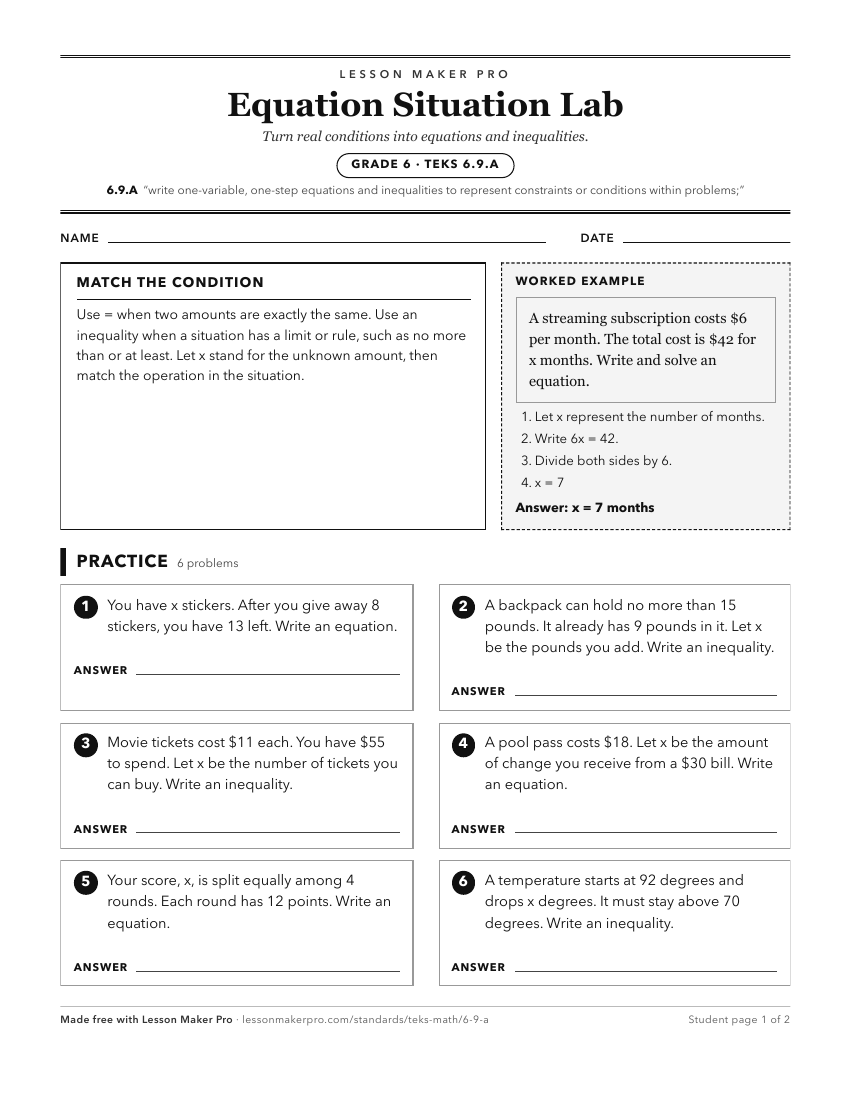
A ready-to-print activity worksheet aligned to 6.9.A, with an answer key for the teacher on its own page. No account needed.
PDF, US Letter, prints cleanly in black and white.
Download the worksheetKeep exploring
Related Standards
- 7.10.A
write one-variable, two-step equations and inequalities to represent constraints or conditions within problems
- 7.10.C
write a corresponding real-world problem given a one-variable, two-step equation or inequality
- 8.8.A
write one-variable equations or inequalities with variables on both sides that represent problems using rational number coefficients and constants
- 6.9.C
write corresponding real-world problems given one-variable, one-step equations or inequalities
Turn this exact standard into a lesson
Grade, subject, topic, and the complete standard are prefilled. Create one free, no account needed.
Also for this standard:Make a WorksheetMake a QuizMake a Sub Lesson