TEKS Math 7.10.A
The Standard
write one-variable, two-step equations and inequalities to represent constraints or conditions within problems
Texas Essential Knowledge and Skills for Mathematics
Teacher's field guide
What This Standard Means
What Students Need to Do
- Students choose a variable for an unknown quantity and translate a situation into a mathematical statement with two operations. They use equality for exact conditions and inequality symbols for limits or ranges.
What Mastery Looks Like
- Students define the variable and include both the fixed amount and the changing amount. They choose an equals sign or inequality symbol that matches words such as exactly, at least, or no more than.
Common Misconceptions
- Students often use an equals sign when the situation gives a maximum or minimum. They may reverse inequality symbols, omit the fixed amount, or attach the rate to the wrong quantity.
How to Assess It
- Give this exit ticket: A club charges $15 to join and $6 per visit. Define a variable, then write one statement for exactly $51 and another for no more than $60.
Lesson moves
Ways to Teach It
Use cups and counters to model a hidden amount, then add a fixed fee and set an exact total or spending limit.
Ask students to explain how exactly $40 differs from no more than $40, then write a matching mathematical statement for each phrase.
Run a card sort matching short scenarios, variable definitions, and two-step equations or inequalities, with students correcting any unmatched cards.
Have students compare two phone plans with monthly fees and per-gigabyte charges, then write a statement for a given bill or budget.
Free download
Printable 7.10.A Worksheet
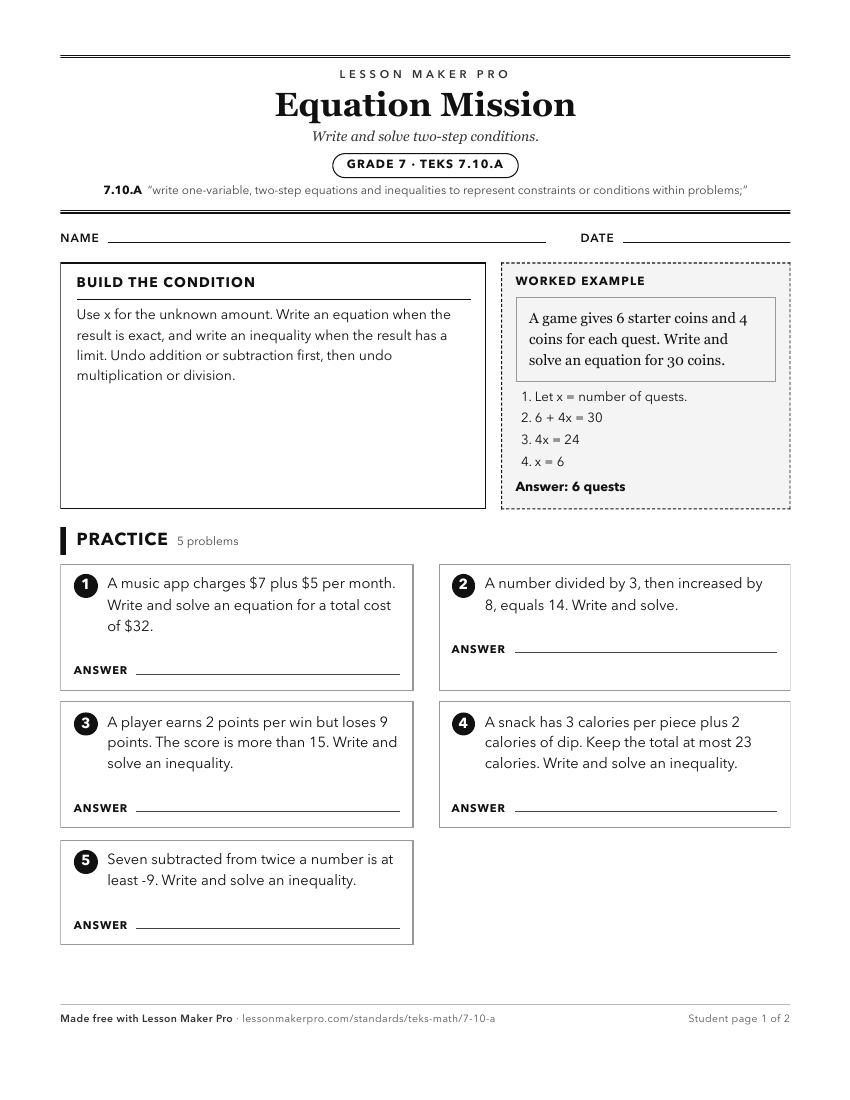
A ready-to-print activity worksheet aligned to 7.10.A, with an answer key for the teacher on its own page. No account needed.
PDF, US Letter, prints cleanly in black and white.
Download the worksheetKeep exploring
Related Standards
- 6.9.A
write one-variable, one-step equations and inequalities to represent constraints or conditions within problems
- 7.10.C
write a corresponding real-world problem given a one-variable, two-step equation or inequality
- 8.8.A
write one-variable equations or inequalities with variables on both sides that represent problems using rational number coefficients and constants
- 6.9.C
write corresponding real-world problems given one-variable, one-step equations or inequalities
Turn this exact standard into a lesson
Grade, subject, topic, and the complete standard are prefilled. Create one free, no account needed.
Also for this standard:Make a WorksheetMake a QuizMake a Sub Lesson