TEKS Math 7.10.C
The Standard
write a corresponding real-world problem given a one-variable, two-step equation or inequality
Texas Essential Knowledge and Skills for Mathematics
Teacher's field guide
What This Standard Means
What Students Need to Do
- Students turn a given equation or inequality into a believable situation. They connect the variable, numbers, operations, and comparison symbol to details in the situation.
What Mastery Looks Like
- A student writes a realistic situation that matches every number, operation, and inequality symbol. The student defines the variable and asks a clear question that can be answered using the given relationship.
Common Misconceptions
- Students may reverse the order of operations when building the story or attach a number to the wrong quantity. They may also confuse phrases such as “at most” and “at least,” or leave the variable undefined.
How to Assess It
- Exit ticket: For 3x + 5 ≤ 26, write a realistic problem, define x, and explain what 3, 5, and 26 represent.
Lesson moves
Ways to Teach It
Give pairs equation cards, number cards, and setting cards, then have them build and act out a matching situation.
Ask students to compare two stories for 4x + 7 > 31 and explain which words correctly show the inequality.
Play a card-matching relay where teams pair equations and inequalities with matching story cards, then correct one mismatched pair.
Show an amusement park price list with admission and ride costs, then have students write a budget problem for a given inequality.
Free download
Printable 7.10.C Worksheet
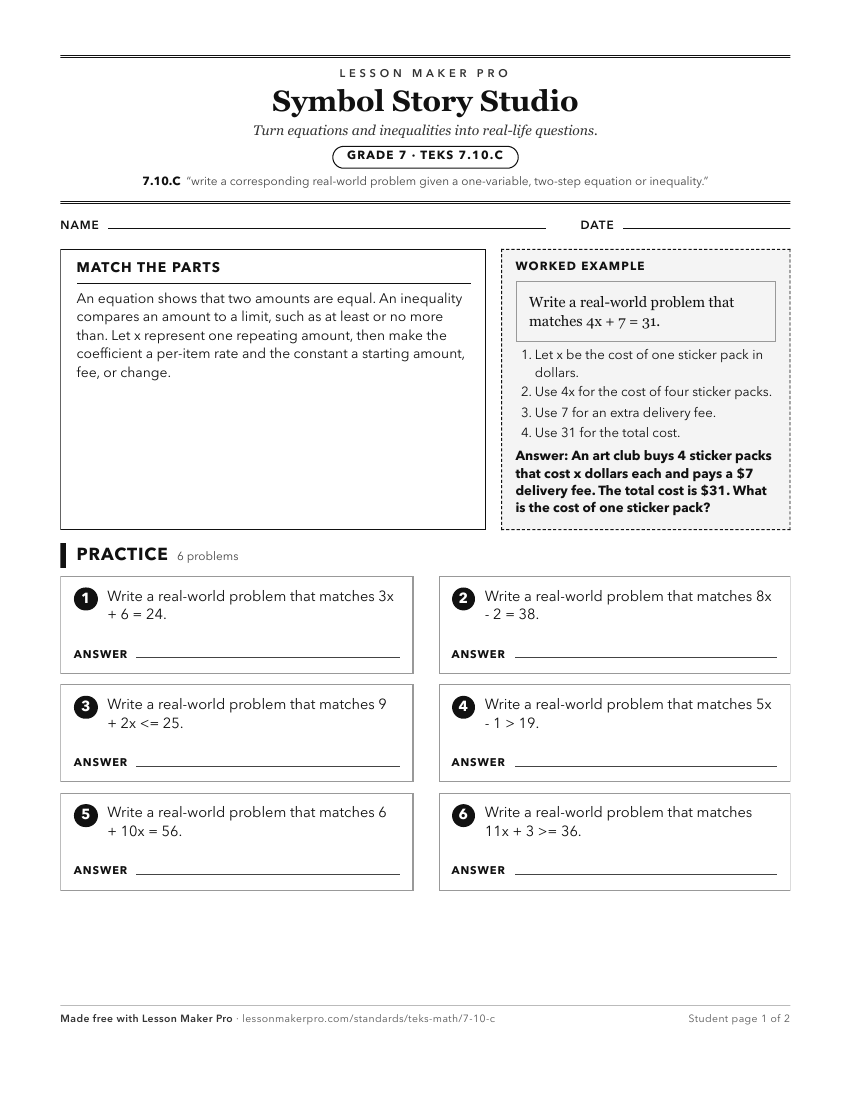
A ready-to-print activity worksheet aligned to 7.10.C, with an answer key for the teacher on its own page. No account needed.
PDF, US Letter, prints cleanly in black and white.
Download the worksheetKeep exploring
Related Standards
- 6.9.A
write one-variable, one-step equations and inequalities to represent constraints or conditions within problems
- 7.10.A
write one-variable, two-step equations and inequalities to represent constraints or conditions within problems
- 8.8.B
write a corresponding real-world problem when given a one-variable equation or inequality with variables on both sides of the equal sign using rational number c...
- 6.9.C
write corresponding real-world problems given one-variable, one-step equations or inequalities
Turn this exact standard into a lesson
Grade, subject, topic, and the complete standard are prefilled. Create one free, no account needed.
Also for this standard:Make a WorksheetMake a QuizMake a Sub Lesson