TEKS Math 4.5.C
The Standard
use models to determine the formulas for the perimeter of a rectangle (l + w + l + w or 2l + 2w), including the special form for perimeter of a square (4s) and the area of a rectangle (l x w)
Texas Essential Knowledge and Skills for Mathematics
Teacher's field guide
What This Standard Means
What Students Need to Do
- Students use tiles, grids, or labeled drawings to see how rectangle formulas come from side lengths, rows, and columns. They find perimeter and area, including perimeter for squares.
What Mastery Looks Like
- Students connect the four sides of a rectangle to both perimeter forms and explain why the forms are equal. They use rows and columns to justify the area formula and use 4s for a square’s perimeter.
Common Misconceptions
- Students often mix up perimeter and area, or add length and width only once for perimeter. Some use 2l × 2w, count corner units twice, or miss that all four sides of a square are equal.
How to Assess It
- Give students a 6-by-3 rectangle and a square with side length 4. Ask them to draw or label models, write perimeter and area formulas, and calculate each value.
Lesson moves
Ways to Teach It
Build rectangles with square tiles, trace each shape, then label side lengths and write matching perimeter and area equations.
Write why 2l + 2w matches l + w + l + w, and explain why a square can use 4s.
Play Formula Match with cards showing rectangles, dimensions, formulas, and values; students collect complete matching sets.
Measure a book cover, then calculate the ribbon needed around its edge and the paper needed to cover its face.
Free download
Printable 4.5.C Worksheet
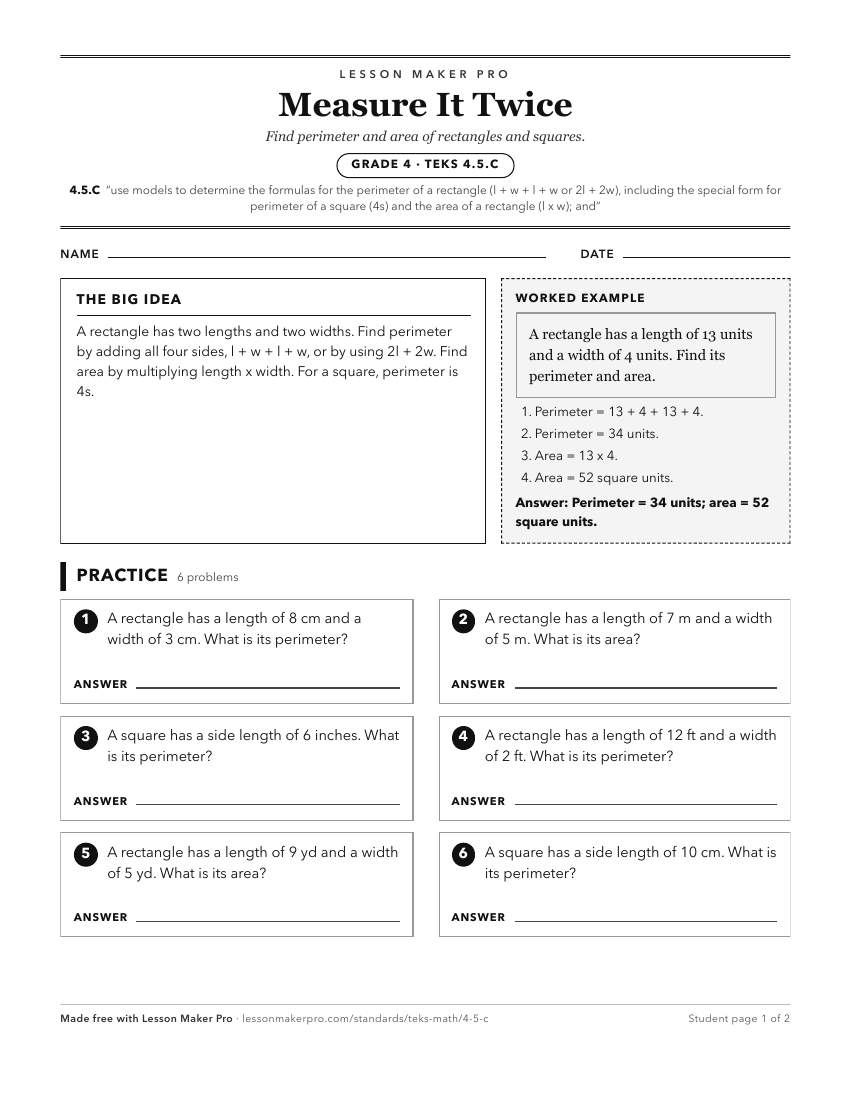
A ready-to-print activity worksheet aligned to 4.5.C, with an answer key for the teacher on its own page. No account needed.
PDF, US Letter, prints cleanly in black and white.
Download the worksheetKeep exploring
Related Standards
- 6.8.B
model area formulas for parallelograms, trapezoids, and triangles by decomposing and rearranging parts of these shapes
- 7.8.C
use models to determine the approximate formulas for the circumference and area of a circle and connect the models to the actual formulas
- 5.4.G
use concrete objects and pictorial models to develop the formulas for the volume of a rectangular prism, including the special form for a cube (V = l x w x h, V...
- 2.9.F
use concrete models of square units to find the area of a rectangle by covering it with no gaps or overlaps, counting to find the total number of square units, ...
Turn this exact standard into a lesson
Grade, subject, topic, and the complete standard are prefilled. Create one free, no account needed.
Also for this standard:Make a WorksheetMake a QuizMake a Sub Lesson