TEKS Math 6.8
Knowledge and Skills Statement (Standard Cluster)
The student applies mathematical process standards to use geometry to represent relationships and solve problems
Texas Essential Knowledge and Skills for Mathematics
Cluster contents
Student Expectations in This Statement
6.8 is a knowledge and skills statement. These are the student expectations under it.
- 6.8.A
extend previous knowledge of triangles and their properties to include the sum of angles of a triangle, the relationship between the lengths of sides and measur...
- 6.8.B
model area formulas for parallelograms, trapezoids, and triangles by decomposing and rearranging parts of these shapes
- 6.8.C
write equations that represent problems related to the area of rectangles, parallelograms, trapezoids, and triangles and volume of right rectangular prisms wher...
- 6.8.D
determine solutions for problems involving the area of rectangles, parallelograms, trapezoids, and triangles and volume of right rectangular prisms where dimens...
Teacher's field guide
What This Cluster Means
What Students Need to Do
- Students use angle sums, side-angle relationships, and side lengths to analyze triangles. They build area formulas by cutting and rearranging shapes. They write and solve equations for area and rectangular prism volume using positive rational dimensions.
What Mastery Looks Like
- Students can justify whether three lengths form a triangle and connect larger angles with longer opposite sides. They can explain area formulas by rearranging shapes. They write and solve accurate area and volume equations with whole-number, decimal, or fractional dimensions.
Common Misconceptions
- Students may think any three lengths form a triangle, or that the longest side is opposite the smallest angle. They may use a slanted side as height, omit the one-half factor, or add dimensions when finding volume. Some also apply the triangle angle sum to exterior angles.
How to Assess It
- Give an exit ticket with three tasks: test whether 4, 6, and 11 form a triangle, find a missing triangle angle, and find a trapezoid’s area. Add a right rectangular prism with fractional dimensions and ask students to write and solve a volume equation.
Lesson moves
Ways to Teach It
Cut a paper parallelogram and trapezoid, rearrange the pieces into rectangles, then label how each area formula follows.
Ask students to explain why side lengths 3, 5, and 9 cannot form a triangle, using a drawing and an inequality.
Run a card sort matching shape diagrams, rational dimensions, equations, and solutions for area or volume.
Measure a cereal box and a trapezoid-shaped tabletop, then calculate the box volume and tabletop area using equations.
Free download
Printable 6.8 Worksheet
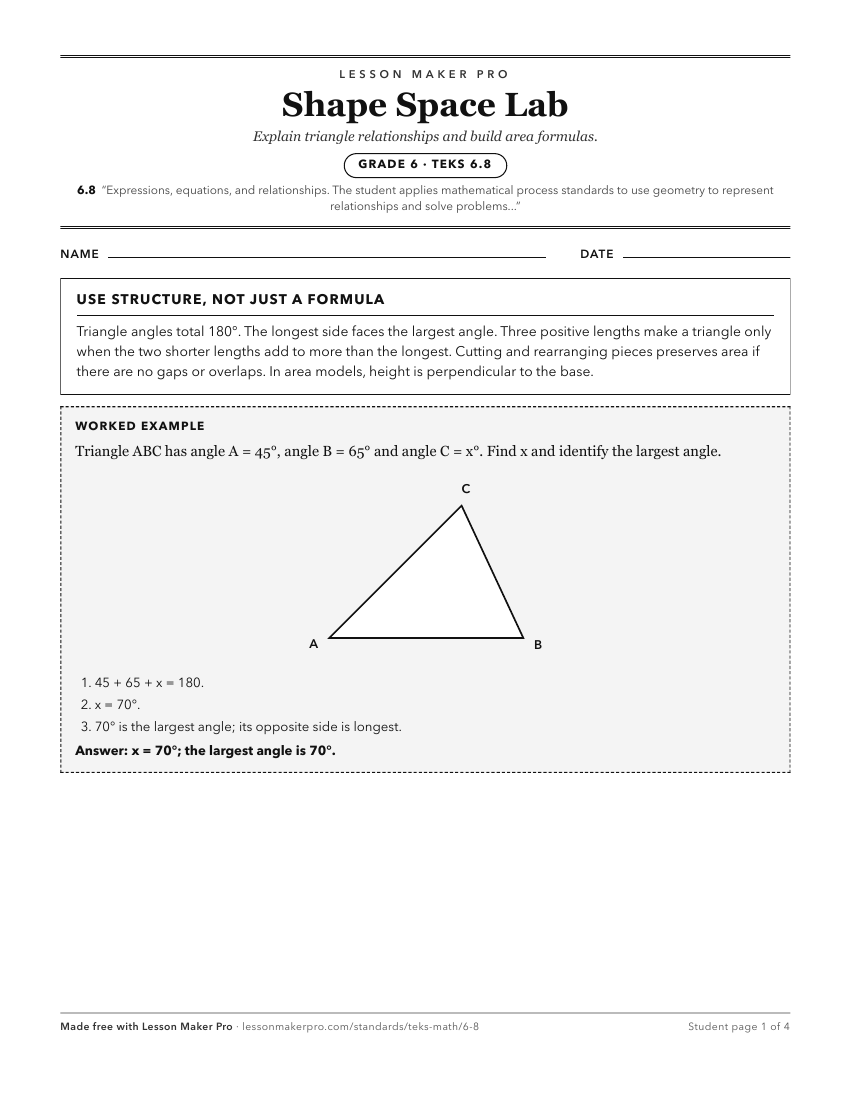
A ready-to-print activity worksheet aligned to 6.8, with an answer key for the teacher on its own page. No account needed.
PDF, US Letter, prints cleanly in black and white.
Download the worksheetKeep exploring
Related Standards
- 8.6
The student applies mathematical process standards to develop mathematical relationships and make connections to geometric formulas
- 7.5
The student applies mathematical process standards to use geometry to describe or solve problems involving proportional relationships
- 8.7
The student applies mathematical process standards to use geometry to solve problems
- 7.9
The student applies mathematical process standards to solve geometric problems
Turn this cluster into a lesson
Grade, subject, topic, and the complete cluster are prefilled. Create one free, no account needed.
Also for this cluster:Make a WorksheetMake a QuizMake a Sub Lesson