TEKS Math 8.10
Knowledge and Skills Statement (Standard Cluster)
The student applies mathematical process standards to develop transformational geometry concepts
Texas Essential Knowledge and Skills for Mathematics
Cluster contents
Student Expectations in This Statement
8.10 is a knowledge and skills statement. These are the student expectations under it.
- 8.10.A
generalize the properties of orientation and congruence of rotations, reflections, translations, and dilations of two-dimensional shapes on a coordinate plane
- 8.10.B
differentiate between transformations that preserve congruence and those that do not
- 8.10.C
explain the effect of translations, reflections over the x- or y-axis, and rotations limited to 90°, 180°, 270°, and 360° as applied to two-dimensional shapes o...
- 8.10.D
model the effect on linear and area measurements of dilated two-dimensional shapes
Teacher's field guide
What This Cluster Means
What Students Need to Do
- Students transform polygons on a coordinate plane and describe each move with coordinate rules. They compare orientation, congruence, side lengths, and areas before and after transformations. They connect a dilation scale factor to length and area changes.
What Mastery Looks Like
- Students write and apply coordinate rules accurately for each transformation. They identify which transformations preserve size and shape, track orientation, and use scale factors to predict new lengths and areas.
Common Misconceptions
- Students may reverse coordinate rules for rotations or change the wrong sign during reflections. They may think dilations preserve congruence, or multiply area by the scale factor instead of its square.
How to Assess It
- Give a triangle with vertices (1, 2), (4, 2), and (1, 5). Ask students to apply a 90° counterclockwise rotation and a dilation by 2, then compare orientation, side lengths, and areas.
Lesson moves
Ways to Teach It
Trace a polygon on transparent grid paper, then slide, flip, turn, and enlarge it while recording coordinates, orientation, lengths, and area.
Ask students to explain why a dilation by 3 multiplies side lengths by 3 but area by 9.
Play transformation rule match, pairing coordinate rules with diagrams, transformation names, and statements about congruence and orientation.
Use a floor plan enlargement to calculate how a scale factor changes wall lengths and room areas.
Free download
Printable 8.10 Worksheet
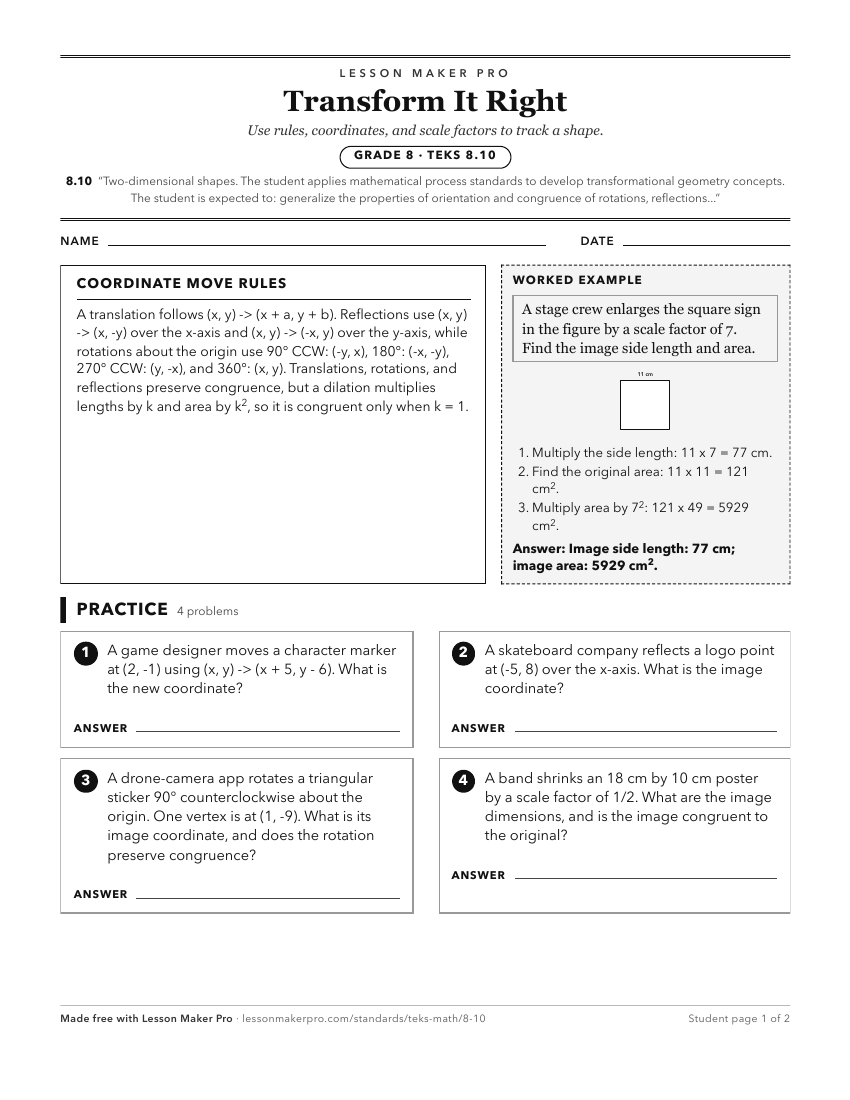
A ready-to-print activity worksheet aligned to 8.10, with an answer key for the teacher on its own page. No account needed.
PDF, US Letter, prints cleanly in black and white.
Download the worksheetKeep exploring
Related Standards
- 8.6
The student applies mathematical process standards to develop mathematical relationships and make connections to geometric formulas
- 8.7
The student applies mathematical process standards to use geometry to solve problems
- 7.9
The student applies mathematical process standards to solve geometric problems
- 6.8
The student applies mathematical process standards to use geometry to represent relationships and solve problems
Turn this cluster into a lesson
Grade, subject, topic, and the complete cluster are prefilled. Create one free, no account needed.
Also for this cluster:Make a WorksheetMake a QuizMake a Sub Lesson