TEKS Math 8.10.B
The Standard
differentiate between transformations that preserve congruence and those that do not
Texas Essential Knowledge and Skills for Mathematics
Teacher's field guide
What This Standard Means
What Students Need to Do
- Students decide whether a translation, reflection, rotation, or dilation keeps a figure the same size and shape. They justify decisions by comparing corresponding side lengths and angle measures.
What Mastery Looks Like
- Students correctly classify translations, rotations, and reflections as motions that keep size and shape. They explain that a dilation with a scale factor other than 1 changes side lengths, so the figures are not congruent.
Common Misconceptions
- Students often think a reflected figure is not congruent because its orientation changes. They may assume every dilation changes congruence, overlooking scale factor 1, or trust a sketch instead of measurements.
How to Assess It
- Give students four diagrams showing a translation, rotation, reflection, and dilation with scale factor 2. Ask them to label each as congruent or not congruent and justify each choice.
Lesson moves
Ways to Teach It
Trace a triangle on patty paper, then slide, turn, and flip it before comparing corresponding side lengths and angles.
Ask students to explain why a reflection changes orientation but not congruence, using side lengths and angles as evidence.
Play a card sort with transformation diagrams, placing each under congruent or not congruent and defending one disputed choice.
Compare an original photo with copies printed at 100% and 150%, then decide which copy is congruent to the original.
Free download
Printable 8.10.B Worksheet
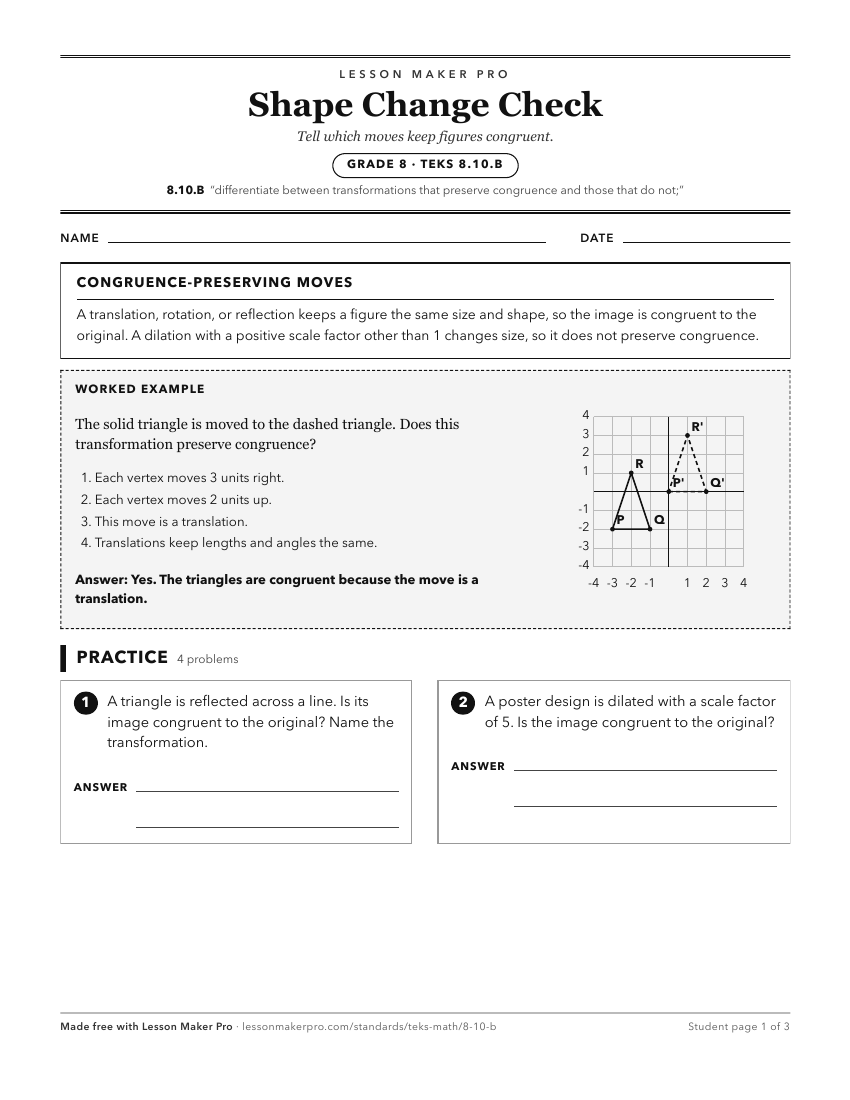
A ready-to-print activity worksheet aligned to 8.10.B, with an answer key for the teacher on its own page. No account needed.
PDF, US Letter, prints cleanly in black and white.
Download the worksheetKeep exploring
Related Standards
- 1.6.B
distinguish between attributes that define a two-dimensional or three-dimensional figure and attributes that do not define the shape
- 8.3.B
compare and contrast the attributes of a shape and its dilation(s) on a coordinate plane
- 8.10.A
generalize the properties of orientation and congruence of rotations, reflections, translations, and dilations of two-dimensional shapes on a coordinate plane
- 6.7.C
determine if two expressions are equivalent using concrete models, pictorial models, and algebraic representations
Turn this exact standard into a lesson
Grade, subject, topic, and the complete standard are prefilled. Create one free, no account needed.
Also for this standard:Make a WorksheetMake a QuizMake a Sub Lesson