TEKS Math 6.7.C
The Standard
determine if two expressions are equivalent using concrete models, pictorial models, and algebraic representations
Texas Essential Knowledge and Skills for Mathematics
Teacher's field guide
What This Standard Means
What Students Need to Do
- Students build and draw expressions with algebra tiles, then write matching algebraic forms. They rewrite each expression using properties and decide whether both forms have the same value for every variable value.
What Mastery Looks Like
- A student can build or draw both expressions and show that the same quantities result. They can use distribution and combining like terms to justify equivalence for every variable value.
Common Misconceptions
- Students may think different-looking expressions cannot be equivalent. They may distribute incorrectly, combine unlike terms, or treat the equal sign as a command to calculate. Some believe checking one variable value proves equivalence.
How to Assess It
- Exit ticket: Use algebra tiles or a drawing to decide whether 3(x + 2) and 3x + 6 are equivalent, then verify algebraically.
Lesson moves
Ways to Teach It
Give students algebra tiles to build 2(x + 3) and 2x + 6, then match and label corresponding pieces.
Have students write why checking one value can suggest equivalence but does not prove two expressions are always equivalent.
Play an expression matching game with cards showing tile models, drawings, expanded expressions, and factored expressions.
Compare 4 bags holding x apples plus 2 extras each with 4x apples plus 8 extras, then explain why the totals match.
Free download
Printable 6.7.C Worksheet
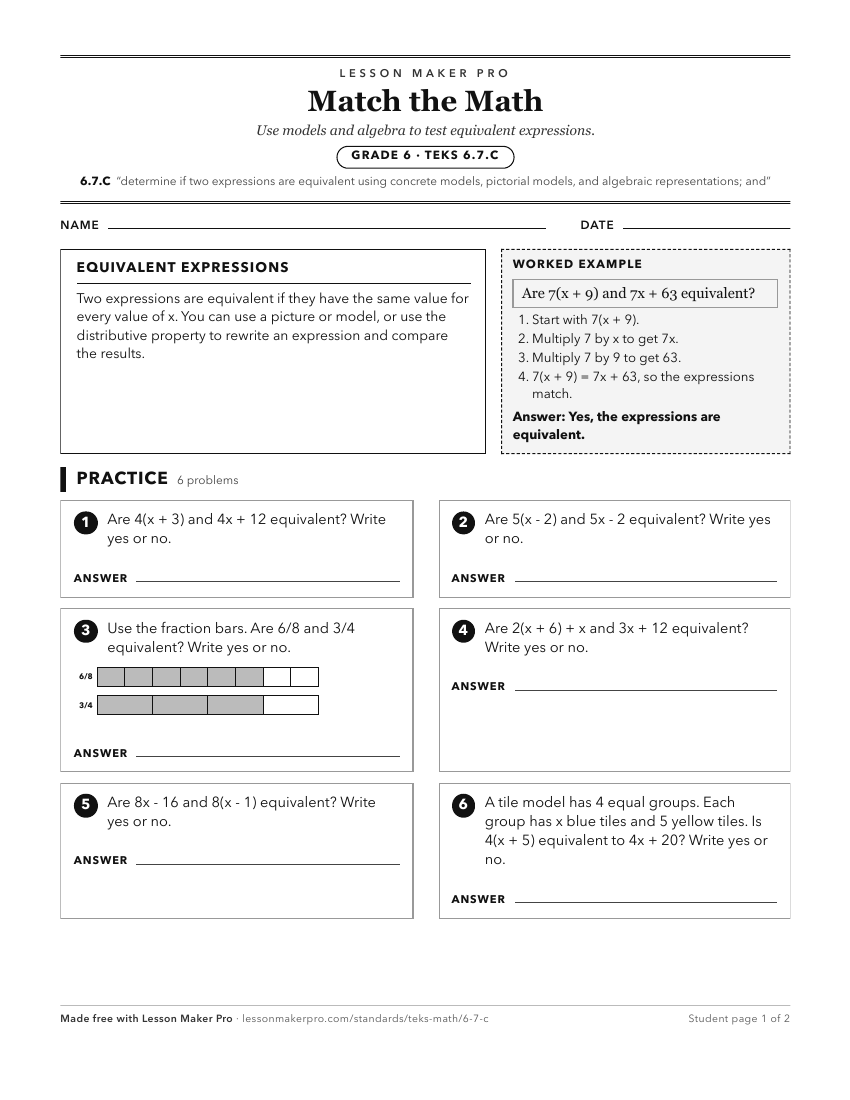
A ready-to-print activity worksheet aligned to 6.7.C, with an answer key for the teacher on its own page. No account needed.
PDF, US Letter, prints cleanly in black and white.
Download the worksheetKeep exploring
Related Standards
- 6.3.C
represent integer operations with concrete models and connect the actions with the models to standardized algorithms
- 6.10.A
model and solve one-variable, one-step equations and inequalities that represent problems, including geometric concepts
- 6.7.B
distinguish between expressions and equations verbally, numerically, and algebraically
- 4.3.C
determine if two given fractions are equivalent using a variety of methods
Turn this exact standard into a lesson
Grade, subject, topic, and the complete standard are prefilled. Create one free, no account needed.
Also for this standard:Make a WorksheetMake a QuizMake a Sub Lesson