TEKS Math 6.7.B
The Standard
distinguish between expressions and equations verbally, numerically, and algebraically
Texas Essential Knowledge and Skills for Mathematics
Teacher's field guide
What This Standard Means
What Students Need to Do
- Students identify whether a mathematical phrase names a quantity or makes a claim that two quantities are equal. They explain their choice using words, numbers, or variables.
What Mastery Looks Like
- Students correctly sort numerical and algebraic examples based on whether they make a statement of equality. They explain that one represents a quantity, while the other states that two quantities are equal.
Common Misconceptions
- Students may call any group of numbers and variables an equation. They may treat the equal sign as a signal to calculate rather than a claim that two quantities match. They may also try to solve an expression that has no equal sign.
How to Assess It
- Give students 4x + 7, 4x + 7 = 19, 15 - 3, and 15 - 3 = 12. Have them label each and explain how the equal sign changes its meaning.
Lesson moves
Ways to Teach It
Give pairs a card set of numerical and algebraic examples to sort into two labeled hoops, then justify each placement.
Ask students to write two sentences explaining why 3x + 5 and 3x + 5 = 20 serve different purposes.
Play a sorting relay where teams classify one card at a time and earn a point for a correct verbal explanation.
Show a grocery receipt total and a budget statement, then have students represent each situation with an expression or an equation.
Free download
Printable 6.7.B Worksheet
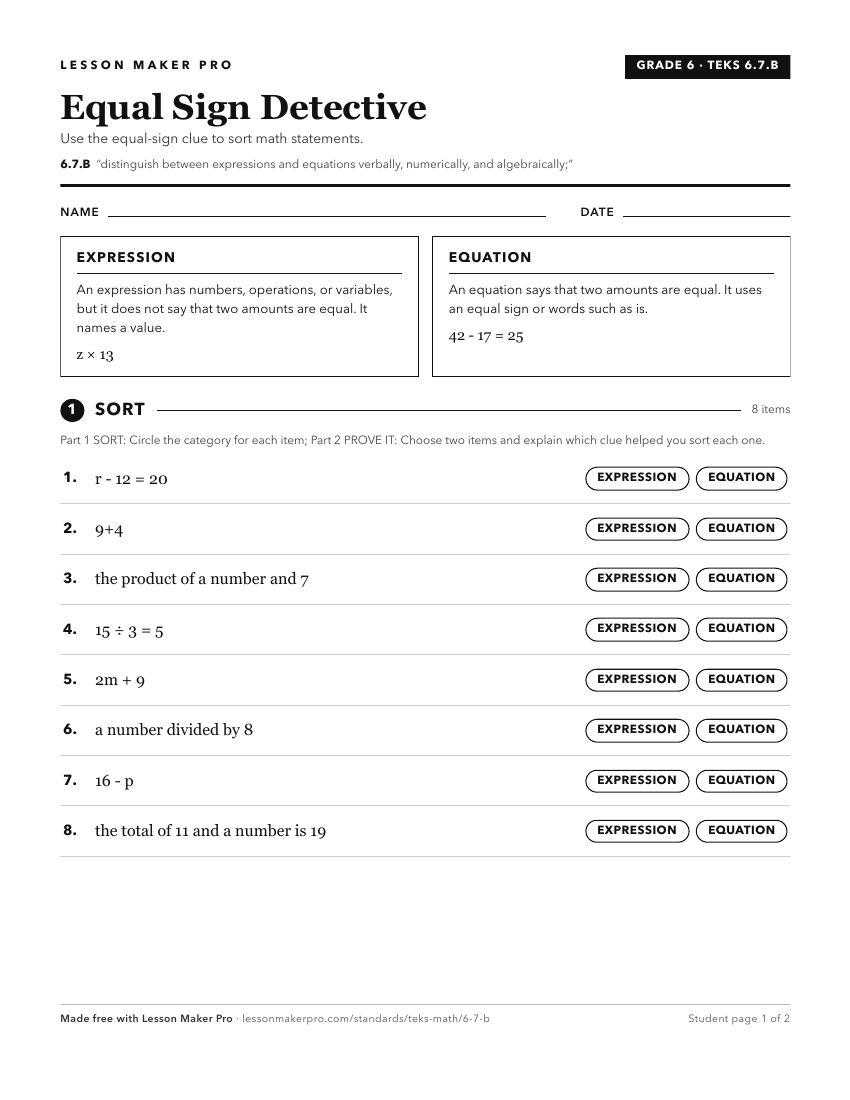
A ready-to-print activity worksheet aligned to 6.7.B, with an answer key for the teacher on its own page. No account needed.
PDF, US Letter, prints cleanly in black and white.
Download the worksheetKeep exploring
Related Standards
- 6.7
The student applies mathematical process standards to develop concepts of expressions and equations
- 5.4
The student applies mathematical process standards to develop concepts of expressions and equations
- 6.4.A
compare two rules verbally, numerically, graphically, and symbolically in the form of y = ax or y = x + a in order to differentiate between additive and multipl...
- 6.7.C
determine if two expressions are equivalent using concrete models, pictorial models, and algebraic representations
Turn this exact standard into a lesson
Grade, subject, topic, and the complete standard are prefilled. Create one free, no account needed.
Also for this standard:Make a WorksheetMake a QuizMake a Sub Lesson