TEKS Math 6.7
Knowledge and Skills Statement (Standard Cluster)
The student applies mathematical process standards to develop concepts of expressions and equations
Texas Essential Knowledge and Skills for Mathematics
Cluster contents
Student Expectations in This Statement
6.7 is a knowledge and skills statement. These are the student expectations under it.
- 6.7.A
generate equivalent numerical expressions using order of operations, including whole number exponents and prime factorization
- 6.7.B
distinguish between expressions and equations verbally, numerically, and algebraically
- 6.7.C
determine if two expressions are equivalent using concrete models, pictorial models, and algebraic representations
- 6.7.D
generate equivalent expressions using the properties of operations: inverse, identity, commutative, associative, and distributive properties
Teacher's field guide
What This Cluster Means
What Students Need to Do
- Students evaluate numerical expressions in the correct order, including exponents, and break composite numbers into prime factors. They decide whether a mathematical statement is an expression or an equation. They use models and operation properties to rewrite expressions without changing their value.
What Mastery Looks Like
- A student can evaluate 3² + 24 ÷ 6 accurately and write 60 as 2² × 3 × 5. The student can classify 5x + 2 and 5x + 2 = 17, then show with tiles or algebra that 3(x + 4) and 3x + 12 have the same value. The student can name the property used when rewriting an expression.
Common Misconceptions
- Students often work strictly left to right, multiply a base by its exponent, or stop before every factor is prime. They may treat the equals sign as a signal that the answer comes next. They may reorder subtraction or division, or distribute to only one term inside parentheses.
How to Assess It
- Exit ticket: Evaluate 2³ + 18 ÷ 3, write 18 as a prime factorization, and rewrite 4(x + 3) using a property. Label 4(x + 3) and 4x + 12 = 28 as expression or equation, then decide whether 4(x + 3) and 4x + 12 are equivalent.
Lesson moves
Ways to Teach It
Give students algebra tiles to build 3(x + 2), then rearrange the tiles to show 3x + 6 and explain why the values match.
Post 4 + 3 and 4 + 3 = 7, then ask students to explain which is an expression and which is an equation.
Play Property Match: students pair cards such as 7 + 0, 4 + 9, and 6(2 + x) with equivalent forms and property names.
Use two phone plans, such as 20 + 5m and 5m + 20, to discuss why different forms can represent the same cost.
Free download
Printable 6.7 Worksheet
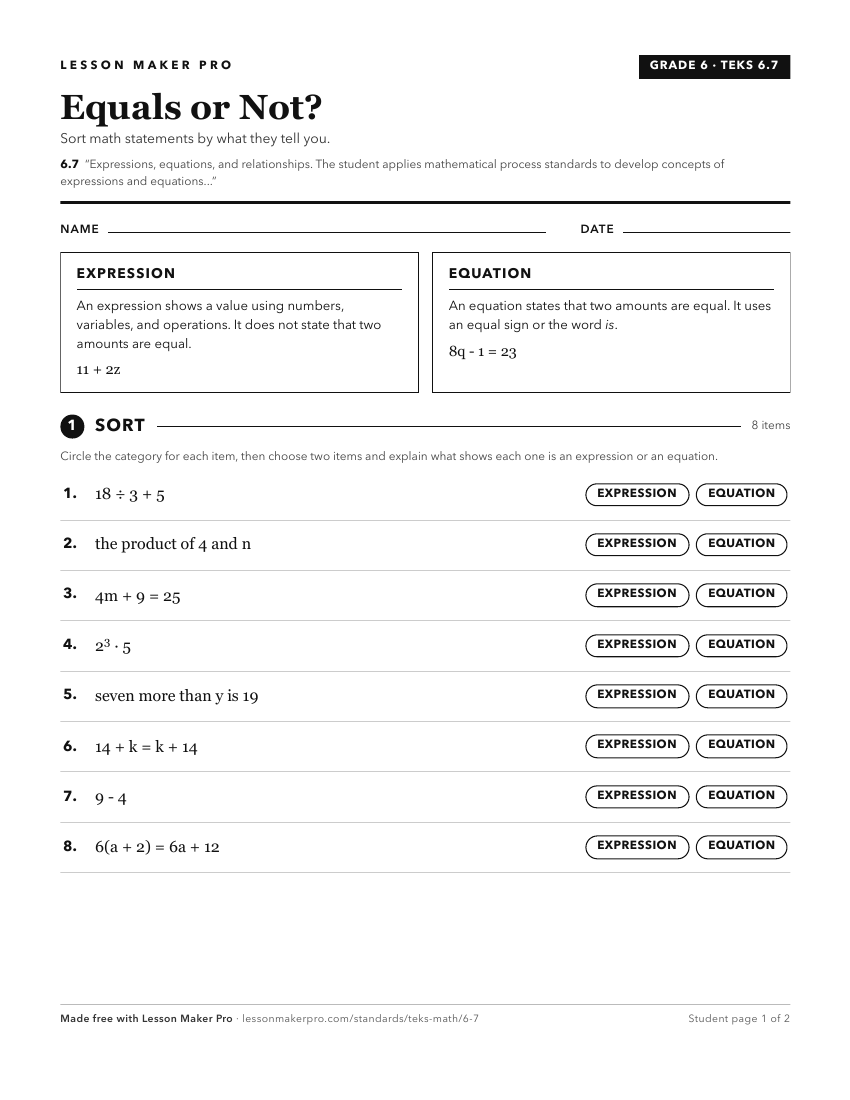
A ready-to-print activity worksheet aligned to 6.7, with an answer key for the teacher on its own page. No account needed.
PDF, US Letter, prints cleanly in black and white.
Download the worksheetKeep exploring
Related Standards
- 6.10
The student applies mathematical process standards to use equations and inequalities to solve problems
- 5.4
The 5th Grade version of this standard.
- 6.9
The student applies mathematical process standards to use equations and inequalities to represent situations
- 4.5
The 4th Grade version of this standard.
Turn this cluster into a lesson
Grade, subject, topic, and the complete cluster are prefilled. Create one free, no account needed.
Also for this cluster:Make a WorksheetMake a QuizMake a Sub Lesson