TEKS Math 5.4
Knowledge and Skills Statement (Standard Cluster)
The student applies mathematical process standards to develop concepts of expressions and equations
Texas Essential Knowledge and Skills for Mathematics
Cluster contents
Student Expectations in This Statement
5.4 is a knowledge and skills statement. These are the student expectations under it.
- 5.4.A
identify prime and composite numbers
- 5.4.B
represent and solve multi-step problems involving the four operations with whole numbers using equations with a letter standing for the unknown quantity
- 5.4.C
generate a numerical pattern when given a rule in the form y = ax or y = x + a and graph
- 5.4.D
recognize the difference between additive and multiplicative numerical patterns given in a table or graph
- 5.4.E
describe the meaning of parentheses and brackets in a numeric expression
- 5.4.F
simplify numerical expressions that do not involve exponents, including up to two levels of grouping
- 5.4.G
use concrete objects and pictorial models to develop the formulas for the volume of a rectangular prism, including the special form for a cube (V = l x w x h, V...
- 5.4.H
represent and solve problems related to perimeter and/or area and related to volume
Teacher's field guide
What This Cluster Means
What Students Need to Do
- Students classify numbers, write equations with letters for unknowns, and solve whole-number problems using all four operations. They generate and graph additive and multiplicative patterns, compare how the patterns change, and simplify expressions with parentheses and brackets. They use models and formulas to solve perimeter, area, and rectangular prism volume problems.
What Mastery Looks Like
- Given a table, graph, expression, or word problem, students choose a matching rule or operation and show their work with an equation. They correctly evaluate grouped expressions, justify prime or composite classifications, and solve volume problems using V = l × w × h, V = s × s × s, or V = Bh.
Common Misconceptions
- Students often call 1 prime, treat every odd number as prime, or confuse factors with multiples. They may read y = ax as y = a + x, continue every pattern by adding, or ignore grouping symbols. They also confuse perimeter, area, and volume units, or add dimensions instead of multiplying to find volume.
How to Assess It
- Use a five-item exit ticket: classify 1, 17, and 18; simplify 3 × [8 + (6 ÷ 2)]; complete tables for y = 4x and y = x + 4; write and solve an equation for “Mia packs 4 boxes of 18 pencils, then gives away 7”; find the volume and base perimeter of a 5 by 4 by 3 prism.
Lesson moves
Ways to Teach It
Build rectangular prisms with unit cubes, record length, width, height, base area, and volume, then use the records to derive V = Bh.
Show tables for y = 3x and y = x + 3; students write how they know which pattern is multiplicative.
Play a card sort matching prime or composite numbers, grouped expressions, equations, pattern tables, and prism diagrams to solved answer cards.
Give a shipping-box sketch with dimensions and prices; students find volume, base area, and total cost for several identical boxes.
Free download
Printable 5.4 Worksheet
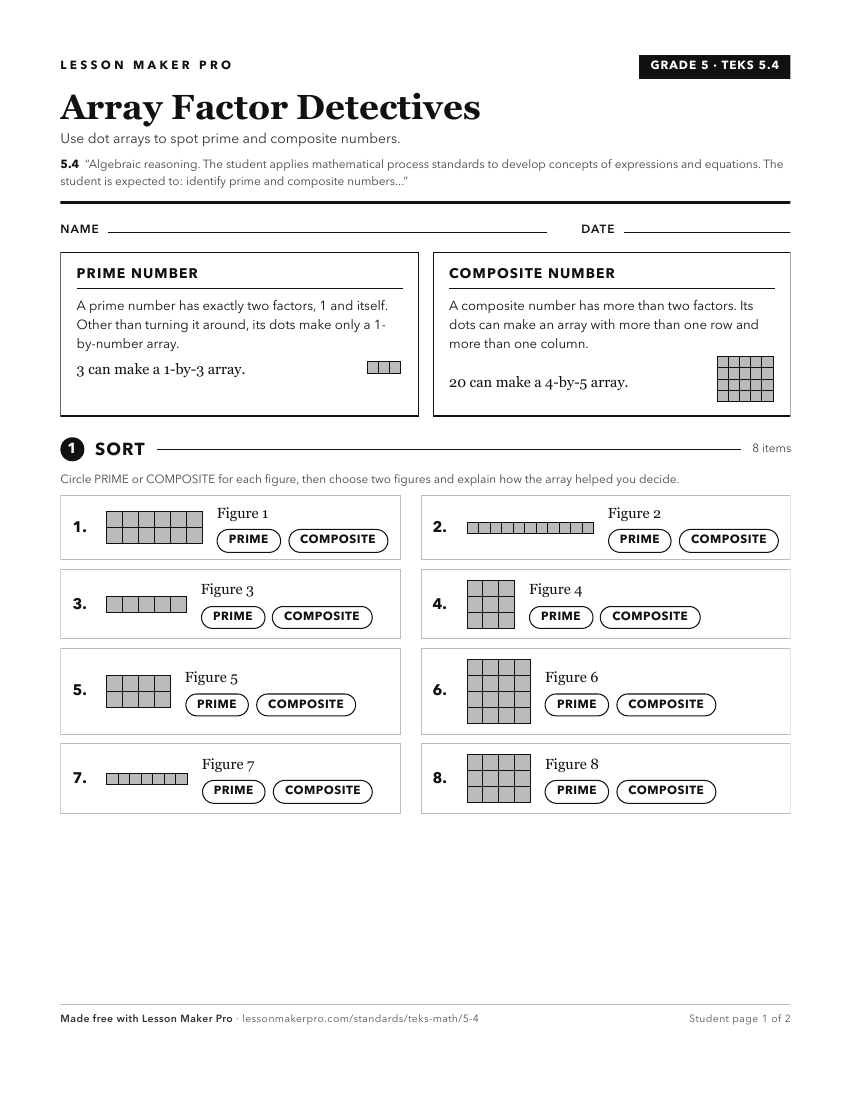
A ready-to-print activity worksheet aligned to 5.4, with an answer key for the teacher on its own page. No account needed.
PDF, US Letter, prints cleanly in black and white.
Download the worksheetKeep exploring
Related Standards
- 6.7
The 6th Grade version of this standard.
- 6.10
The student applies mathematical process standards to use equations and inequalities to solve problems
- 6.9
The student applies mathematical process standards to use equations and inequalities to represent situations
- 4.5
The 4th Grade version of this standard.
Turn this cluster into a lesson
Grade, subject, topic, and the complete cluster are prefilled. Create one free, no account needed.
Also for this cluster:Make a WorksheetMake a QuizMake a Sub Lesson