TEKS Math 6.7.A
The Standard
generate equivalent numerical expressions using order of operations, including whole number exponents and prime factorization
Texas Essential Knowledge and Skills for Mathematics
Teacher's field guide
What This Standard Means
What Students Need to Do
- Students rewrite number-only expressions in different forms while keeping the same value. They follow operation priority, interpret powers such as 3⁴, and break composite numbers into prime factors.
What Mastery Looks Like
- A student can show that 72 = 8 × 9 = 2³ × 3² and explain why each form has the same value. They correctly evaluate expressions with grouping symbols, exponents, multiplication, division, addition, and subtraction.
Common Misconceptions
- Students often work strictly left to right and ignore grouping symbols or exponents. They may read 3⁴ as 3 × 4 instead of four factors of 3. In prime factorization, they may include 1 or stop with a composite factor.
How to Assess It
- Write two expressions equal to 72, one using parentheses and at least two operations, and one showing prime factorization with exponents. Show enough work to verify both values.
Lesson moves
Ways to Teach It
Give students 72 counters to build arrays, record factor pairs, split each factor into primes, and combine repeated primes with exponents.
Have students calculate 2 + 3² × 4 and (2 + 3)² × 4, then discuss whether they are equivalent.
Run an expression match game with cards showing values, expanded powers, prime factorizations, and multi-operation expressions; students justify every match.
Ask students to package 48 granola bars into equal groups, then write several expressions for the arrangements and the prime factorization of 48.
Free download
Printable 6.7.A Worksheet
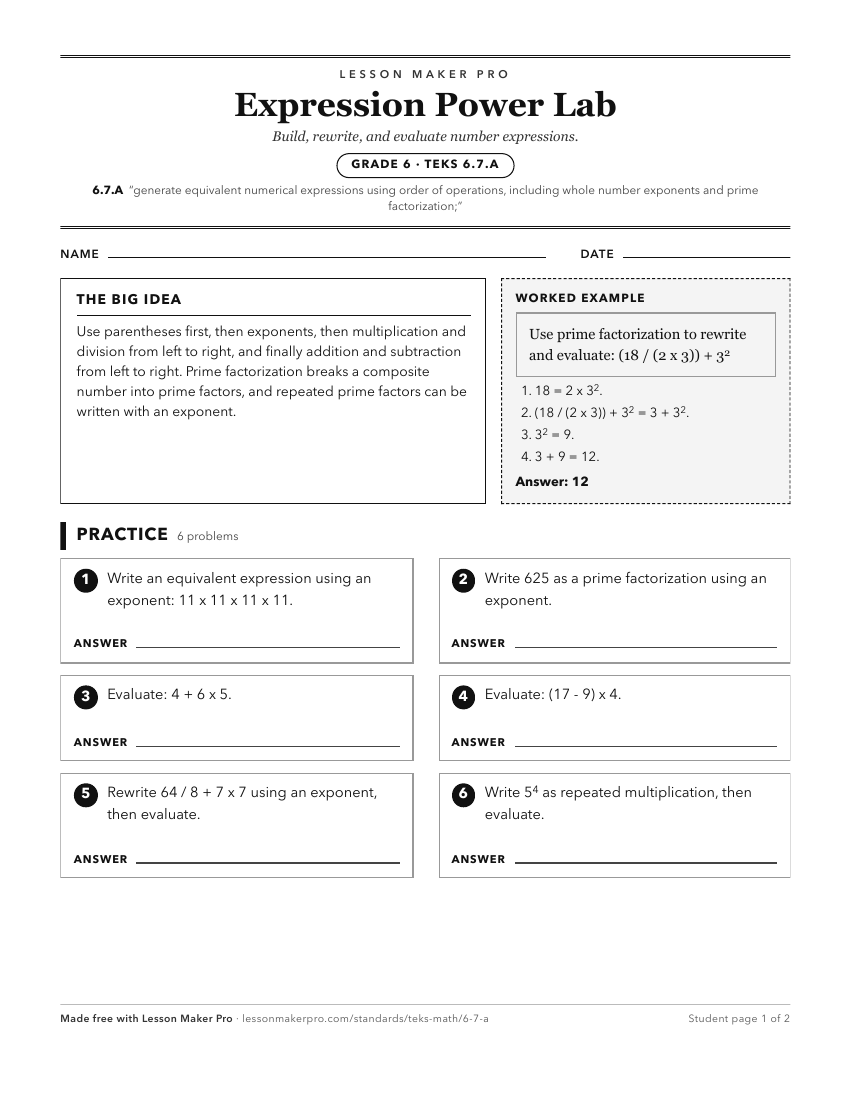
A ready-to-print activity worksheet aligned to 6.7.A, with an answer key for the teacher on its own page. No account needed.
PDF, US Letter, prints cleanly in black and white.
Download the worksheetKeep exploring
Related Standards
- 5.4.B
represent and solve multi-step problems involving the four operations with whole numbers using equations with a letter standing for the unknown quantity
- 5.4.F
simplify numerical expressions that do not involve exponents, including up to two levels of grouping
- 6.7.D
generate equivalent expressions using the properties of operations: inverse, identity, commutative, associative, and distributive properties
- 3.2.A
compose and decompose numbers up to 100,000 as a sum of so many ten thousands, so many thousands, so many hundreds, so many tens, and so many ones using objects...
Turn this exact standard into a lesson
Grade, subject, topic, and the complete standard are prefilled. Create one free, no account needed.
Also for this standard:Make a WorksheetMake a QuizMake a Sub Lesson