TEKS Math 4.3.C
The Standard
determine if two given fractions are equivalent using a variety of methods
Texas Essential Knowledge and Skills for Mathematics
Teacher's field guide
What This Standard Means
What Students Need to Do
- Students decide whether two fractions name the same amount. They use models, number lines, or multiplication patterns to justify each decision.
What Mastery Looks Like
- Students correctly decide whether a pair names the same amount. They support the decision with fraction strips, area models, number lines, or multiplication of both fraction parts.
Common Misconceptions
- Students may compare only the numerators or denominators. Some multiply one part of a fraction but forget to multiply the other part by the same number.
How to Assess It
- Exit ticket: Are 3/4 and 6/8 equal in value? Prove your answer with an area model and a multiplication equation.
Lesson moves
Ways to Teach It
Give students fraction strips and ask them to find three strips that cover the same length as one-half.
Ask, "Can two fractions look different but name the same amount?" Students explain using a drawing and an equation.
Play Equivalent Fraction Match with cards showing fractions, area models, and number-line points; students collect matching sets.
Compare recipe amounts such as 1/2 cup and 2/4 cup, then ask students whether each pair gives the same quantity.
Free download
Printable 4.3.C Worksheet
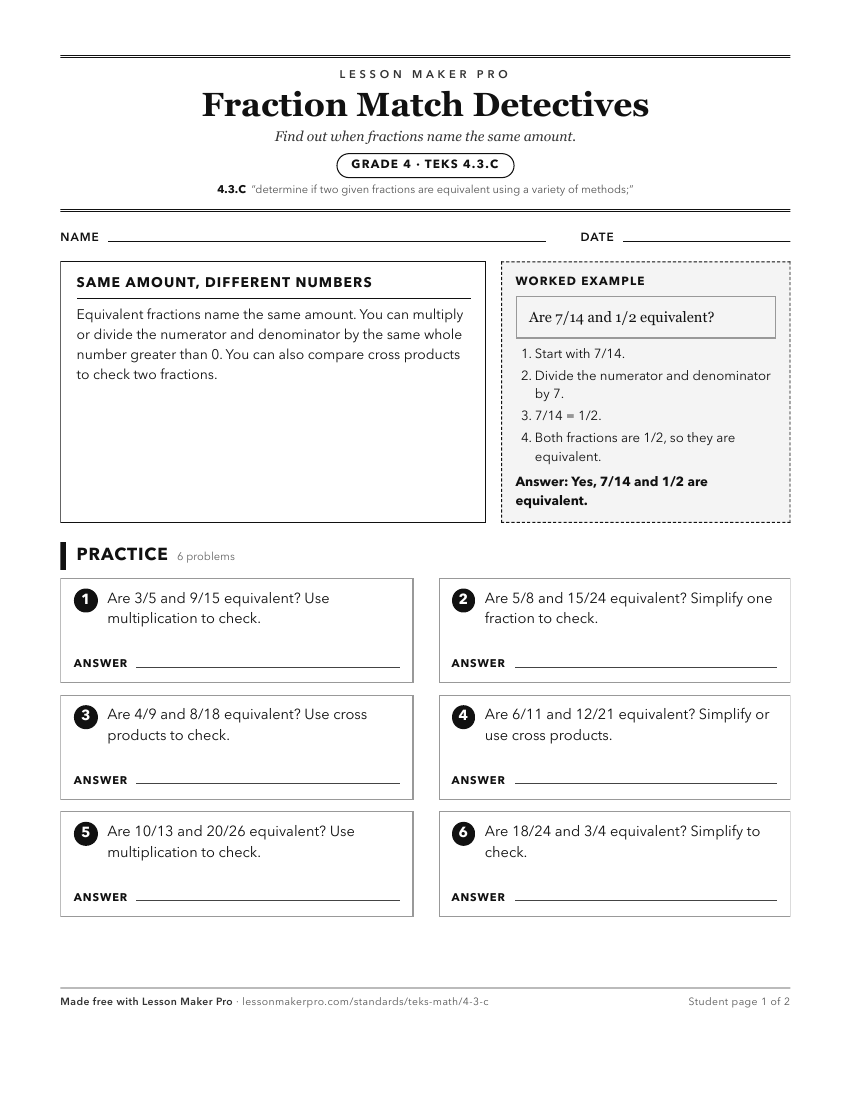
A ready-to-print activity worksheet aligned to 4.3.C, with an answer key for the teacher on its own page. No account needed.
PDF, US Letter, prints cleanly in black and white.
Download the worksheetKeep exploring
Related Standards
- 3.3.G
explain that two fractions are equivalent if and only if they are both represented by the same point on the number line or represent the same portion of a same ...
- 6.7.C
determine if two expressions are equivalent using concrete models, pictorial models, and algebraic representations
- 3.3.H
compare two fractions having the same numerator or denominator in problems by reasoning about their sizes and justifying the conclusion using symbols, words, ob...
- 4.3.D
compare two fractions with different numerators and different denominators and represent the comparison using the symbols >, =, or <
Turn this exact standard into a lesson
Grade, subject, topic, and the complete standard are prefilled. Create one free, no account needed.
Also for this standard:Make a WorksheetMake a QuizMake a Sub Lesson