TEKS Math 8.10.A
The Standard
generalize the properties of orientation and congruence of rotations, reflections, translations, and dilations of two-dimensional shapes on a coordinate plane
Texas Essential Knowledge and Skills for Mathematics
Teacher's field guide
What This Standard Means
What Students Need to Do
- Students compare figures before and after translations, rotations, reflections, and dilations on a coordinate plane. They state general rules about which transformations preserve size and shape, and which preserve or reverse vertex order.
What Mastery Looks Like
- Students can examine a preimage and image and identify whether vertex order and side lengths are preserved. They can explain that rigid transformations preserve congruence, reflections reverse orientation, and dilations usually change size.
Common Misconceptions
- Students may think a reflection preserves orientation because the shape still looks the same. They may also call a dilation congruent when the scale factor is not 1 or confuse orientation with the direction a figure points.
How to Assess It
- Exit ticket: For a translation, a 90-degree rotation, a reflection across the y-axis, and a dilation by 2, state whether congruence and orientation are preserved.
Lesson moves
Ways to Teach It
Trace a scalene triangle on grid paper, then use tracing paper to translate, rotate, reflect, and dilate it while tracking vertex order.
Ask students to explain why a reflected figure is congruent to its preimage even though its clockwise vertex order changes.
Give pairs transformation cards and property cards, then have students match each transformation with its effects on size, shape, and orientation.
Compare resizing and flipping a digital logo, then identify which edits preserve congruence and which preserve orientation.
Free download
Printable 8.10.A Worksheet
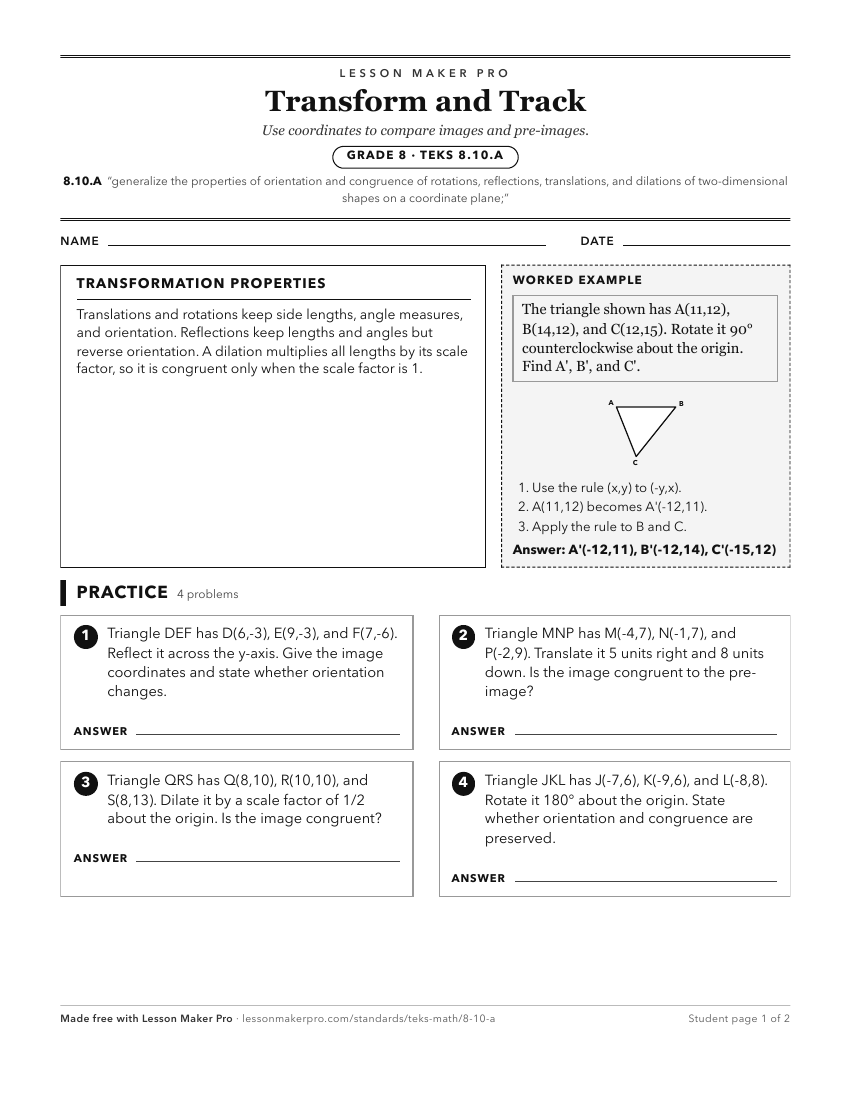
A ready-to-print activity worksheet aligned to 8.10.A, with an answer key for the teacher on its own page. No account needed.
PDF, US Letter, prints cleanly in black and white.
Download the worksheetKeep exploring
Related Standards
- 8.3.B
compare and contrast the attributes of a shape and its dilation(s) on a coordinate plane
- 7.5.A
generalize the critical attributes of similarity, including ratios within and between similar shapes
- 8.10.C
explain the effect of translations, reflections over the x- or y-axis, and rotations limited to 90°, 180°, 270°, and 360° as applied to two-dimensional shapes o...
- 8.3.A
generalize that the ratio of corresponding sides of similar shapes are proportional, including a shape and its dilation
Turn this exact standard into a lesson
Grade, subject, topic, and the complete standard are prefilled. Create one free, no account needed.
Also for this standard:Make a WorksheetMake a QuizMake a Sub Lesson