TEKS Math 8.10.D
The Standard
model the effect on linear and area measurements of dilated two-dimensional shapes
Texas Essential Knowledge and Skills for Mathematics
Teacher's field guide
What This Standard Means
What Students Need to Do
- Students use scale factors to predict and calculate changes in side lengths, perimeter, and area after a dilation. They show that lengths change by the scale factor while area changes by its square.
What Mastery Looks Like
- Students correctly find new side lengths and perimeters by multiplying by the scale factor. They find new areas by multiplying by the square of that factor and explain the pattern.
Common Misconceptions
- Students may multiply area by the scale factor instead of its square. They may add the scale factor to each length or think perimeter and area change by the same factor.
How to Assess It
- Exit ticket: A 3 cm by 5 cm rectangle is dilated by a factor of 2. Find the new dimensions, perimeter, and area, then describe each change.
Lesson moves
Ways to Teach It
On grid paper, students draw a 2-by-4 rectangle, dilate it by factors 2 and 1/2, then compare lengths and areas.
Ask students to explain why doubling every side quadruples area, using a labeled diagram rather than a memorized rule.
Play Scale Factor Match: students pair cards showing an original figure, a dilation factor, new lengths, and new area.
Use a floor plan copy machine scenario to calculate how enlarging a drawing changes wall lengths and printed floor area.
Free download
Printable 8.10.D Worksheet
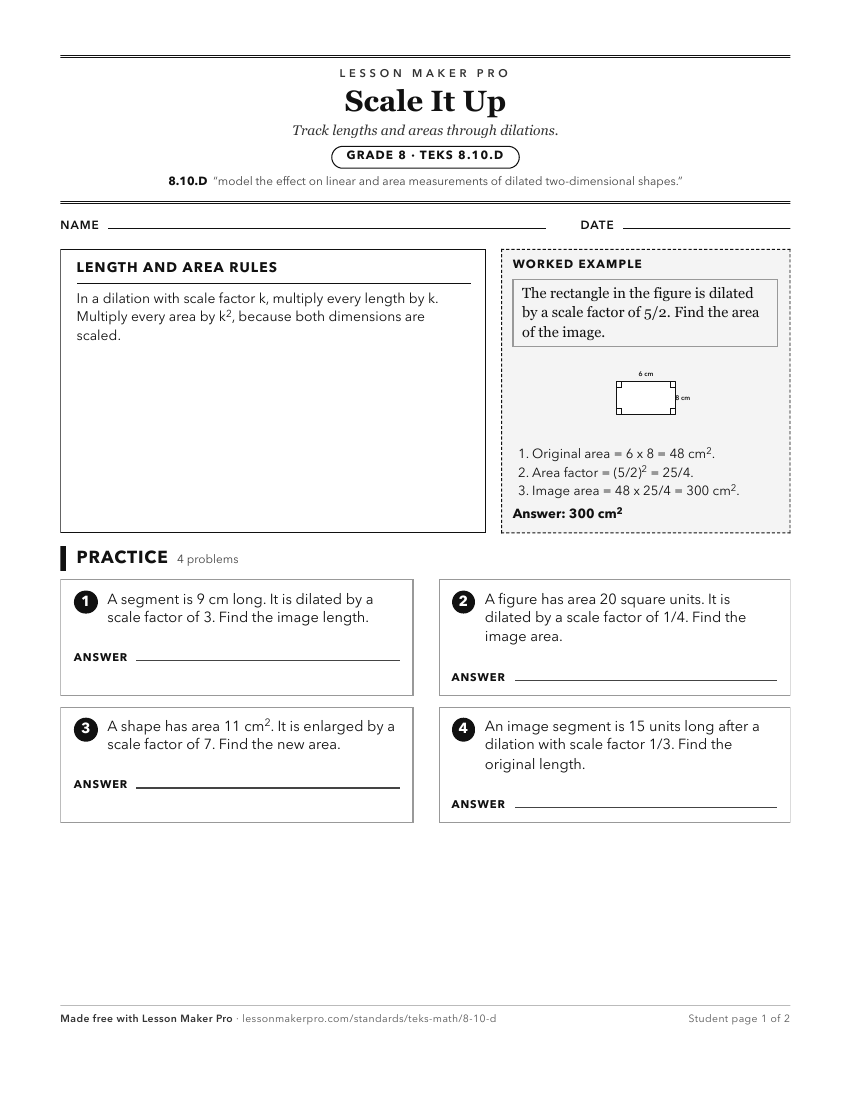
A ready-to-print activity worksheet aligned to 8.10.D, with an answer key for the teacher on its own page. No account needed.
PDF, US Letter, prints cleanly in black and white.
Download the worksheetKeep exploring
Related Standards
- 8.3.B
compare and contrast the attributes of a shape and its dilation(s) on a coordinate plane
- 8.3.C
use an algebraic representation to explain the effect of a given positive rational scale factor applied to two-dimensional figures on a coordinate plane with th...
- 8.3.A
generalize that the ratio of corresponding sides of similar shapes are proportional, including a shape and its dilation
- 7.5.C
solve mathematical and real-world problems involving similar shape and scale drawings
Turn this exact standard into a lesson
Grade, subject, topic, and the complete standard are prefilled. Create one free, no account needed.
Also for this standard:Make a WorksheetMake a QuizMake a Sub Lesson