TEKS Math 3.6
Knowledge and Skills Statement (Standard Cluster)
The student applies mathematical process standards to analyze attributes of two-dimensional geometric figures to develop generalizations about their properties
Texas Essential Knowledge and Skills for Mathematics
Cluster contents
Student Expectations in This Statement
3.6 is a knowledge and skills statement. These are the student expectations under it.
- 3.6.B
use attributes to recognize rhombuses, parallelograms, trapezoids, rectangles, and squares as examples of quadrilaterals and draw examples of quadrilaterals tha...
- 3.6.C
determine the area of rectangles with whole number side lengths in problems using multiplication related to the number of rows times the number of unit squares ...
- 3.6.D
decompose composite figures formed by rectangles into non-overlapping rectangles to determine the area of the original figure using the additive property of are...
- 3.6.E
decompose two congruent two-dimensional figures into parts with equal areas and express the area of each part as a unit fraction of the whole and recognize that...
Teacher's field guide
What This Cluster Means
What Students Need to Do
- Students classify plane figures and solids using sides, angles, faces, edges, vertices, and parallel or equal parts. They use quadrilateral attributes, including overlapping categories, and draw quadrilaterals outside named subgroups. They find rectangle and composite areas, then partition identical figures into equal-area parts and name each part as a unit fraction.
What Mastery Looks Like
- A student sorts plane shapes and solids by named attributes and explains why a figure may fit more than one group. They identify quadrilateral subgroups and draw a quadrilateral outside those groups. They find rectangle and composite areas, then divide congruent shapes into equal-area parts and name the unit fractions.
Common Misconceptions
- Students often treat shape groups as exclusive, so they say a square cannot be a rectangle, or think turning a figure changes its name. They may count grid lines instead of unit squares, add side lengths for area, or double-count pieces in a composite figure. They may also think equal fractional shares must have the same shape, rather than the same area.
How to Assess It
- On an exit ticket, show a square, a cylinder, and an L-shaped grid figure. Ask students to classify the first two, find the L-shape’s area, draw a quadrilateral with no parallel or equal sides, and partition identical rectangles into thirds differently.
Lesson moves
Ways to Teach It
Give pairs two identical paper rectangles, then have them cut each into four equal-area parts differently and label every part one-fourth.
Ask students to answer and defend this prompt with named attributes: “Is every square a rectangle, and is every rectangle a square?”
Play Attribute Sort with shape cards and solid models; teams group figures, name shared attributes, and challenge one misplaced figure.
Show an L-shaped patio on grid paper; students split it into rectangles, write row-by-column products, and add areas to price square tiles.
Free download
Printable 3.6 Worksheet
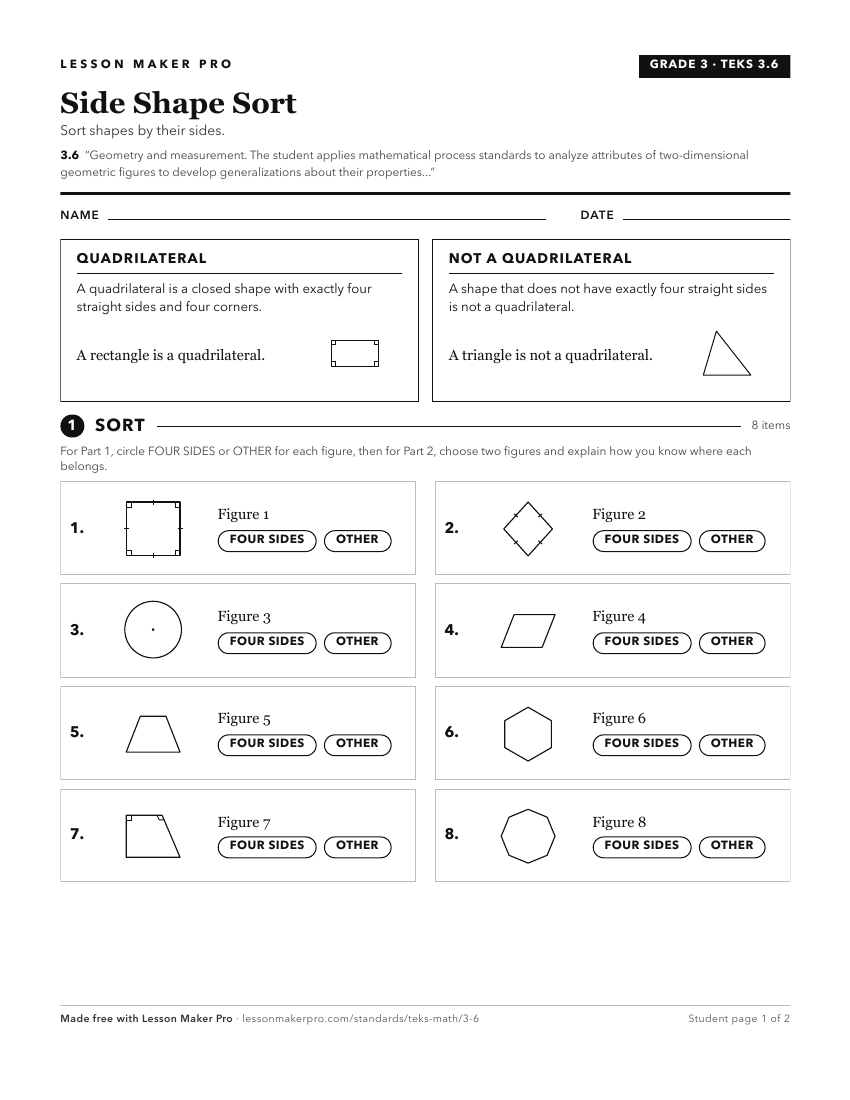
A ready-to-print activity worksheet aligned to 3.6, with an answer key for the teacher on its own page. No account needed.
PDF, US Letter, prints cleanly in black and white.
Download the worksheetKeep exploring
Related Standards
- K.6
The student applies mathematical process standards to analyze attributes of two-dimensional shapes and three-dimensional solids to develop generalizations about...
- 5.5
The student applies mathematical process standards to classify two-dimensional figures by attributes and properties. The student is expected to classify two-dim...
- 1.6
The student applies mathematical process standards to analyze attributes of two-dimensional shapes and three-dimensional solids to develop generalizations about...
- 4.6
The student applies mathematical process standards to analyze geometric attributes in order to develop generalizations about their properties
Turn this cluster into a lesson
Grade, subject, topic, and the complete cluster are prefilled. Create one free, no account needed.
Also for this cluster:Make a WorksheetMake a QuizMake a Sub Lesson