TEKS Math 3.6.C
The Standard
determine the area of rectangles with whole number side lengths in problems using multiplication related to the number of rows times the number of unit squares in each row
Texas Essential Knowledge and Skills for Mathematics
Teacher's field guide
What This Standard Means
What Students Need to Do
- Students find a rectangle's area by counting equal rows of unit squares and multiplying rows by squares in each row. They solve whole-number area problems and use square units.
What Mastery Looks Like
- Students multiply the number of rows by the number of unit squares in each row. They label the answer in square units and can explain how the equation matches the array.
Common Misconceptions
- Students may add the side lengths instead of multiplying, confusing area with perimeter. They may count grid lines rather than unit squares or use the wrong number of rows.
How to Assess It
- Give students a rectangle with 4 rows and 7 unit squares in each row. Ask them to write a multiplication equation and find the area in square units.
Lesson moves
Ways to Teach It
Build rectangles with square tiles, record the rows and squares per row, then write a multiplication equation for each area.
Show a 3 by 8 array and ask, "How does 3 × 8 represent its area?"
Play Area Match by pairing rectangle grid cards with multiplication equations and area cards.
Measure a rectangular desktop to the nearest whole unit, then multiply its length and width to estimate its area.
Free download
Printable 3.6.C Worksheet
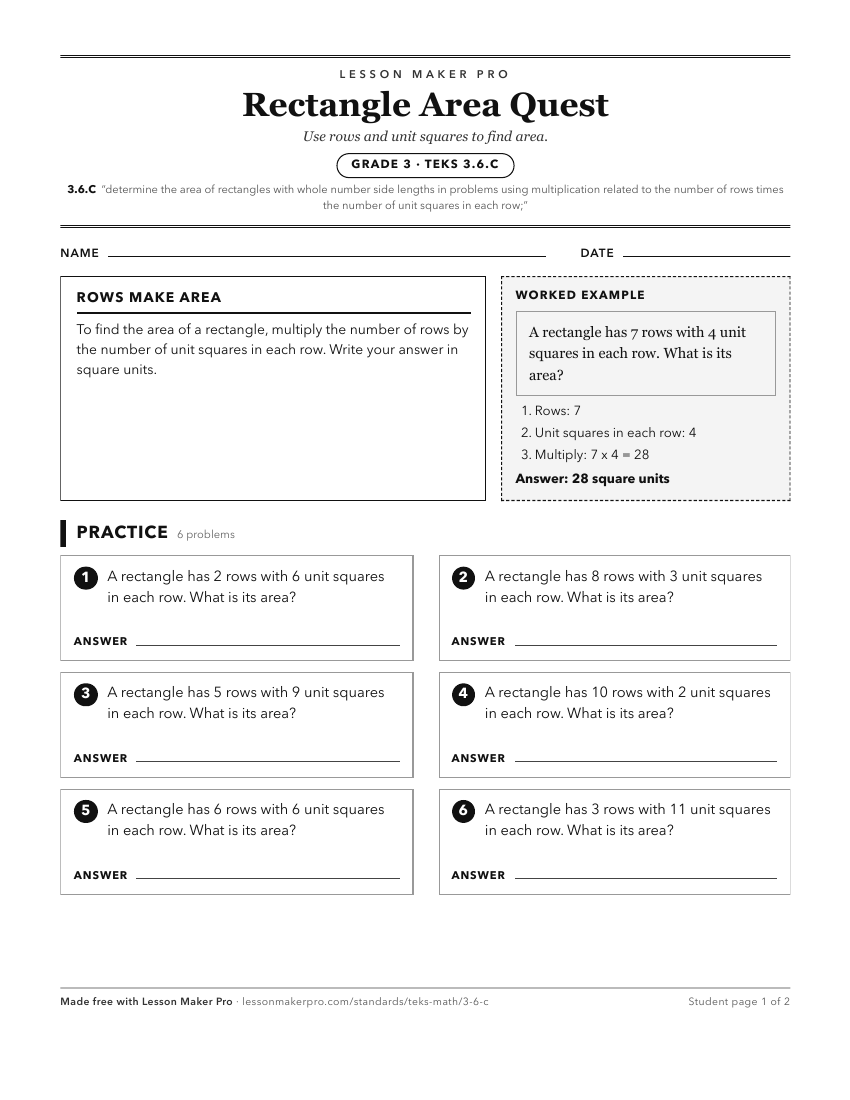
A ready-to-print activity worksheet aligned to 3.6.C, with an answer key for the teacher on its own page. No account needed.
PDF, US Letter, prints cleanly in black and white.
Download the worksheetKeep exploring
Related Standards
- 4.5.D
solve problems related to perimeter and area of rectangles where dimensions are whole numbers
- 5.6.B
determine the volume of a rectangular prism with whole number side lengths in problems related to the number of layers times the number of unit cubes in the are...
- 7.9.C
determine the area of composite figures containing combinations of rectangles, squares, parallelograms, trapezoids, triangles, semicircles, and quarter circles
- 2.9.F
use concrete models of square units to find the area of a rectangle by covering it with no gaps or overlaps, counting to find the total number of square units, ...
Turn this exact standard into a lesson
Grade, subject, topic, and the complete standard are prefilled. Create one free, no account needed.
Also for this standard:Make a WorksheetMake a QuizMake a Sub Lesson