TEKS Math 5.6.B
The Standard
determine the volume of a rectangular prism with whole number side lengths in problems related to the number of layers times the number of unit cubes in the area of the base
Texas Essential Knowledge and Skills for Mathematics
Teacher's field guide
What This Standard Means
What Students Need to Do
- Students find how many unit cubes fill a rectangular prism. They connect the number of cubes in one base layer to the number of equal layers.
What Mastery Looks Like
- Students find the cubes in one base layer, then use the prism's height to find the total. They write a correct multiplication equation and label the answer in cubic units.
Common Misconceptions
- Students may add the three dimensions instead of multiplying them. They may count only visible cubes, use perimeter for the base, or label volume with square units.
How to Assess It
- Give a prism with a 6-by-4 base and 3 layers. Ask students to find the volume and show what each factor represents.
Lesson moves
Ways to Teach It
Have pairs build a 4-by-3-by-2 prism with linking cubes, then record cubes per layer, number of layers, and total cubes.
Ask students to explain why a 5-by-4 base with 3 layers contains 60 cubes, using a sketch and equation.
Play Volume Match: students match prism dimension cards, base area cards, layer cards, and volume cards, then justify each set.
Post whole-number dimensions for shipping boxes and have students calculate how many one-inch cubes would fill each box.
Free download
Printable 5.6.B Worksheet
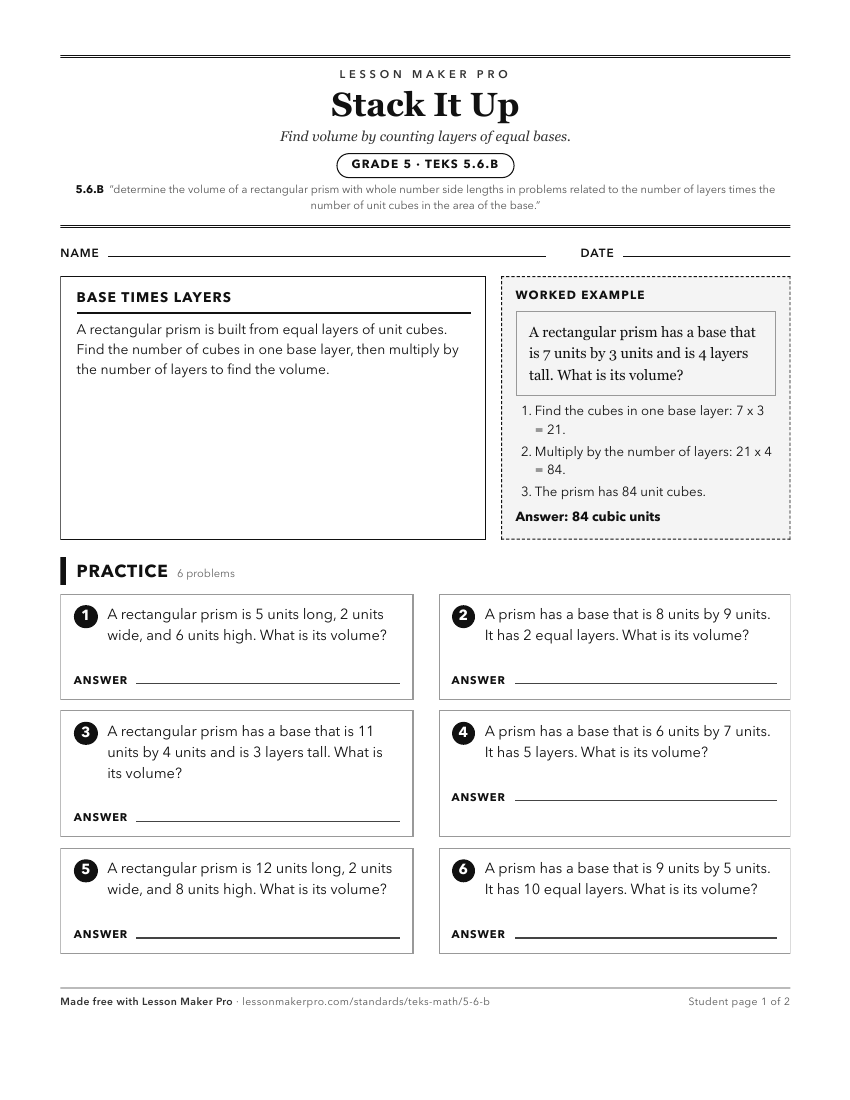
A ready-to-print activity worksheet aligned to 5.6.B, with an answer key for the teacher on its own page. No account needed.
PDF, US Letter, prints cleanly in black and white.
Download the worksheetKeep exploring
Related Standards
- 3.6.C
determine the area of rectangles with whole number side lengths in problems using multiplication related to the number of rows times the number of unit squares ...
- 7.8.A
model the relationship between the volume of a rectangular prism and a rectangular pyramid having both congruent bases and heights and connect that relationship...
- 5.4.G
use concrete objects and pictorial models to develop the formulas for the volume of a rectangular prism, including the special form for a cube (V = l x w x h, V...
- 7.9.A
solve problems involving the volume of rectangular prisms, triangular prisms, rectangular pyramids, and triangular pyramids
Turn this exact standard into a lesson
Grade, subject, topic, and the complete standard are prefilled. Create one free, no account needed.
Also for this standard:Make a WorksheetMake a QuizMake a Sub Lesson