TEKS Math 7.8.A
The Standard
model the relationship between the volume of a rectangular prism and a rectangular pyramid having both congruent bases and heights and connect that relationship to the formulas
Texas Essential Knowledge and Skills for Mathematics
Teacher's field guide
What This Standard Means
What Students Need to Do
- Students compare a rectangular prism and rectangular pyramid with the same base dimensions and height. They use a model to show the pyramid’s volume is one third of the prism’s volume and connect this result to both formulas.
What Mastery Looks Like
- Students show that three equal pyramid volumes fill one matching prism. They calculate the prism with V = Bh and the pyramid with V = 1/3Bh, then explain why the factor of one third appears.
Common Misconceptions
- Students may think the pyramid has half the prism’s volume instead of one third. They may divide only the height by three, use slant height, or ignore the base area.
How to Assess It
- Give a prism and pyramid with base dimensions 6 cm by 4 cm and height 9 cm. Ask students to find both volumes and explain their relationship.
Lesson moves
Ways to Teach It
Use rice to fill a rectangular pyramid three times, pouring each fill into a matching rectangular prism and recording the result.
Ask students to write: Why does a pyramid use one third of the matching prism’s volume formula?
Play a card match with prism dimensions, pyramid dimensions, volume formulas, and calculated volumes.
Compare a pyramid-shaped tent and a rectangular shelter with the same footprint and height, then calculate and compare their interior space.
Free download
Printable 7.8.A Worksheet
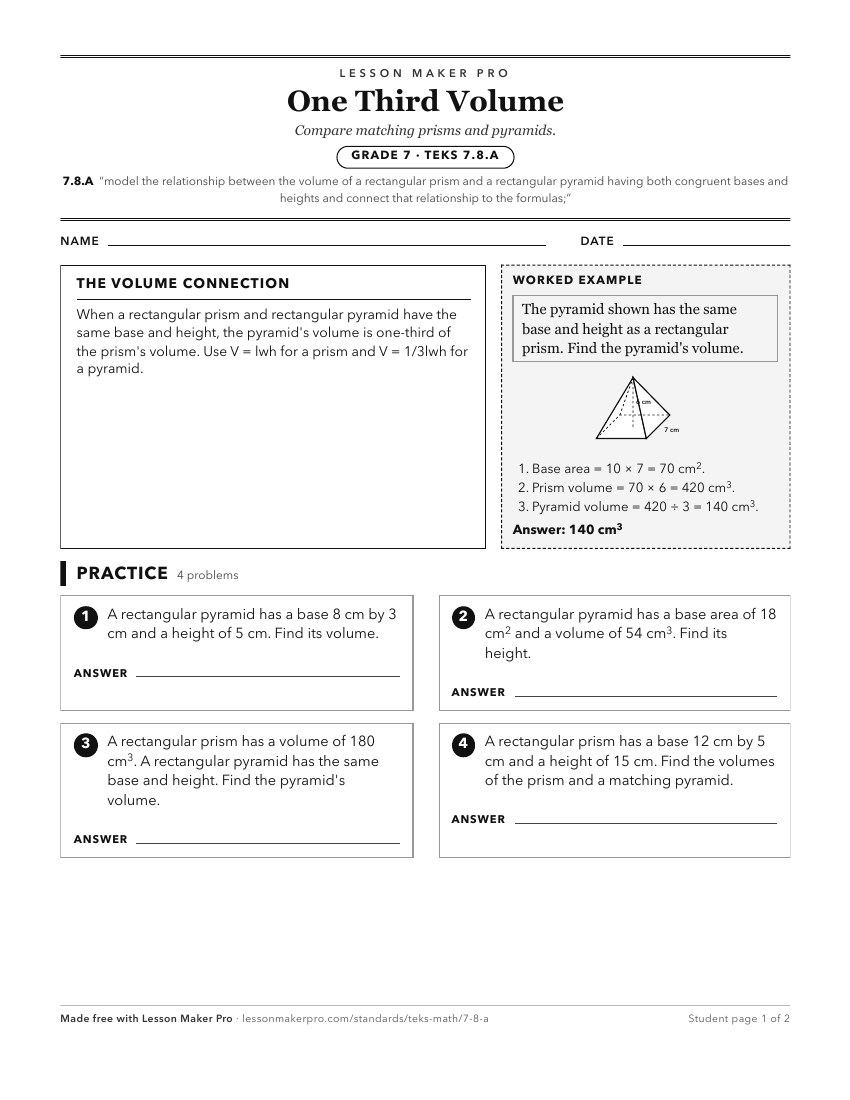
A ready-to-print activity worksheet aligned to 7.8.A, with an answer key for the teacher on its own page. No account needed.
PDF, US Letter, prints cleanly in black and white.
Download the worksheetKeep exploring
Related Standards
- 7.8.B
explain verbally and symbolically the relationship between the volume of a triangular prism and a triangular pyramid having both congruent bases and heights and...
- 8.6.B
model the relationship between the volume of a cylinder and a cone having both congruent bases and heights and connect that relationship to the formulas
- 5.4.G
use concrete objects and pictorial models to develop the formulas for the volume of a rectangular prism, including the special form for a cube (V = l x w x h, V...
- 7.9.A
solve problems involving the volume of rectangular prisms, triangular prisms, rectangular pyramids, and triangular pyramids
Turn this exact standard into a lesson
Grade, subject, topic, and the complete standard are prefilled. Create one free, no account needed.
Also for this standard:Make a WorksheetMake a QuizMake a Sub Lesson