TEKS Math 1.6.H
The Standard
identify examples and non-examples of halves and fourths
Texas Essential Knowledge and Skills for Mathematics
Teacher's field guide
What This Standard Means
What Students Need to Do
- Students examine shapes split into two or four parts and check whether the parts are equal in size. They identify fair shares and reject unequal partitions.
What Mastery Looks Like
- Students correctly sort shapes with equal shares from shapes with unequal shares. They explain that two or four pieces count only when every share is the same size.
Common Misconceptions
- Students may count pieces without checking whether they are equal in size. They may reject diagonal or differently shaped equal shares because they expect matching rectangles.
How to Assess It
- Give students six partitioned shapes, including equal and unequal shares. Ask them to circle the fair shares and explain one choice using the word equal.
Lesson moves
Ways to Teach It
Have students fold paper squares into two and four equal shares, then compare their folds with teacher-made uneven cuts.
Ask, “Does cutting a sandwich into four pieces always make fair shares?” Students draw and explain an example and a counterexample.
Play a card sort where pairs race to place partitioned shape cards under “equal shares” or “unequal shares” headings.
Show pictures of pizzas and brownies cut for sharing, then have students decide which groups received fair portions.
Free download
Printable 1.6.H Worksheet
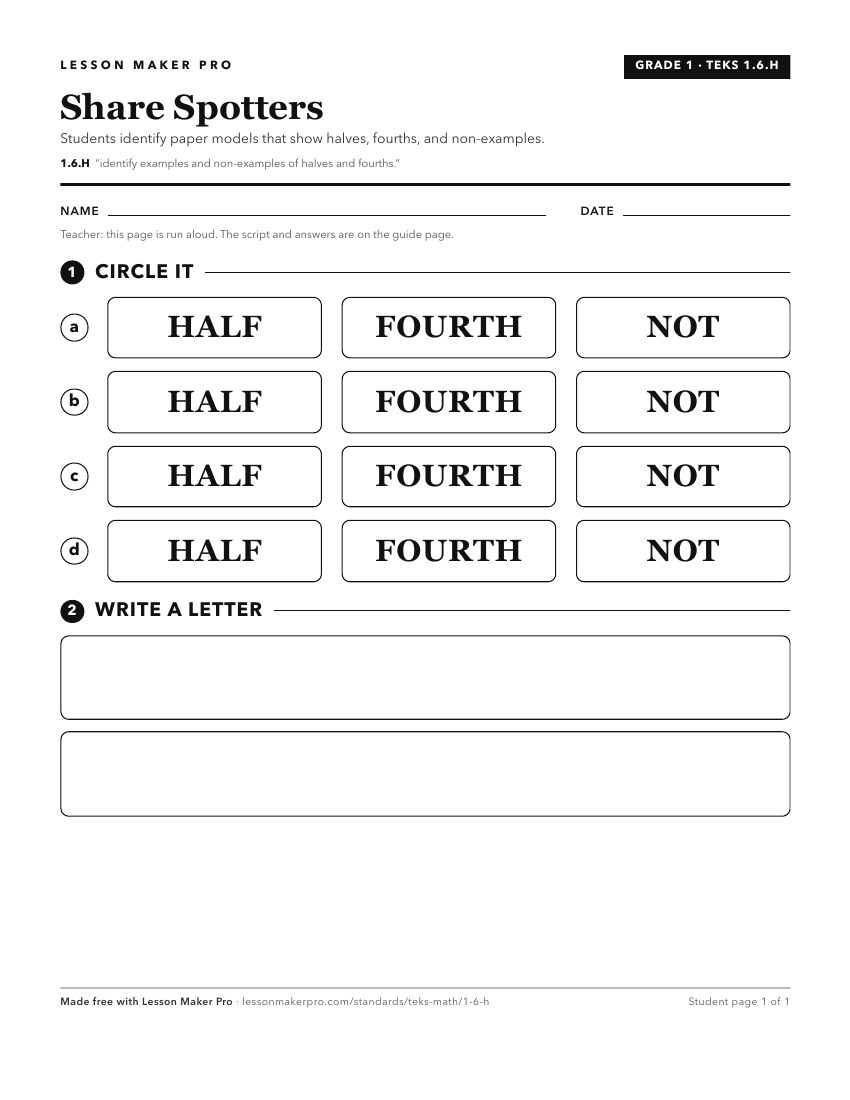
A ready-to-print activity worksheet aligned to 1.6.H, with an answer key for the teacher on its own page. No account needed.
PDF, US Letter, prints cleanly in black and white.
Download the worksheetKeep exploring
Related Standards
- 4.3.F
evaluate the reasonableness of sums and differences of fractions using benchmark fractions 0, 1/4, 1/2, 3/4, and 1, referring to the same whole
- 3.7.A
represent fractions of halves, fourths, and eighths as distances from zero on a number line
- 2.3.A
partition objects into equal parts and name the parts, including halves, fourths, and eighths, using words
- 2.3.D
identify examples and non-examples of halves, fourths, and eighths
Turn this exact standard into a lesson
Grade, subject, topic, and the complete standard are prefilled. Create one free, no account needed.
Also for this standard:Make a WorksheetMake a QuizMake a Sub Lesson