TEKS Math 2.3.D
The Standard
identify examples and non-examples of halves, fourths, and eighths
Texas Essential Knowledge and Skills for Mathematics
Teacher's field guide
What This Standard Means
What Students Need to Do
- Students examine shapes divided into parts and decide whether the shares are equal. They identify valid halves, fourths, and eighths and explain why uneven partitions do not qualify.
What Mastery Looks Like
- Students correctly sort partitioned shapes by the size and number of equal shares. They explain that unequal parts are non-examples, even when the total number of parts is correct.
Common Misconceptions
- Students may name the shares by counting pieces without checking whether the pieces are equal. They may reject equal shares with different shapes or accept parts that only look equal. They may also confuse the number of total parts with the number of shaded parts.
How to Assess It
- Show four partitioned rectangles, including equal and unequal parts. Ask students to label each as a valid half, fourth, eighth, or non-example and explain one choice.
Lesson moves
Ways to Teach It
Give students paper circles to fold into two, four, and eight equal shares, then compare their folds with uneven examples.
Display two partitioned shapes and ask, "Which shows fair shares, and what evidence proves it?"
Play a sorting game with cards showing shapes divided equally and unequally into different numbers of parts.
Show pictures of sandwiches, pizzas, and granola bars being shared, then have students decide which divisions give everyone equal portions.
Free download
Printable 2.3.D Worksheet
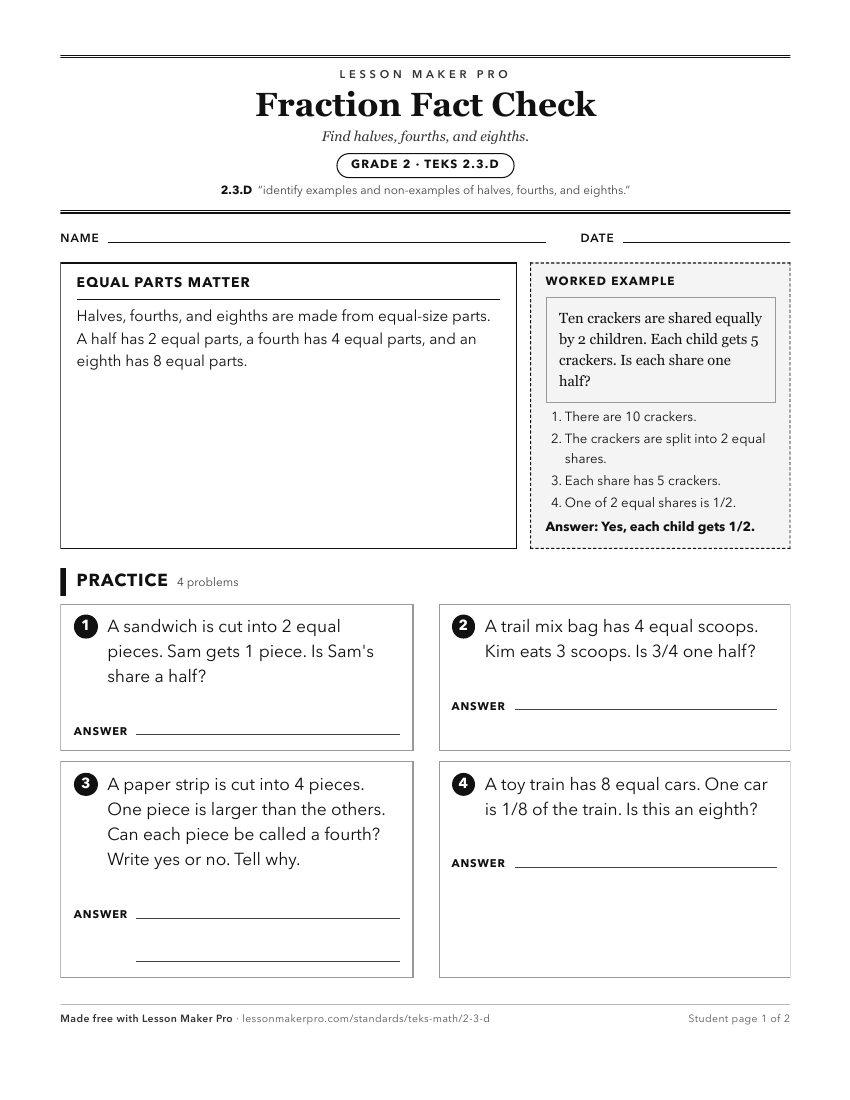
A ready-to-print activity worksheet aligned to 2.3.D, with an answer key for the teacher on its own page. No account needed.
PDF, US Letter, prints cleanly in black and white.
Download the worksheetKeep exploring
Related Standards
- 3.3.F
represent equivalent fractions with denominators of 2, 3, 4, 6, and 8 using a variety of objects and pictorial models, including number lines
- 3.7.A
represent fractions of halves, fourths, and eighths as distances from zero on a number line
- 2.3.A
partition objects into equal parts and name the parts, including halves, fourths, and eighths, using words
- 1.6.H
identify examples and non-examples of halves and fourths
Turn this exact standard into a lesson
Grade, subject, topic, and the complete standard are prefilled. Create one free, no account needed.
Also for this standard:Make a WorksheetMake a QuizMake a Sub Lesson