TEKS ELAR 7.10
Knowledge and Skills Statement (Standard Cluster)
Composition: listening, speaking, reading, writing, and thinking using multiple texts
Texas Essential Knowledge and Skills for English Language Arts and Reading
Cluster contents
Student Expectations in This Statement
7.10 is a knowledge and skills statement. These are the student expectations under it.
- 7.10.A
plan a first draft by selecting a genre appropriate for a particular topic, purpose, and audience using a range of strategies such as discussion, background rea...
- 7.10.B
develop drafts into a focused, structured, and coherent piece of writing by: organizing with purposeful structure, including an introduction, transitions, coher...
- 7.10.C
revise drafts for clarity, development, organization, style, word choice, and sentence variety
- 7.10.D.i
complete complex sentences with subject-verb agreement and avoidance of splices, run-ons, and fragments
- 7.10.D.ii
consistent, appropriate use of verb tenses
- 7.10.D.iii
conjunctive adverbs
- 7.10.D.iv
prepositions and prepositional phrases and their influence on subject-verb agreement
- 7.10.D.ix
correct spelling, including commonly confused terms such as its/it's, affect/effect, there/their/they're, and to/two/too
- 7.10.D.v
pronoun-antecedent agreement
- 7.10.D.vi
subordinating conjunctions to form complex sentences and correlative conjunctions such as either/or and neither/nor
- 7.10.D.vii
correct capitalization
- 7.10.D.viii
punctuation, including commas to set off words, phrases, and clauses, and semicolons
- 7.10.E
publish written work for appropriate audiences
Teacher's field guide
What This Cluster Means
What Students Need to Do
- Students plan, draft, revise, edit, and publish several kinds of writing. They match the genre and content to a clear purpose and audience. They organize ideas, add specific support, improve style, and correct grammar, spelling, capitalization, and punctuation.
What Mastery Looks Like
- A student chooses a form that fits the topic, audience, and purpose, then plans and drafts a focused piece. The writing has clear paragraphs, useful transitions, specific support, and varied sentences. The student revises meaning, edits conventions, and prepares a readable final copy for its intended audience.
Common Misconceptions
- Students often treat revision as correcting spelling rather than improving ideas, structure, and clarity. They may add transitions without creating a clear link between ideas. Common editing errors include comma splices, tense shifts, agreement errors, and confusion among homophones such as their, there, and they’re.
How to Assess It
- Give students a six-sentence draft with weak organization, thin details, a run-on, a tense shift, and a homophone error. Ask them to revise two sentences and edit three errors, then label each change.
Lesson moves
Ways to Teach It
Give groups sentence strips from a mixed-up essay to arrange into an introduction, body paragraphs, transitions, and conclusion, then defend their order.
Have students answer, “Which revision would most improve this draft, and why?” using evidence from a projected paragraph.
Run an editing relay where teams correct cards featuring fragments, run-ons, agreement errors, tense shifts, punctuation problems, and commonly confused words.
Ask students to write a school announcement for classmates, then rewrite it as an email to families and compare their choices.
Free download
Printable 7.10 Worksheet
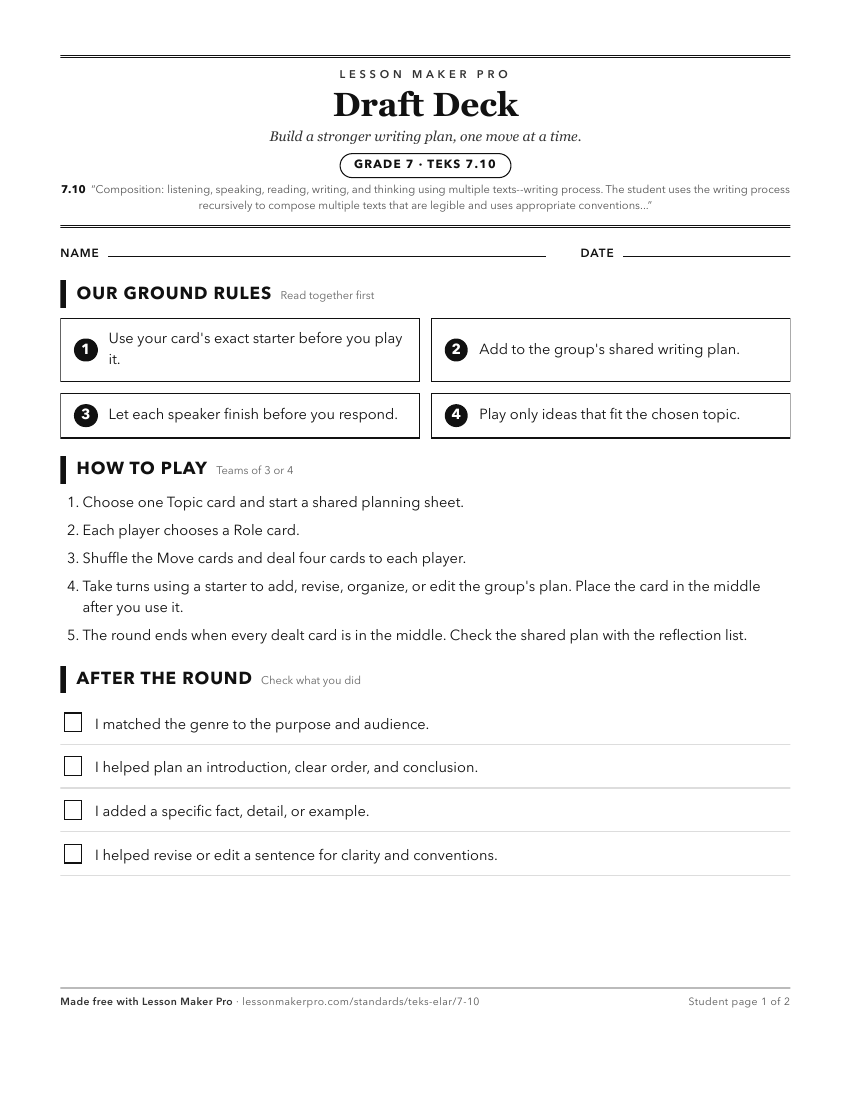
A ready-to-print activity worksheet aligned to 7.10, with an answer key for the teacher on its own page. No account needed.
PDF, US Letter, prints cleanly in black and white.
Download the worksheetKeep exploring
Related Standards
- 4.12
The student uses genre characteristics and craft to compose multiple texts that are meaningful.
- 7.11
Genres. The student uses genre characteristics and craft to compose multiple texts that are meaningful
- 7.12
Inquiry and research: listening, speaking, reading, writing, and thinking using multiple texts. The student engages in both short-term and sustained recursive i...
- 6.11
The student uses genre characteristics and craft to compose multiple texts that are meaningful.
Turn this cluster into a lesson
Grade, subject, topic, and the complete cluster are prefilled. Create one free, no account needed.
Also for this cluster:Make a WorksheetMake a QuizMake a Sub Lesson