TEKS ELAR 7.12
Knowledge and Skills Statement (Standard Cluster)
Inquiry and research: listening, speaking, reading, writing, and thinking using multiple texts. The student engages in both short-term and sustained recursive inquiry processes for a variety of purposes
Texas Essential Knowledge and Skills for English Language Arts and Reading
Cluster contents
Student Expectations in This Statement
7.12 is a knowledge and skills statement. These are the student expectations under it.
- 7.12.A
generate student-selected and teacher-guided questions for formal and informal inquiry
- 7.12.B
develop and revise a plan
- 7.12.C
refine the major research question, if necessary, guided by the answers to a secondary set of questions
- 7.12.D
identify and gather relevant information from a variety of sources
- 7.12.E
differentiate between primary and secondary sources
- 7.12.F
synthesize information from a variety of sources
- 7.12.G
differentiate between paraphrasing and plagiarism when using source materials
- 7.12.H
examine sources for: reliability, credibility, and bias, and faulty reasoning such as hyperbole, emotional appeals, and stereotype
- 7.12.I
display academic citations and use source materials ethically
- 7.12.J
use an appropriate mode of delivery, whether written, oral, or multimodal, to present results
Teacher's field guide
What This Cluster Means
What Students Need to Do
- Students ask a focused research question, make a plan, and adjust both as new information appears. They gather varied sources, judge credibility and bias, and spot weak reasoning. They synthesize findings, paraphrase without copying, cite sources, and present the results clearly.
What Mastery Looks Like
- Students build a focused research question, revise it as they learn, and follow a workable plan. They select relevant, credible sources, combine ideas in their own words, cite them correctly, and explain findings in a suitable format.
Common Misconceptions
- Students may think primary sources are always more trustworthy than secondary sources. They may copy sentences, swap a few words, and call that paraphrasing. They also may treat strong emotion, popularity, or a polished website as proof of credibility.
How to Assess It
- Give students a firsthand account, a news article, and a sponsored post about one event. Ask them to classify each source, identify bias or faulty reasoning, rank credibility, and write one cited paraphrase.
Lesson moves
Ways to Teach It
Give pairs source cards to sort by primary or secondary, credible or questionable, then require written evidence for each choice.
Use the prompt, “How did your secondary questions change your main research question?” and have students write a revised question.
Play Paraphrase or Plagiarism by showing source passages and student versions, then having teams identify and repair copied wording.
Research a proposed school policy, then present a one-slide recommendation using two credible sources and visible citations.
Free download
Printable 7.12 Worksheet
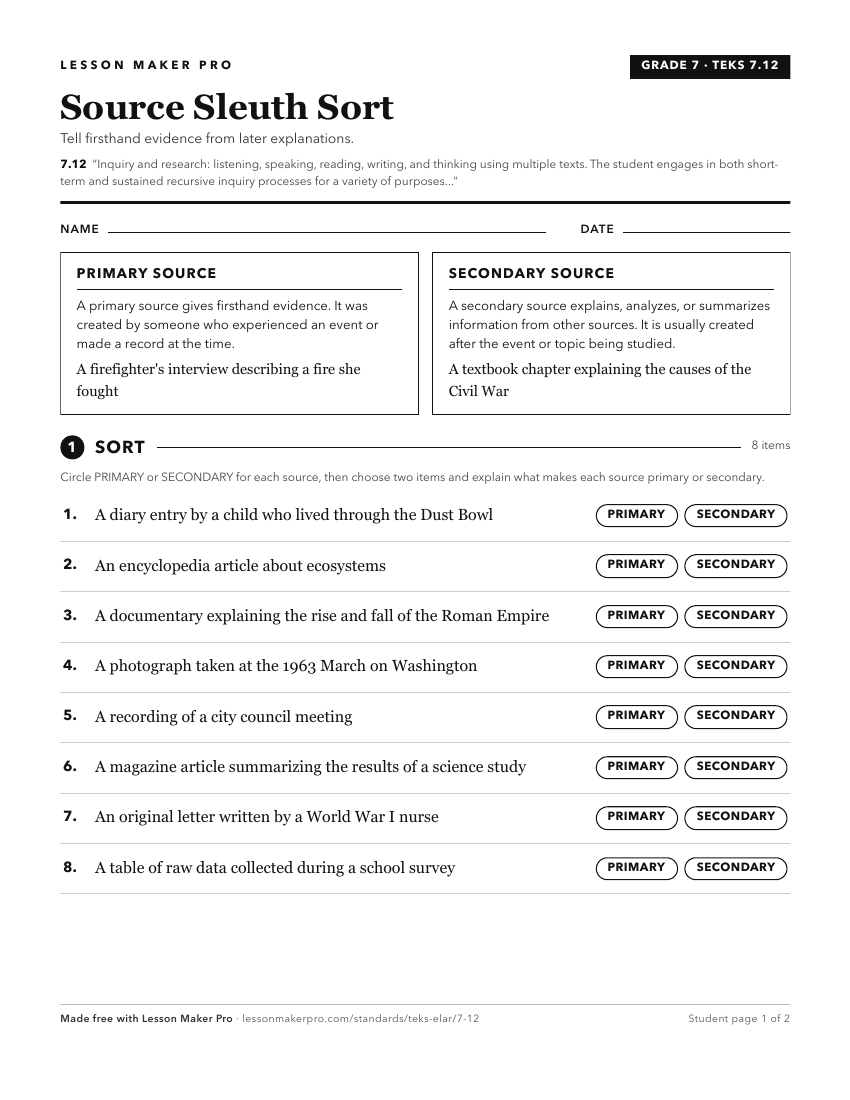
A ready-to-print activity worksheet aligned to 7.12, with an answer key for the teacher on its own page. No account needed.
PDF, US Letter, prints cleanly in black and white.
Download the worksheetKeep exploring
Related Standards
- 4.13
The student engages in both short-term and sustained recursive inquiry processes for a variety of purposes.
- 8.12
The student engages in both short-term and sustained recursive inquiry processes for a variety of purposes.
- 5.13
The student engages in both short-term and sustained recursive inquiry processes for a variety of purposes.
- 2.13
The student engages in both short-term and sustained recursive inquiry processes for a variety of purposes.
Turn this cluster into a lesson
Grade, subject, topic, and the complete cluster are prefilled. Create one free, no account needed.
Also for this cluster:Make a WorksheetMake a QuizMake a Sub Lesson