TEKS ELAR 4.13
Knowledge and Skills Statement (Standard Cluster)
The student engages in both short-term and sustained recursive inquiry processes for a variety of purposes.
Texas Essential Knowledge and Skills for English Language Arts and Reading
Cluster contents
Student Expectations in This Statement
4.13 is a knowledge and skills statement. These are the student expectations under it.
- 4.13.A
generate and clarify questions on a topic for formal and informal inquiry
- 4.13.B
develop and follow a research plan with adult assistance
- 4.13.C
identify and gather relevant information from a variety of sources
- 4.13.D
identify primary and secondary sources
- 4.13.E
demonstrate understanding of information gathered
- 4.13.F
recognize the difference between paraphrasing and plagiarism when using source materials
- 4.13.G
develop a bibliography
- 4.13.H
use an appropriate mode of delivery, whether written, oral, or multimodal, to present results.
Teacher's field guide
What This Cluster Means
What Students Need to Do
- Students turn a topic into focused questions, make a simple plan with adult help, and gather useful information from several sources. They identify source types, paraphrase without copying, record bibliography details, and present their findings clearly.
What Mastery Looks Like
- A student can use a focused question to follow a simple plan, take relevant notes from several sources, and explain the findings. The student labels primary and secondary sources, paraphrases without copying, lists source details, and chooses a clear presentation format.
Common Misconceptions
- Students often write questions that are too broad, collect unrelated facts, or treat every website as useful. They may assume an old source is automatically primary, swap a few words and call it paraphrasing, or omit source details.
How to Assess It
- Give students a topic and two short sources, one interview excerpt and one encyclopedia paragraph. Ask them to write a focused question, label each source, paraphrase one relevant fact, and record its bibliography details.
Lesson moves
Ways to Teach It
Set up source stations with a diary entry, interview, article, and website; students sort them as primary or secondary and collect relevant notes.
Use the prompt, “How can a broad question about local water use be revised into a focused, researchable question?”
Play Paraphrase Match: teams pair source sentences with accurate paraphrases, then flag copied wording and explain why it counts as plagiarism.
Have students interview a school staff member about cafeteria waste, compare the interview with an article, and present recommendations with a bibliography.
Free download
Printable 4.13 Worksheet
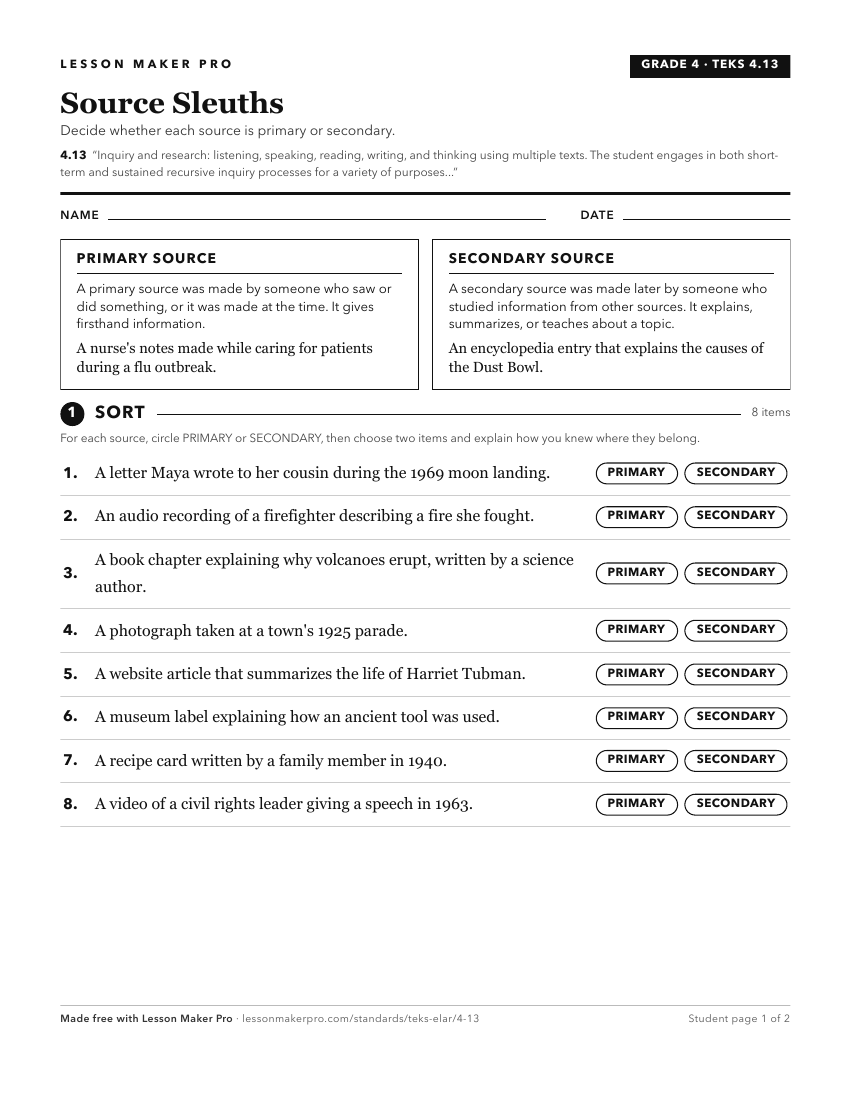
A ready-to-print activity worksheet aligned to 4.13, with an answer key for the teacher on its own page. No account needed.
PDF, US Letter, prints cleanly in black and white.
Download the worksheetKeep exploring
Related Standards
Turn this cluster into a lesson
Grade, subject, topic, and the complete cluster are prefilled. Create one free, no account needed.
Also for this cluster:Make a WorksheetMake a QuizMake a Sub Lesson