TEKS ELAR 6.12
Knowledge and Skills Statement (Standard Cluster)
The student engages in both short-term and sustained recursive inquiry processes for a variety of purposes.
Texas Essential Knowledge and Skills for English Language Arts and Reading
Cluster contents
Student Expectations in This Statement
6.12 is a knowledge and skills statement. These are the student expectations under it.
- 6.12.A
generate student-selected and teacher-guided questions for formal and informal inquiry
- 6.12.B
develop and revise a plan
- 6.12.C
refine the major research question, if necessary, guided by the answers to a secondary set of questions
- 6.12.D
identify and gather relevant information from a variety of sources
- 6.12.E
differentiate between primary and secondary sources
- 6.12.F
synthesize information from a variety of sources
- 6.12.G
differentiate between paraphrasing and plagiarism when using source materials
- 6.12.H.i
reliability, credibility, and bias
- 6.12.H.ii
faulty reasoning such as hyperbole, emotional appeals, and stereotype
- 6.12.I
display academic citations and use source materials ethically
- 6.12.J
use an appropriate mode of delivery, whether written, oral, or multimodal, to present results.
Teacher's field guide
What This Cluster Means
What Students Need to Do
- Students ask a focused research question, make and revise a plan, and use secondary questions to guide the search. They gather relevant details from varied sources, then check each source for credibility, bias, and faulty reasoning. They synthesize findings, paraphrase and cite ethically, and present conclusions in a suitable format.
What Mastery Looks Like
- A student can narrow a broad topic into a workable question and adjust the research plan as new answers appear. The student selects relevant sources, distinguishes primary from secondary sources, and explains concerns about credibility or reasoning. The final product combines ideas across sources, uses accurate citations, and fits the audience and purpose.
Common Misconceptions
- Students may treat the first question as final, even when evidence suggests a better focus. They may confuse primary sources with reliable sources, copy wording while calling it paraphrasing, or trust polished websites without checking authorship, evidence, bias, emotional appeals, or stereotypes.
How to Assess It
- Give students two short source excerpts about one claim, one credible and one biased. Ask them to identify each source type, flag one credibility issue, paraphrase one useful detail with a citation, and write a two-sentence synthesis.
Lesson moves
Ways to Teach It
Give pairs six source cards on one topic to sort as primary or secondary, then rank by credibility and justify each choice.
Ask students to write one major question and three secondary questions, then revise the major question after reading two short sources.
Play Citation Detective with paraphrase, quotation, and plagiarism examples; teams label each and repair any unethical use.
Have students investigate a school lunch claim using menus, student interviews, and nutrition reports, then present a cited infographic.
Free download
Printable 6.12 Worksheet
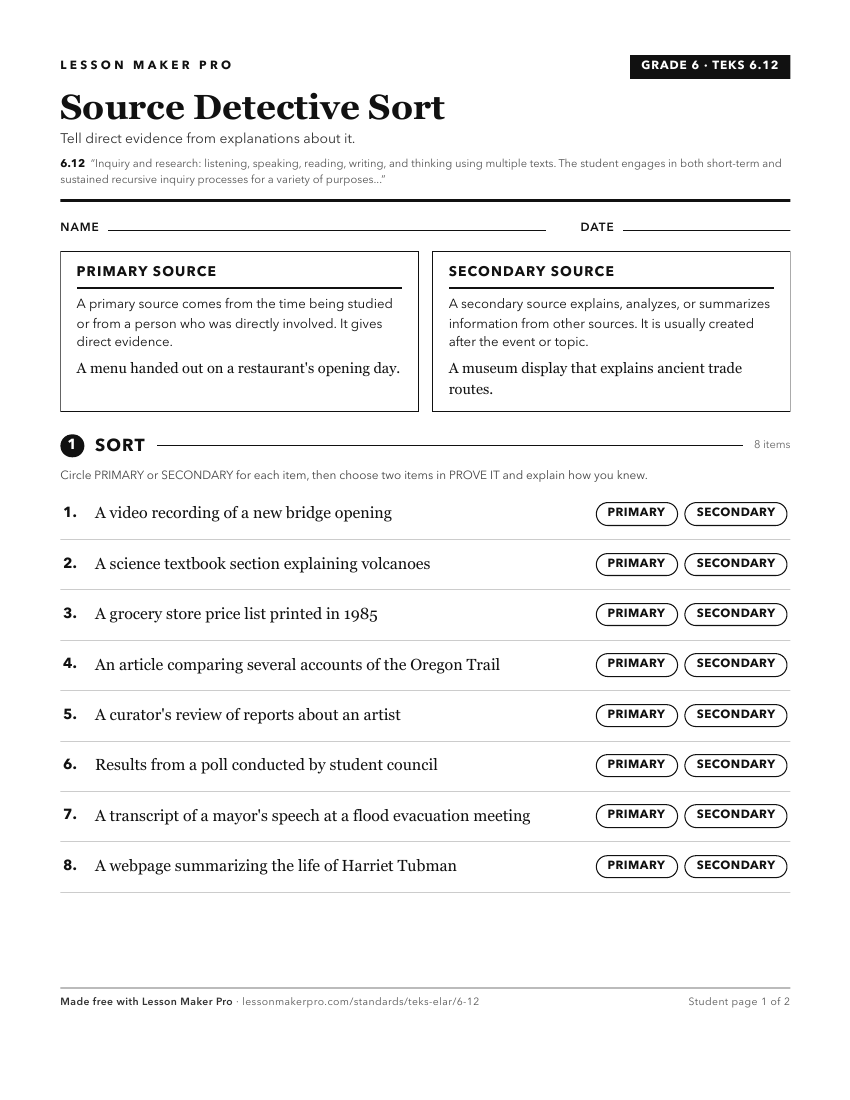
A ready-to-print activity worksheet aligned to 6.12, with an answer key for the teacher on its own page. No account needed.
PDF, US Letter, prints cleanly in black and white.
Download the worksheetKeep exploring
Related Standards
Turn this cluster into a lesson
Grade, subject, topic, and the complete cluster are prefilled. Create one free, no account needed.
Also for this cluster:Make a WorksheetMake a QuizMake a Sub Lesson