TEKS ELAR 6.12.H.i
The Standard
reliability, credibility, and bias
Texas Essential Knowledge and Skills for English Language Arts and Reading · The student engages in both short-term and sustained recursive inquiry processes for a variety of purposes.
Teacher's field guide
What This Standard Means
What Students Need to Do
- Students decide whether information from a source can be trusted and explain their reasoning. They check the author, evidence, publication date, purpose, and wording for warning signs.
What Mastery Looks Like
- A student compares sources on the same topic and decides which is more dependable. The student cites clues such as author expertise, named evidence, publication date, loaded language, and missing viewpoints.
Common Misconceptions
- Students may trust a source because it looks polished, appears first in search results, or ends in .org. They may think any opinion shows dishonesty or that a biased source has no useful information. They also confuse recent publication dates with accurate evidence.
How to Assess It
- Give students two short source cards about the same topic. Ask them to choose the stronger source and cite two details that support their choice.
Lesson moves
Ways to Teach It
Set up a source-sorting station with printed webpages, author bios, dates, and citations for students to rank from strongest to weakest.
Ask students to write: Which source would you trust more, and what exact details influenced your decision?
Play Source Detective by awarding points when teams spot unsupported claims, outdated facts, loaded words, missing authors, or weak evidence.
Compare two online reviews of a local restaurant and identify how sponsorship, personal experience, and word choice shape each review.
Free download
Printable 6.12.H.i Worksheet
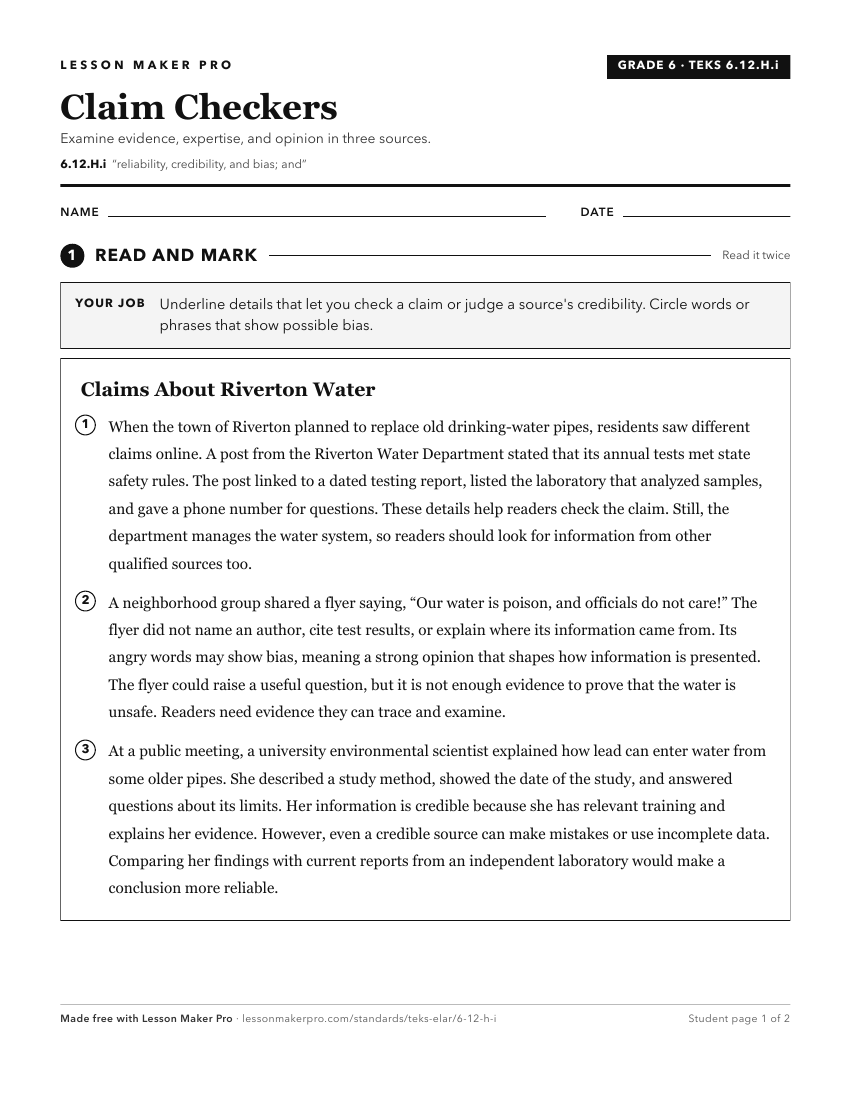
A ready-to-print activity worksheet aligned to 6.12.H.i, with an answer key for the teacher on its own page. No account needed.
PDF, US Letter, prints cleanly in black and white.
Download the worksheetKeep exploring
Related Standards
- 8.12.H.i
reliability, credibility, and bias, including omission; and
- 5.13.D
understand credibility of primary and secondary sources;
- 2.9.E.ii
distinguishing facts from opinion; and
- 7.12.H
examine sources for: reliability, credibility, and bias, and faulty reasoning such as hyperbole, emotional appeals, and stereotype
Turn this exact standard into a lesson
Grade, subject, topic, and the complete standard are prefilled. Create one free, no account needed.
Also for this standard:Make a WorksheetMake a QuizMake a Sub Lesson