TEKS ELAR 5.13.D
The Standard
understand credibility of primary and secondary sources
Texas Essential Knowledge and Skills for English Language Arts and Reading
Teacher's field guide
What This Standard Means
What Students Need to Do
- Students examine primary and secondary sources and decide how much each can be trusted. They use details about authorship, date, purpose, evidence, and accuracy to explain their judgment.
What Mastery Looks Like
- Students can identify a source as primary or secondary. They can judge its credibility using the author, date, purpose, evidence, and agreement with other sources.
Common Misconceptions
- Students may think every firsthand account is accurate or that every secondary source is biased. They may also judge a source by its appearance instead of checking the author, date, evidence, and purpose.
How to Assess It
- Give students a diary excerpt and a textbook paragraph about the same event. Ask which source is more credible for one specific question and require two supporting clues.
Lesson moves
Ways to Teach It
Give groups printed letters, photographs, interviews, and articles to sort by source type, then place each on a credibility scale.
Discuss the prompt, “Can an eyewitness be wrong?” and ask students to support their answer with two reasons.
Play Credibility Detective with source cards showing authors, dates, evidence, and purposes, awarding points for well-supported judgments.
Investigate a school lunch rumor by comparing a student post, the cafeteria menu, and the district nutrition page.
Free download
Printable 5.13.D Worksheet
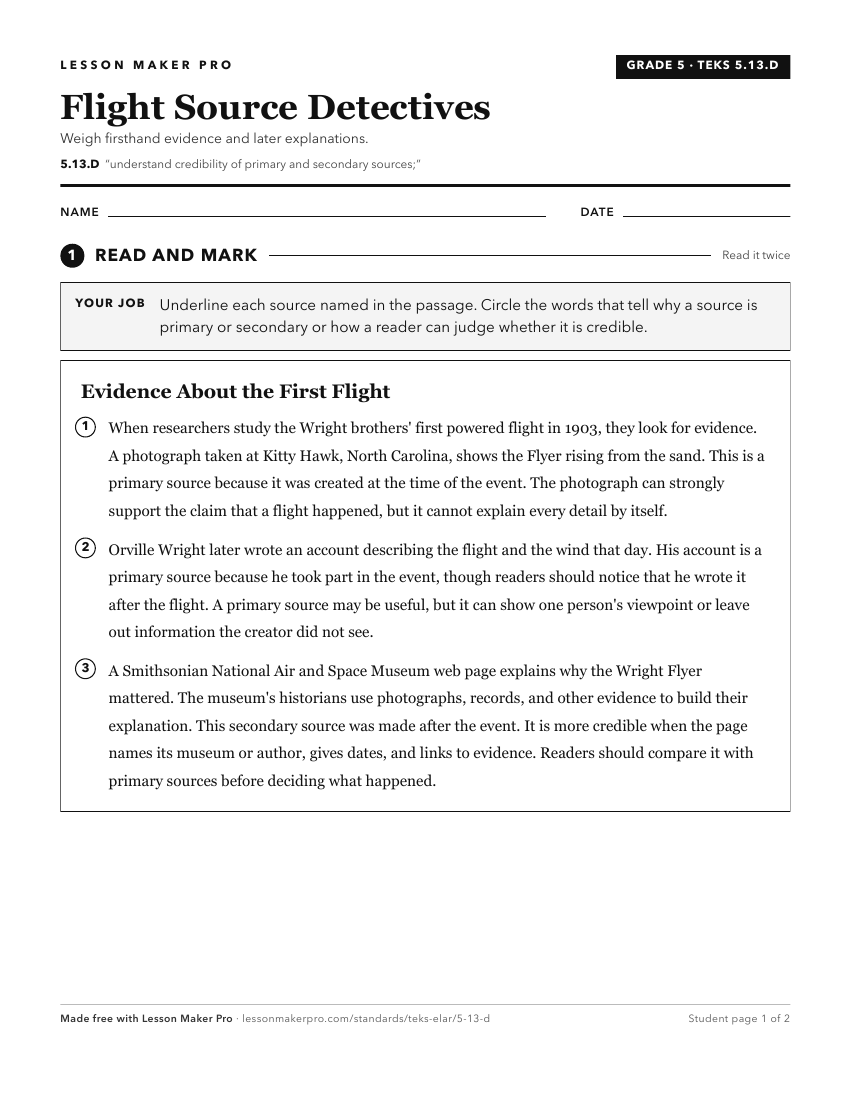
A ready-to-print activity worksheet aligned to 5.13.D, with an answer key for the teacher on its own page. No account needed.
PDF, US Letter, prints cleanly in black and white.
Download the worksheetKeep exploring
Related Standards
Turn this exact standard into a lesson
Grade, subject, topic, and the complete standard are prefilled. Create one free, no account needed.
Also for this standard:Make a WorksheetMake a QuizMake a Sub Lesson