TEKS ELAR 4.13.D
The Standard
identify primary and secondary sources
Texas Essential Knowledge and Skills for English Language Arts and Reading
Teacher's field guide
What This Standard Means
What Students Need to Do
- Students decide whether information comes directly from a person, event, or time being studied, or from someone interpreting it later. They use the source's creator, date, and purpose to explain the difference.
What Mastery Looks Like
- Students correctly sort evidence based on who created it, when it was created, and its purpose. They explain their choices with details from the source rather than relying only on its format.
Common Misconceptions
- Students may think every old document is firsthand evidence or that every website is a later account. They may also assume firsthand evidence is always accurate and unbiased.
How to Assess It
- Give students a diary entry, a textbook paragraph, a photograph, and a biography excerpt. Ask them to sort each item and justify one choice using its creator and purpose.
Lesson moves
Ways to Teach It
Set out letters, photographs, encyclopedia entries, and biographies for teams to sort, then have them label each item with evidence.
Ask students to explain whether an interview with a storm survivor or an article about the storm gives more direct evidence.
Play Source Sort Relay, where teams classify cards and earn a point only when they give an accurate reason.
Compare a family photograph with a written family history to show how people use different sources to learn about the past.
Free download
Printable 4.13.D Worksheet
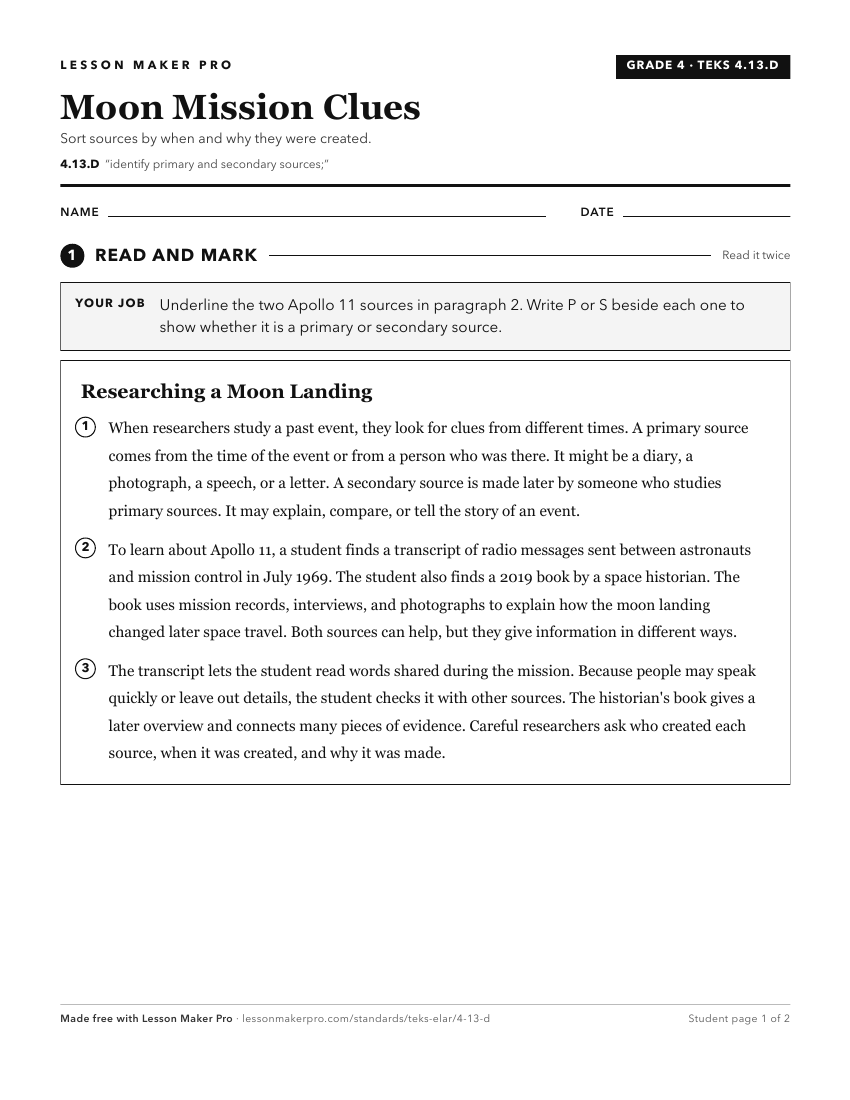
A ready-to-print activity worksheet aligned to 4.13.D, with an answer key for the teacher on its own page. No account needed.
PDF, US Letter, prints cleanly in black and white.
Download the worksheetKeep exploring
Related Standards
Turn this exact standard into a lesson
Grade, subject, topic, and the complete standard are prefilled. Create one free, no account needed.
Also for this standard:Make a WorksheetMake a QuizMake a Sub Lesson