TEKS ELAR 7.12.I
The Standard
display academic citations and use source materials ethically
Texas Essential Knowledge and Skills for English Language Arts and Reading
Teacher's field guide
What This Standard Means
What Students Need to Do
- Students credit every source they quote, paraphrase, summarize, or use for an image. They format in-text citations and a source list consistently while preserving the author’s meaning.
What Mastery Looks Like
- Students can add a relevant quote or paraphrase without changing the source’s meaning. They use quotation marks when needed and provide matching, consistently formatted citations.
Common Misconceptions
- Students may think listing a URL is enough or that changing a few words makes a passage their own. They often omit quotation marks, cite direct quotes but not paraphrases, or copy a source-list entry without checking it.
How to Assess It
- Give students a short source passage. Ask them to write one paraphrase with an in-text citation and a matching source-list entry.
Lesson moves
Ways to Teach It
Give pairs source cards, quotation marks, and citation labels, then have them build and correct cited sentences on chart paper.
Ask students to write: When does borrowing become plagiarism, and what should a writer do to avoid it?
Run a citation error hunt with six sample sentences containing missing credits, weak paraphrases, or incorrect source-list entries.
Have students cite a statistic and image for a mock social media post about a local school issue.
Free download
Printable 7.12.I Worksheet
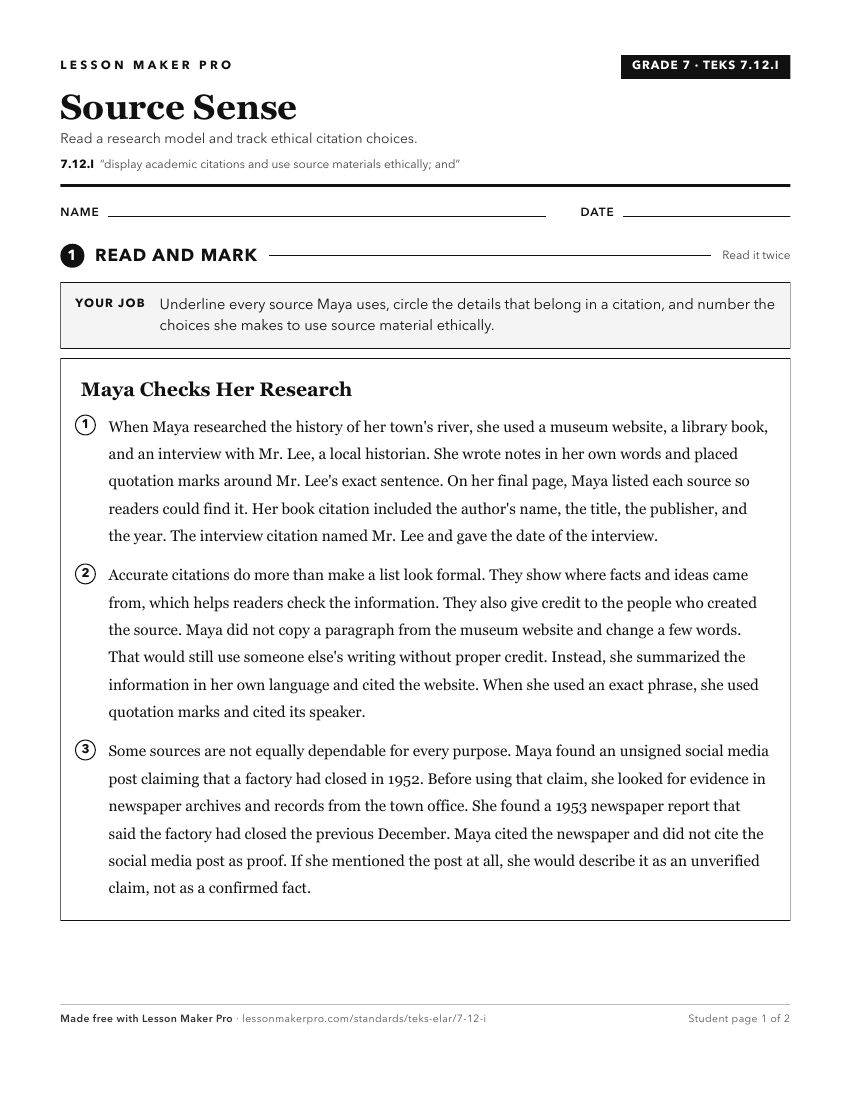
A ready-to-print activity worksheet aligned to 7.12.I, with an answer key for the teacher on its own page. No account needed.
PDF, US Letter, prints cleanly in black and white.
Download the worksheetKeep exploring
Related Standards
Turn this exact standard into a lesson
Grade, subject, topic, and the complete standard are prefilled. Create one free, no account needed.
Also for this standard:Make a WorksheetMake a QuizMake a Sub Lesson