TEKS ELAR 8.12.I
The Standard
display academic citations and use source materials ethically
Texas Essential Knowledge and Skills for English Language Arts and Reading
Teacher's field guide
What This Standard Means
What Students Need to Do
- Students credit the words, ideas, images, and information they borrow from sources. They use a consistent citation format and distinguish quotations, paraphrases, and their own thinking.
What Mastery Looks Like
- Students format in-text citations and a works cited entry using the assigned style. They clearly mark quotations, cite paraphrases, and connect each borrowed idea to its source.
Common Misconceptions
- Students may list a URL instead of giving a full citation, or cite a source only in the bibliography. They may also copy wording without quotation marks, assume paraphrasing needs no citation, or cite images incorrectly.
How to Assess It
- Give students a short source and a three-sentence response containing a quotation and a paraphrase. Ask them to correct the citations and explain one change.
Lesson moves
Ways to Teach It
Give pairs source cards and sample notes, then have them label each use as quotation, paraphrase, summary, or plagiarism.
Ask students to explain in writing why changing a few words does not remove the need for a citation.
Run a citation repair relay where teams correct missing quotation marks, incomplete entries, and uncited paraphrases in short passages.
Have students cite a news article, photograph, and website used in a mock community presentation about a local issue.
Free download
Printable 8.12.I Worksheet
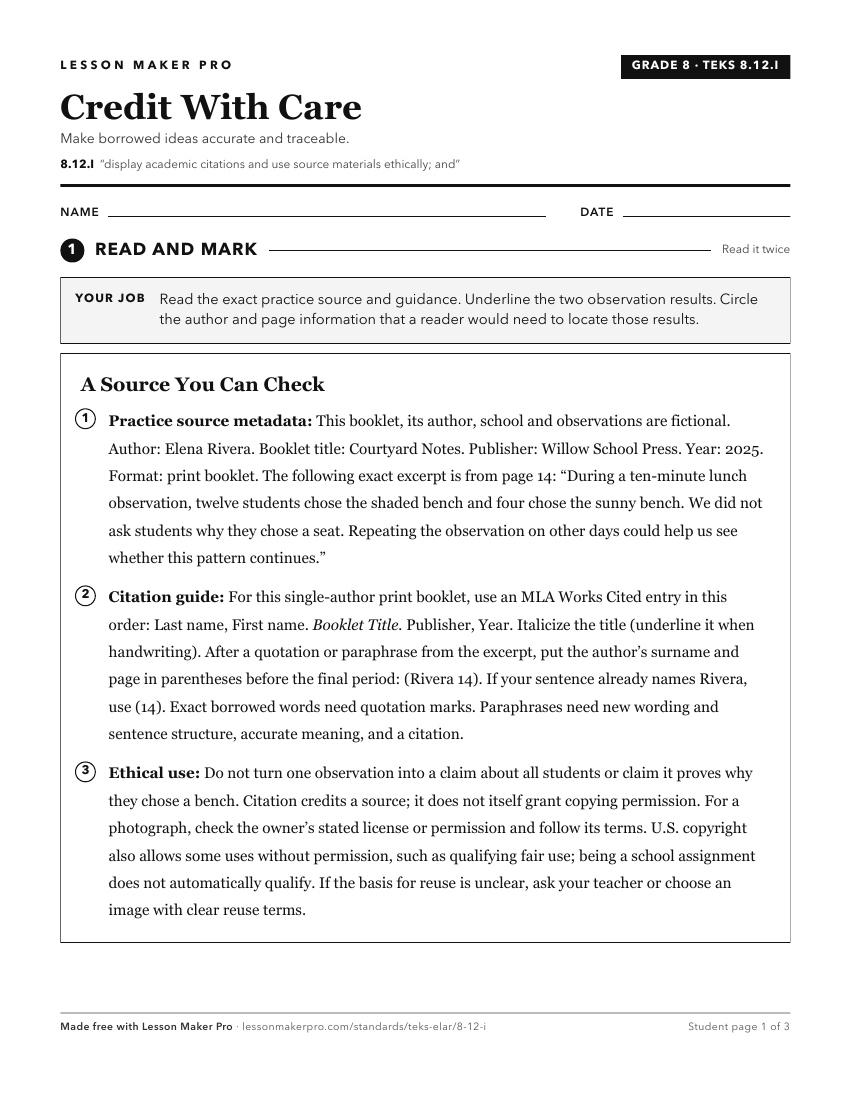
A ready-to-print activity worksheet aligned to 8.12.I, with an answer key for the teacher on its own page. No account needed.
PDF, US Letter, prints cleanly in black and white.
Download the worksheetKeep exploring
Related Standards
Turn this exact standard into a lesson
Grade, subject, topic, and the complete standard are prefilled. Create one free, no account needed.
Also for this standard:Make a WorksheetMake a QuizMake a Sub Lesson