TEKS ELAR 7.10.D.vi
The Standard
subordinating conjunctions to form complex sentences and correlative conjunctions such as either/or and neither/nor
Texas Essential Knowledge and Skills for English Language Arts and Reading · Composition: listening, speaking, reading, writing, and thinking using multiple texts
Teacher's field guide
What This Standard Means
What Students Need to Do
- Students combine related ideas into complex sentences with words such as because, although, when, and if. They also use paired conjunctions correctly and keep the joined elements parallel.
What Mastery Looks Like
- A student can revise choppy ideas into a clear complex sentence and punctuate it correctly. They place paired conjunctions around matching words, phrases, or clauses without changing the intended meaning.
Common Misconceptions
- Students may leave a dependent clause as a fragment or add a comma where none is needed. They may mix pairs, such as either/nor, or join elements that are not parallel.
How to Assess It
- Exit ticket: Combine “Maya was tired. Maya finished the chapter” using although. Then correct “The club will either meet in the library or the cafeteria.”
Lesson moves
Ways to Teach It
Give pairs sentence strips, connector cards, and punctuation tiles, then have them build and explain three correct complex sentences.
Ask students how because, although, and if change the meaning of one sentence, then have them write a version with each word.
Run an editing relay where teams correct fragments, mixed conjunction pairs, and faulty parallel structure on posted sentence cards.
Have students revise a school announcement using when, if, either/or, and neither/nor to make choices and conditions clear.
Free download
Printable 7.10.D.vi Worksheet
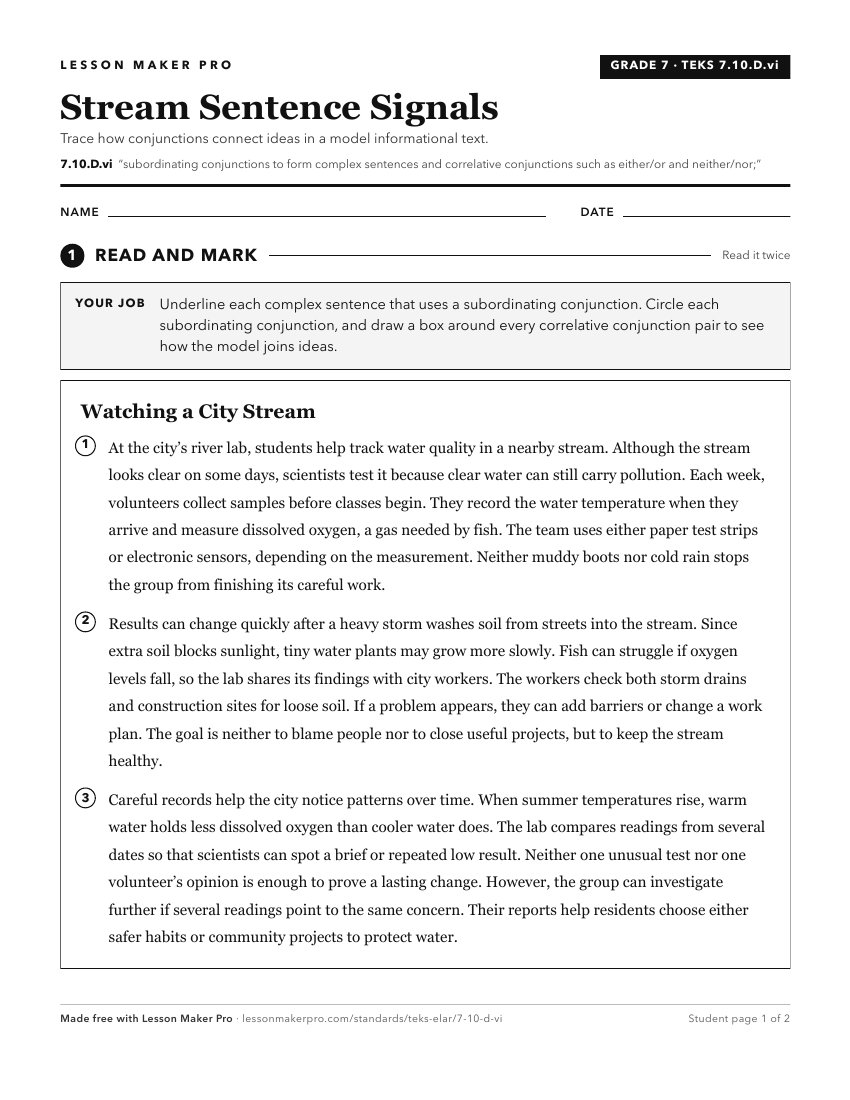
A ready-to-print activity worksheet aligned to 7.10.D.vi, with an answer key for the teacher on its own page. No account needed.
PDF, US Letter, prints cleanly in black and white.
Download the worksheetKeep exploring
Related Standards
- 5.11.D.viii
subordinating conjunctions to form complex sentences;
- 3.11.D.viii
coordinating conjunctions to form compound subjects, predicates, and sentences;
- 4.11.D.viii
coordinating conjunctions to form compound subjects, predicates, and sentences;
- 6.10.D.vi
subordinating conjunctions to form complex sentences and correlative conjunctions such as either/or and neither/nor;
Turn this exact standard into a lesson
Grade, subject, topic, and the complete standard are prefilled. Create one free, no account needed.
Also for this standard:Make a WorksheetMake a QuizMake a Sub Lesson