TEKS ELAR 7.10.D.ix
The Standard
correct spelling, including commonly confused terms such as its/it's, affect/effect, there/their/they're, and to/two/too
Texas Essential Knowledge and Skills for English Language Arts and Reading · Composition: listening, speaking, reading, writing, and thinking using multiple texts
Teacher's field guide
What This Standard Means
What Students Need to Do
- Students use sentence meaning and grammar to choose the correct spelling for commonly confused words. They edit drafts to find and replace incorrect word choices.
What Mastery Looks Like
- Students select the correct word from each commonly confused set based on the sentence meaning. They find and fix these errors in their own drafts without changing the intended message.
Common Misconceptions
- Students often treat it's as possessive because it has an apostrophe, but it's means it is. They may also choose words by sound instead of checking meaning, ownership, number, or sentence role.
How to Assess It
- Use this exit ticket: fill each blank and explain one choice. “___ going to put ___ books over ___.” “Rain may ___ the final ___.” “The dog wagged ___ tail because ___ excited.” “___ friends were ___ tired ___ walk.”
Lesson moves
Ways to Teach It
Sort sentence cards under its, it's, affect, effect, there, their, they're, to, two, and too, then justify each choice.
Write four sentence pairs showing how meaning changes when a confused word is swapped, then explain each change to a partner.
Play an editing relay where teams correct one confused word in each posted sentence, then pass the marker to the next editor.
Edit a mock school announcement for confused-word errors, then publish a clean version for the hallway or class website.
Free download
Printable 7.10.D.ix Worksheet
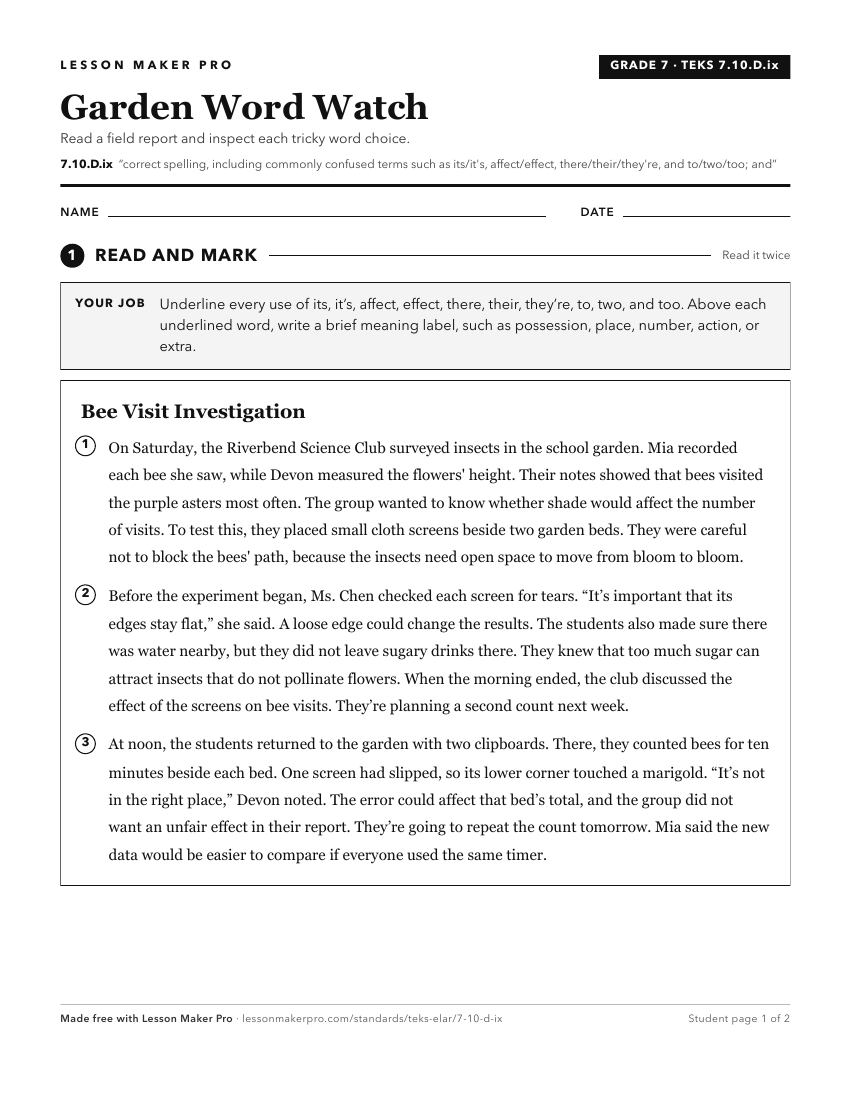
A ready-to-print activity worksheet aligned to 7.10.D.ix, with an answer key for the teacher on its own page. No account needed.
PDF, US Letter, prints cleanly in black and white.
Download the worksheetKeep exploring
Related Standards
- 4.11.D.xi
correct spelling of words with grade-appropriate orthographic patterns and rules and high-frequency words; and
- 8.10.D.vii
correct spelling, including commonly confused terms such as its/it's, affect/effect, there/their/they're, and to/two/too; and
- 3.11.D.xi
correct spelling of words with grade-appropriate orthographic patterns and rules and high-frequency words; and
- 6.10.D.ix
correct spelling, including commonly confused terms such as its/it's, affect/effect, there/their/they're, and to/two/too; and
Turn this exact standard into a lesson
Grade, subject, topic, and the complete standard are prefilled. Create one free, no account needed.
Also for this standard:Make a WorksheetMake a QuizMake a Sub Lesson