NGSS MS-PS1-3
The Standard
Gather and make sense of information to describe that synthetic materials come from natural resources and impact society.
Next Generation Science Standards
Teacher's field guide
What This Standard Means
What Students Need to Do
- Students gather information from reliable sources and trace how a natural resource becomes a synthetic material through a chemical process. They explain how that material affects society, using qualitative evidence.
What Mastery Looks Like
- Students can trace a material from a natural resource through a chemical process to a new substance. They use source evidence to explain one benefit and one drawback for people or communities.
Common Misconceptions
- Students may think synthetic means fake, harmful, or made without natural resources. They may confuse a chemical change with cutting, melting, or reshaping a material, and may overlook benefits or drawbacks.
How to Assess It
- Give students a short description of polyester production. Ask them to name the natural resource, identify the chemical process, and state one supported benefit or drawback.
Lesson moves
Ways to Teach It
Heat milk, add vinegar, and strain the curds to make casein plastic, then record how its properties differ from milk.
Use evidence cards to write a claim about whether a town should replace petroleum plastic with plant-based plastic.
Sort cards labeled resource, chemical process, synthetic material, and social impact, then race to build accurate production chains.
Examine clothing labels, choose one synthetic fiber, and research its source, production process, use, and disposal impacts.
Free download
Printable MS-PS1-3 Worksheet
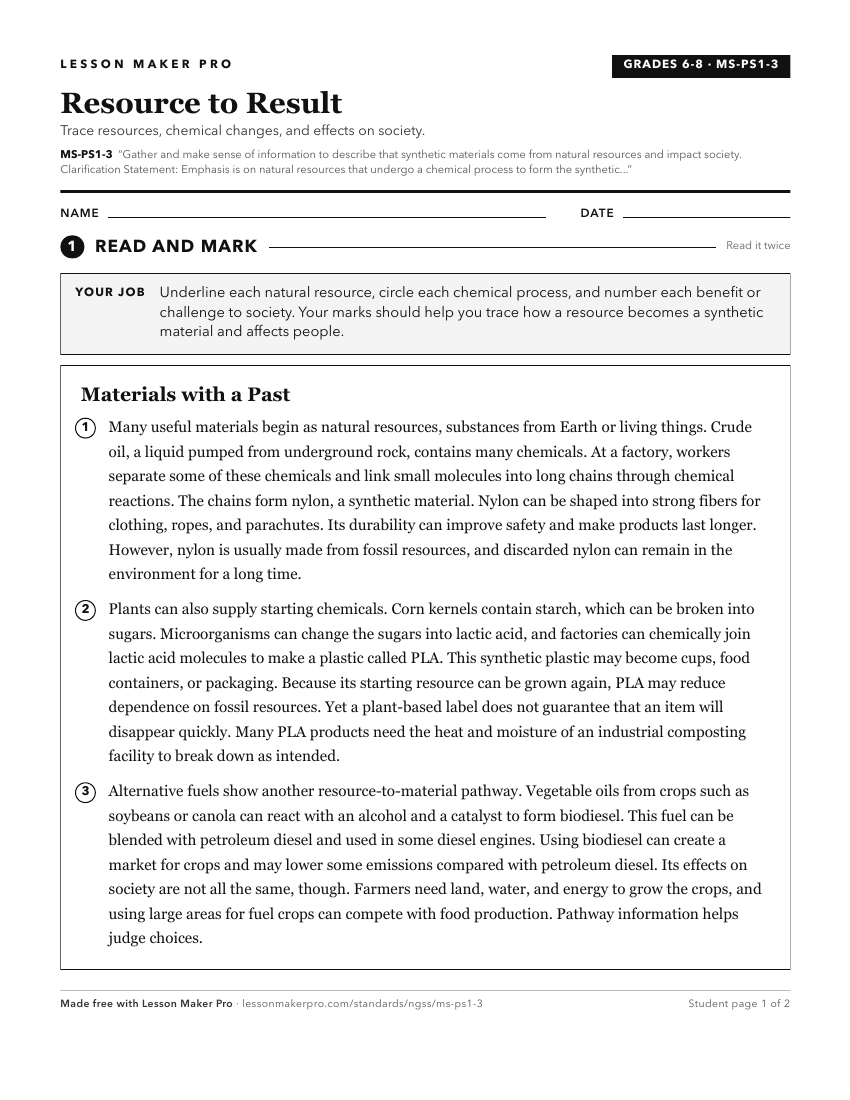
A ready-to-print activity worksheet aligned to MS-PS1-3, with an answer key for the teacher on its own page. No account needed.
PDF, US Letter, prints cleanly in black and white.
Download the worksheetLearning progression
Where This Standard Sits
See the whole path on the Physical Science progression map.
What This Unlocks
Mastery here sets students up for these next.
- HS-PS1-7
Understanding that synthetic materials result from chemical transformations supports seeing reactions as rearrangements of matter before quantifying conserved mass.
- HS-PS1-5
Understanding synthetic materials as products of chemical reactions supports later explanations of how conditions change how fast reactions occur.
- HS-PS1-1
Middle school work with material properties and sources gives context for why element properties matter in periodic table predictions.
- HS-PS1-6
Understanding that reactions transform natural resources into useful products supports later design choices to increase desired chemical products.
- HS-PS1-4
Understanding synthetic materials as products of chemical processes supports later modeling of reactions as bond changes with energy effects.
- HS-PS1-3
Understanding that materials have distinct properties and origins supports investigating how bulk properties reveal particle-level forces in substances.
Keep exploring
Related Standards
- 2-PS1-1
Plan and conduct an investigation to describe and classify different kinds of materials by their observable properties.
- 4-ESS3-1
Obtain and combine information to describe that energy and fuels are derived from natural resources and their uses affect the environment.
- 5-ESS3-1
Obtain and combine information about ways individual communities use science ideas to protect the Earth's resources and environment.
- 5-PS1-3
Make observations and measurements to identify materials based on their properties.
Turn this exact standard into a lesson
Grade, subject, topic, and the complete standard are prefilled. Create one free, no account needed.
Also for this standard:Make a WorksheetMake a QuizMake a Sub Lesson