NGSS HS-PS1-1
The Standard
Use the periodic table as a model to predict the relative properties of elements based on the patterns of electrons in the outermost energy level of atoms.
Next Generation Science Standards
Teacher's field guide
What This Standard Means
What Students Need to Do
- Students use group and period positions to determine valence-electron patterns for main group elements. They use those patterns to predict relative reactivity, likely ion charges, bond types, bond counts, and reactions with oxygen.
What Mastery Looks Like
- A student can explain why sodium and potassium behave similarly, then predict which is more reactive. They can predict that magnesium forms Mg²⁺, chlorine forms Cl⁻, and MgCl₂ has a 1:2 ratio.
Common Misconceptions
- Students may confuse group number with total electrons or assume elements in the same period have similar properties. They may think reactivity always increases in one direction across the table. They may also write compound formulas without balancing ion charges.
How to Assess It
- Exit ticket: Compare sodium and potassium. State their valence-electron counts, predict which reacts more strongly with oxygen, and justify your answer using periodic position.
Lesson moves
Ways to Teach It
Give groups element cards and colored beads to build outer-shell models, then sort the cards by predicted ion charge and bond count.
Ask students to write: Why do sodium and potassium react similarly, yet potassium reacts more strongly?
Play Periodic Table Prediction Bingo using clues about valence electrons, likely ions, bond types, and oxygen reactions.
Have students compare lithium battery and sodium storage safety sheets, then explain how periodic position relates to each handling rule.
Free download
Printable HS-PS1-1 Worksheet
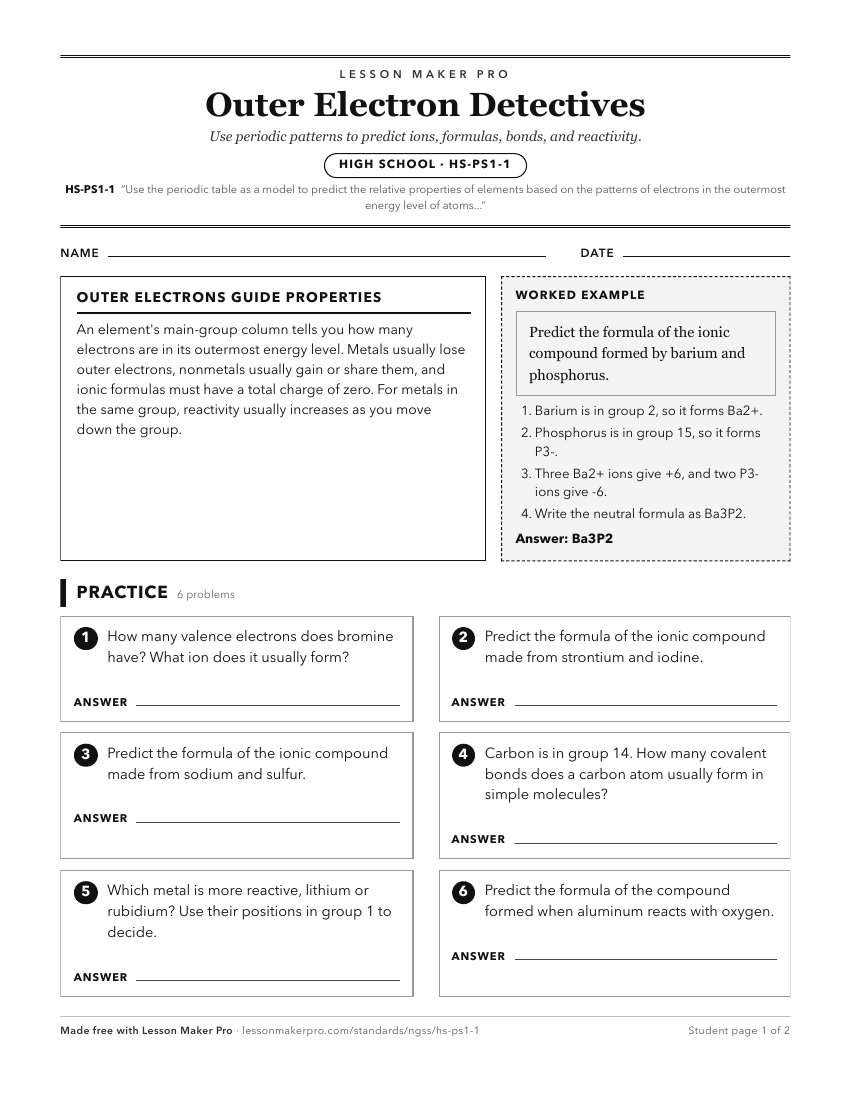
A ready-to-print activity worksheet aligned to HS-PS1-1, with an answer key for the teacher on its own page. No account needed.
PDF, US Letter, prints cleanly in black and white.
Download the worksheetLearning progression
Where This Standard Sits
See the whole path on the Physical Science progression map.
Before This Standard
If students are struggling here, check these first.
- MS-PS1-2
Interpreting substance properties and reaction evidence prepares students to connect observable properties to atomic structure and periodic patterns.
- MS-PS1-3
Middle school work with material properties and sources gives context for why element properties matter in periodic table predictions.
- MS-PS1-1
Knowing atoms combine into molecules and structures supports using atomic structure to explain periodic patterns in element properties.
Keep exploring
Related Standards
- HS-PS1-2
Construct and revise an explanation for the outcome of a simple chemical reaction based on the outermost electron states of atoms, trends in the periodic table,...
- 1-ESS1-1
Use observations of the sun, moon, and stars to describe patterns that can be predicted.
- HS-PS1-8
Develop models to illustrate the changes in the composition of the nucleus of the atom and the energy released during the processes of fission, fusion, and radi...
Turn this exact standard into a lesson
Grade, subject, topic, and the complete standard are prefilled. Create one free, no account needed.
Also for this standard:Make a WorksheetMake a QuizMake a Sub Lesson