NGSS MS-PS1-1
The Standard
Develop models to describe the atomic composition of simple molecules and extended structures.
Next Generation Science Standards
Teacher's field guide
What This Standard Means
What Students Need to Do
- Students create drawings, physical models, or digital models that show which atoms are present and how they are arranged. They model both small molecules and repeating extended structures.
What Mastery Looks Like
- Students use correct element symbols or color keys and show the right number and arrangement of atoms in a simple molecule. For an extended structure, they show a clear repeating pattern without drawing every atom in the sample.
Common Misconceptions
- Students may treat a chemical formula as a complete model, count colors without identifying elements, or assume models show actual atom sizes. They may draw sodium chloride or diamond as one isolated molecule instead of a repeating structure.
How to Assess It
- Exit ticket: Draw and label a model of NH3, then sketch a small section of a repeating sodium chloride structure. Explain what each color or symbol represents.
Lesson moves
Ways to Teach It
Give pairs colored clay and toothpicks to build ammonia, methanol, and a repeating sodium chloride array from formula cards.
Ask students to write: How is a model of one methanol molecule different from a model of a salt crystal?
Run a matching relay where teams pair formula cards, atom-count cards, and molecular or repeating-structure diagrams.
Have students examine salt crystals and a diamond photo, then connect each visible object to a repeating atomic pattern.
Free download
Printable MS-PS1-1 Worksheet
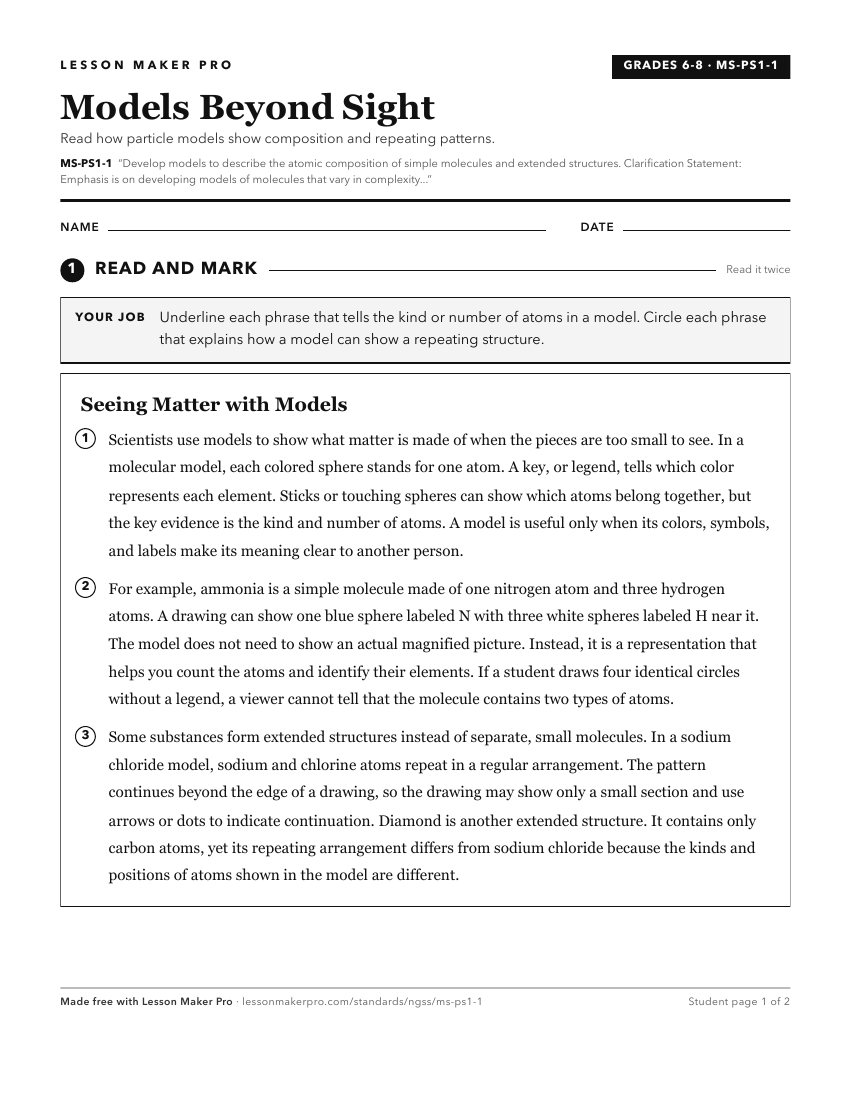
A ready-to-print activity worksheet aligned to MS-PS1-1, with an answer key for the teacher on its own page. No account needed.
PDF, US Letter, prints cleanly in black and white.
Download the worksheetLearning progression
Where This Standard Sits
See the whole path on the Physical Science progression map.
Before This Standard
If students are struggling here, check these first.
- 5-PS1-1
Students move from unseen particles making up matter to atoms arranged in molecules and larger repeating structures.
- 5-PS1-3
Identifying materials by characteristic properties supports the later idea that substances have specific particle compositions shown in models.
- 5-PS1-2
Conservation of matter in observable changes prepares students to explain substances as particles that rearrange into molecules and structures.
What This Unlocks
Mastery here sets students up for these next.
- HS-PS1-2
Understanding atoms as components of molecules and structures is needed to explain how electron states drive reaction products.
- HS-PS1-3
Modeling molecules and extended structures prepares students to connect particle arrangement with bulk properties and forces between particles.
- HS-PS1-4
Atomic and molecular models support understanding bonds, whose energy changes explain heat released or absorbed in reactions.
- HS-PS1-1
Knowing atoms combine into molecules and structures supports using atomic structure to explain periodic patterns in element properties.
Keep exploring
Related Standards
- MS-PS1-5
Develop and use a model to describe how the total number of atoms does not change in a chemical reaction and thus mass is conserved.
- HS-PS1-8
Develop models to illustrate the changes in the composition of the nucleus of the atom and the energy released during the processes of fission, fusion, and radi...
Turn this exact standard into a lesson
Grade, subject, topic, and the complete standard are prefilled. Create one free, no account needed.
Also for this standard:Make a WorksheetMake a QuizMake a Sub Lesson