NGSS MS-PS1-5
The Standard
Develop and use a model to describe how the total number of atoms does not change in a chemical reaction and thus mass is conserved.
Next Generation Science Standards
Teacher's field guide
What This Standard Means
What Students Need to Do
- Students build particle drawings or physical models that track each type of atom through a chemical reaction. They use the model to explain why a closed system keeps the same mass.
What Mastery Looks Like
- Students create a particle model that shows the same count of each type of atom before and after a reaction. They explain that atoms are rearranged into new substances rather than created or destroyed.
Common Misconceptions
- Students may think atoms disappear when a gas forms or new atoms appear when a solid forms. They may also confuse changes in particle arrangement with changes in the number or type of atoms.
How to Assess It
- Give students particle drawings from before and after a reaction, with one product particle missing. Ask them to add the missing particle and explain their choice.
Lesson moves
Ways to Teach It
Give pairs colored snap cubes representing atoms, then have them break apart reactant molecules and rebuild product molecules without adding or removing cubes.
Ask students to explain where the atoms go when vinegar and baking soda react inside a sealed bag.
Play a particle-model matching game where students pair reactant and product cards containing equal counts of each colored atom.
Compare the measured mass of a sealed reaction before and after, then connect the unchanged mass to the atoms inside.
Free download
Printable MS-PS1-5 Worksheet
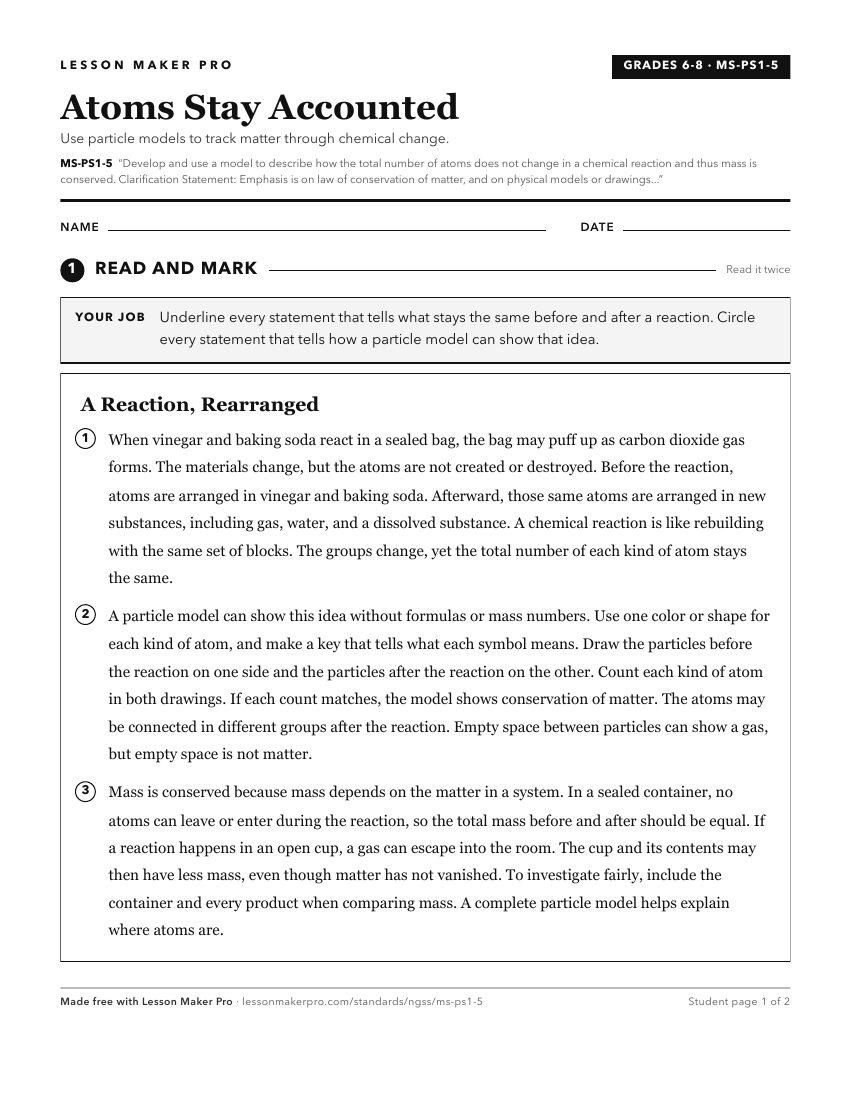
A ready-to-print activity worksheet aligned to MS-PS1-5, with an answer key for the teacher on its own page. No account needed.
PDF, US Letter, prints cleanly in black and white.
Download the worksheetLearning progression
Where This Standard Sits
See the whole path on the Physical Science progression map.
Before This Standard
If students are struggling here, check these first.
What This Unlocks
Mastery here sets students up for these next.
- HS-PS1-7
The high school math work depends on the middle school idea that reactions rearrange atoms without changing atom counts or mass.
- HS-PS1-4
Understanding reactions as rearrangements of conserved atoms supports modeling bond breaking and forming to explain energy release or absorption.
- HS-PS1-6
Conservation of atoms and mass supports reaction thinking, but equilibrium optimization adds reversible reactions and condition effects.
- HS-PS1-5
Tracking atoms in reactions supports understanding reacting particles, which is needed before explaining how temperature and concentration change reaction rates.
- HS-PS1-2
Understanding reactions as rearrangements of conserved atoms supports HS explanations of products using valence electrons and periodic chemical patterns.
Keep exploring
Related Standards
Turn this exact standard into a lesson
Grade, subject, topic, and the complete standard are prefilled. Create one free, no account needed.
Also for this standard:Make a WorksheetMake a QuizMake a Sub Lesson