NGSS HS-PS1-4
The Standard
Develop a model to illustrate that the release or absorption of energy from a chemical reaction system depends upon the changes in total bond energy.
Next Generation Science Standards
Teacher's field guide
What This Standard Means
What Students Need to Do
- Students build a model showing how bond changes affect energy transfer during a chemical reaction. They compare energy needed to break bonds with energy released when new bonds form. They show that energy moves between the reaction system and its surroundings.
What Mastery Looks Like
- Students can create a molecular drawing or energy profile that shows where energy enters or leaves a reaction system. They explain that breaking bonds requires energy and forming bonds releases energy. Their model shows energy conservation and a clear system boundary.
Common Misconceptions
- Students often think breaking bonds releases energy, when breaking bonds requires energy. They may judge a reaction by one bond instead of comparing all bonds broken and formed. Some models show energy appearing or disappearing rather than moving between the system and surroundings.
How to Assess It
- Provide reactant and product particle diagrams plus an energy profile with products lower. Students add bond-breaking, bond-forming, and energy-flow labels, then explain the net release.
Lesson moves
Ways to Teach It
Give pairs molecular cutouts and energy tokens; students spend tokens to break reactant bonds, regain tokens when product bonds form, then model net flow.
Ask students to explain why breaking bonds alone cannot release energy, using a labeled particle diagram and two sentences.
Play a card sort matching reaction diagrams, energy profiles, and labels for net energy entering or leaving the system.
Compare instant cold packs and hand warmers, then sketch system boundaries and arrows showing where energy moves.
Free download
Printable HS-PS1-4 Worksheet
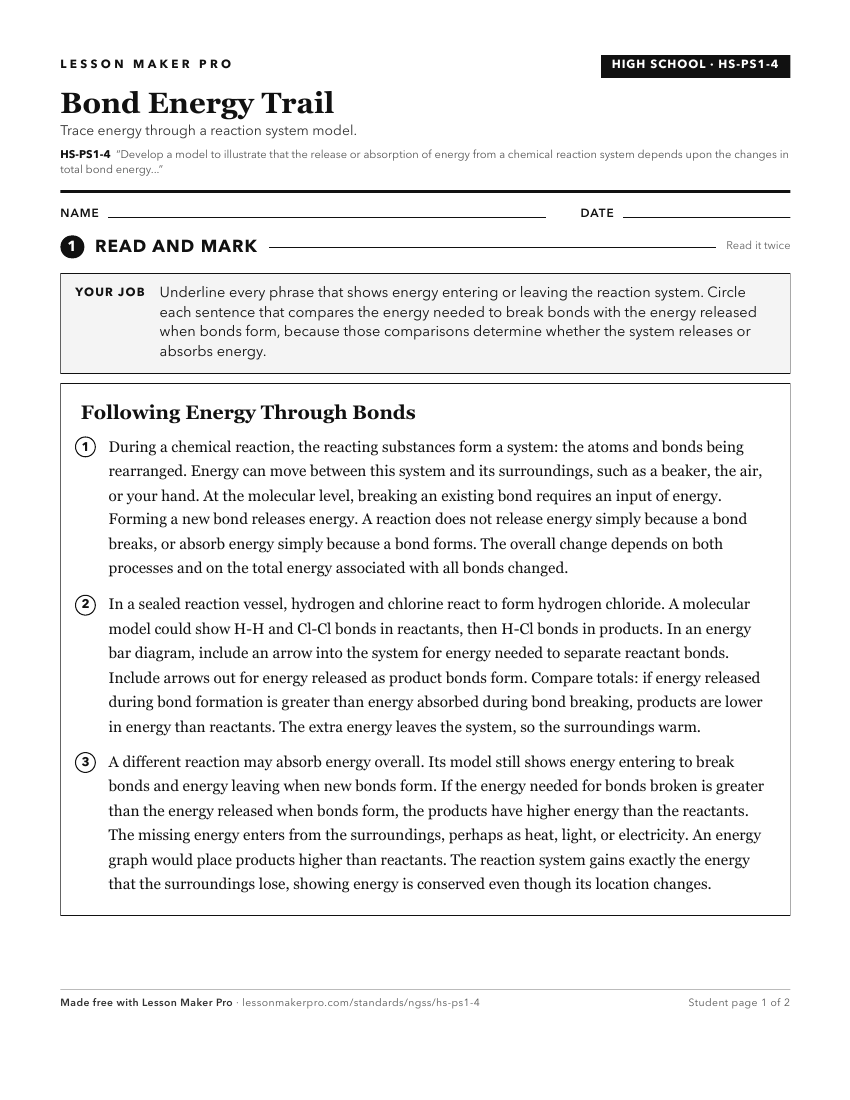
A ready-to-print activity worksheet aligned to HS-PS1-4, with an answer key for the teacher on its own page. No account needed.
PDF, US Letter, prints cleanly in black and white.
Download the worksheetLearning progression
Where This Standard Sits
See the whole path on the Physical Science progression map.
Before This Standard
If students are struggling here, check these first.
- MS-PS1-2
Identifying chemical reactions from before-and-after substance data supports later modeling of reactions as bond changes with energy release or absorption.
- MS-PS1-5
Understanding reactions as rearrangements of conserved atoms supports modeling bond breaking and forming to explain energy release or absorption.
- MS-PS1-4
Particle models of thermal energy support understanding reaction energy changes as energy stored and transferred among particles and bonds.
- MS-PS1-3
Understanding synthetic materials as products of chemical processes supports later modeling of reactions as bond changes with energy effects.
- MS-PS1-1
Atomic and molecular models support understanding bonds, whose energy changes explain heat released or absorbed in reactions.
- MS-PS1-6
Experience with reactions that release or absorb heat supports the HS shift to explaining energy changes through bond energies.
Keep exploring
Related Standards
- MS-LS1-7
Develop a model to describe how food is rearranged through chemical reactions forming new molecules that support growth and/or release energy as this matter mov...
- MS-PS3-2
Develop a model to describe that when the arrangement of objects interacting at a distance changes, different amounts of potential energy are stored in the syst...
Turn this exact standard into a lesson
Grade, subject, topic, and the complete standard are prefilled. Create one free, no account needed.
Also for this standard:Make a WorksheetMake a QuizMake a Sub Lesson