NGSS MS-PS1-4
The Standard
Develop a model that predicts and describes changes in particle motion, temperature, and state of a pure substance when thermal energy is added or removed.
Next Generation Science Standards
Teacher's field guide
What This Standard Means
What Students Need to Do
- Students create particle models for a pure solid, liquid, or gas as it is heated or cooled. They use the models to predict changes in motion, temperature, and state.
What Mastery Looks Like
- A correct model keeps the particles unchanged while showing changes in their speed, arrangement, and spacing. Students predict state changes during heating or cooling and show temperature leveling during a phase change.
Common Misconceptions
- Students may draw particles growing larger when heated instead of showing greater motion and spacing. They may think particles stop moving in solids or that temperature always changes during melting and boiling.
How to Assess It
- Exit ticket: Draw liquid water before heating, while boiling, and as a gas. Label particle motion, spacing, temperature, state, and energy transfer.
Lesson moves
Ways to Teach It
Heat crushed ice in a beaker, record temperature each minute, and add particle sketches before, during, and after melting.
Write an explanation of why boiling water keeps the same temperature even while the burner continues adding energy.
Sort particle diagram cards by state, then arrange them into heating and cooling sequences and justify each placement.
Model what happens to water particles as an ice cube melts in a drink, including energy transfer from the drink.
Free download
Printable MS-PS1-4 Worksheet
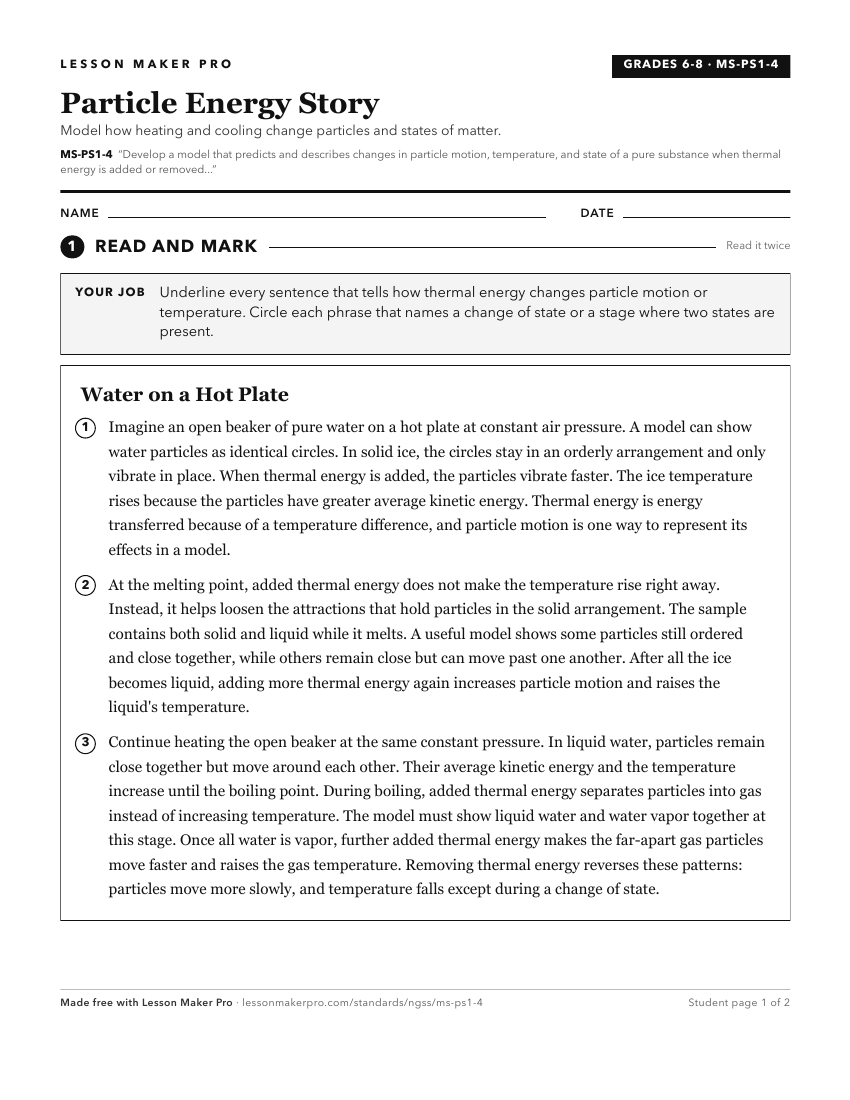
A ready-to-print activity worksheet aligned to MS-PS1-4, with an answer key for the teacher on its own page. No account needed.
PDF, US Letter, prints cleanly in black and white.
Download the worksheetLearning progression
Where This Standard Sits
See the whole path on the Physical Science progression map.
What This Unlocks
Mastery here sets students up for these next.
- HS-PS3-3
Understanding thermal energy, temperature, and particle motion supports reasoning about energy inputs, outputs, and losses in conversion devices.
- HS-PS3-2
Middle school particle models for thermal energy step up to high school accounting of macroscopic energy as particle motion or fields.
- HS-PS1-2
Particle-level models of matter prepare students to explain reactions using smaller atomic features and property patterns.
- HS-PS3-1
Understanding thermal energy changes in particles supports tracking energy transfers and conservation across components in a computational model.
- HS-PS1-4
Particle models of thermal energy support understanding reaction energy changes as energy stored and transferred among particles and bonds.
- HS-PS1-3
Particle models of state changes prepare students to connect bulk properties with particle attractions and force strength.
Keep exploring
Related Standards
Turn this exact standard into a lesson
Grade, subject, topic, and the complete standard are prefilled. Create one free, no account needed.
Also for this standard:Make a WorksheetMake a QuizMake a Sub Lesson