NGSS HS-PS3-1
The Standard
Create a computational model to calculate the change in the energy of one component in a system when the change in energy of the other component(s) and energy flows in and out of the system are known.
Next Generation Science Standards
Teacher's field guide
What This Standard Means
What Students Need to Do
- Students build an equation, table, or spreadsheet that tracks energy changes within a system. They calculate one unknown change and explain the meaning of each term.
What Mastery Looks Like
- Students correctly calculate an unknown energy change in a two-component or three-component system. They explain what each value represents and use consistent signs for energy entering and leaving.
Common Misconceptions
- Students may treat energy as disappearing when it leaves one component. They may also reverse signs for energy entering or leaving, or confuse stored energy with energy transfer.
How to Assess It
- Give this prompt: “A system receives 120 J, component A gains 45 J, and 20 J leaves. Calculate component B’s energy change and explain each term.”
Lesson moves
Ways to Teach It
Use a cart, ramp, meterstick, and motion sensor to calculate changes in gravitational and kinetic energy with a simple spreadsheet.
Ask students to explain in writing why energy lost by one component does not always equal energy gained by another component.
Give teams energy-value cards and have them race to build balanced equations with one missing component.
Model a phone charging system by calculating battery energy gained after accounting for electrical input and thermal energy released.
Free download
Printable HS-PS3-1 Worksheet
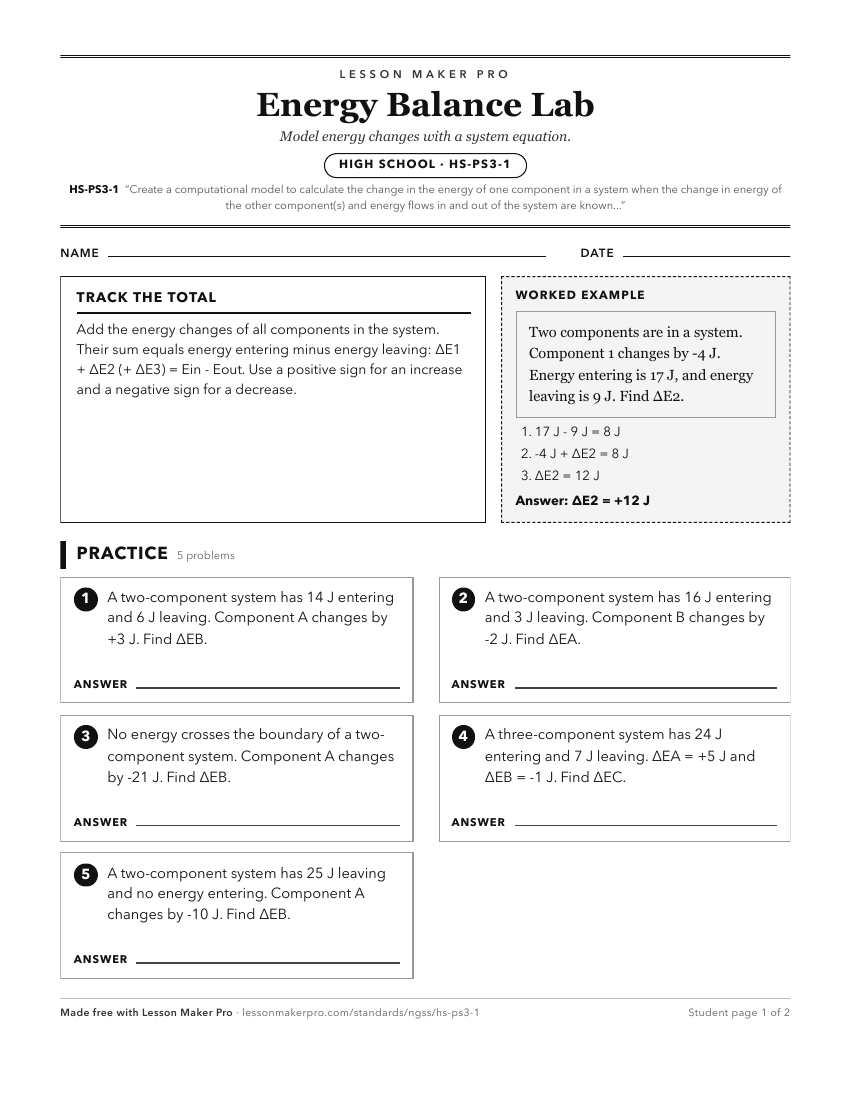
A ready-to-print activity worksheet aligned to HS-PS3-1, with an answer key for the teacher on its own page. No account needed.
PDF, US Letter, prints cleanly in black and white.
Download the worksheetLearning progression
Where This Standard Sits
See the whole path on the Physical Science progression map.
Before This Standard
If students are struggling here, check these first.
- MS-PS3-4
Middle school links temperature change to energy transfer, matter type, and mass, which supports high school energy accounting in systems.
- MS-PS3-2
Students carry forward tracking stored energy in interacting systems to calculate component energy changes from transfers and conservation.
- MS-PS3-3
Thermal transfer design experience supports tracking energy flows between system components before using calculations to model energy changes.
- MS-PS3-1
Graphing kinetic energy relationships prepares students to quantify energy changes before modeling energy transfers within a system.
- MS-PS1-4
Understanding thermal energy changes in particles supports tracking energy transfers and conservation across components in a computational model.
- MS-PS3-5
Middle school energy transfer arguments support high school quantitative tracking of energy changes among system components and flows.
Keep exploring
Related Standards
Turn this exact standard into a lesson
Grade, subject, topic, and the complete standard are prefilled. Create one free, no account needed.
Also for this standard:Make a WorksheetMake a QuizMake a Sub Lesson