NGSS HS-ESS2-4
The Standard
Use a model to describe how variations in the flow of energy into and out of Earth systems result in changes in climate.
Next Generation Science Standards
Teacher's field guide
What This Standard Means
What Students Need to Do
- Students use an energy-budget model to track sunlight absorbed or reflected by Earth and heat released to space. They explain how volcanic aerosols, greenhouse gases, ocean circulation, solar output, and orbital changes can shift climate over different timescales.
What Mastery Looks Like
- A student can read or build an energy-budget model, change one factor, and predict whether the planet gains or loses energy. The student links that prediction to temperature, precipitation, ice volume, sea level, or organism ranges and identifies a plausible timescale.
Common Misconceptions
- Students often confuse climate with daily weather and treat any short-term temperature change as a climate trend. They may assume increased sunlight is the only cause of warming, overlooking reduced heat loss from greenhouse gases. They also expect slow orbital or atmospheric changes to explain trends lasting only decades.
How to Assess It
- Exit ticket: A model shows 100 energy units arriving, 30 reflected, and 68 leaving as heat. Ask students to identify the imbalance and predict changes in surface temperature and glacial ice if it continues.
Lesson moves
Ways to Teach It
Place black and white paper under a lamp, record temperature changes, then sketch how surface reflectivity affects Earth's energy balance.
Compare volcanic aerosol and carbon dioxide graph cards, then write which climate response should last longer and why.
Sort cause cards into four timescale bins, then earn a point by predicting one temperature, ice, sea level, or biosphere change.
Graph 30 years of local temperature and precipitation data, then discuss whether the pattern fits a regional climate trend.
Free download
Printable HS-ESS2-4 Worksheet
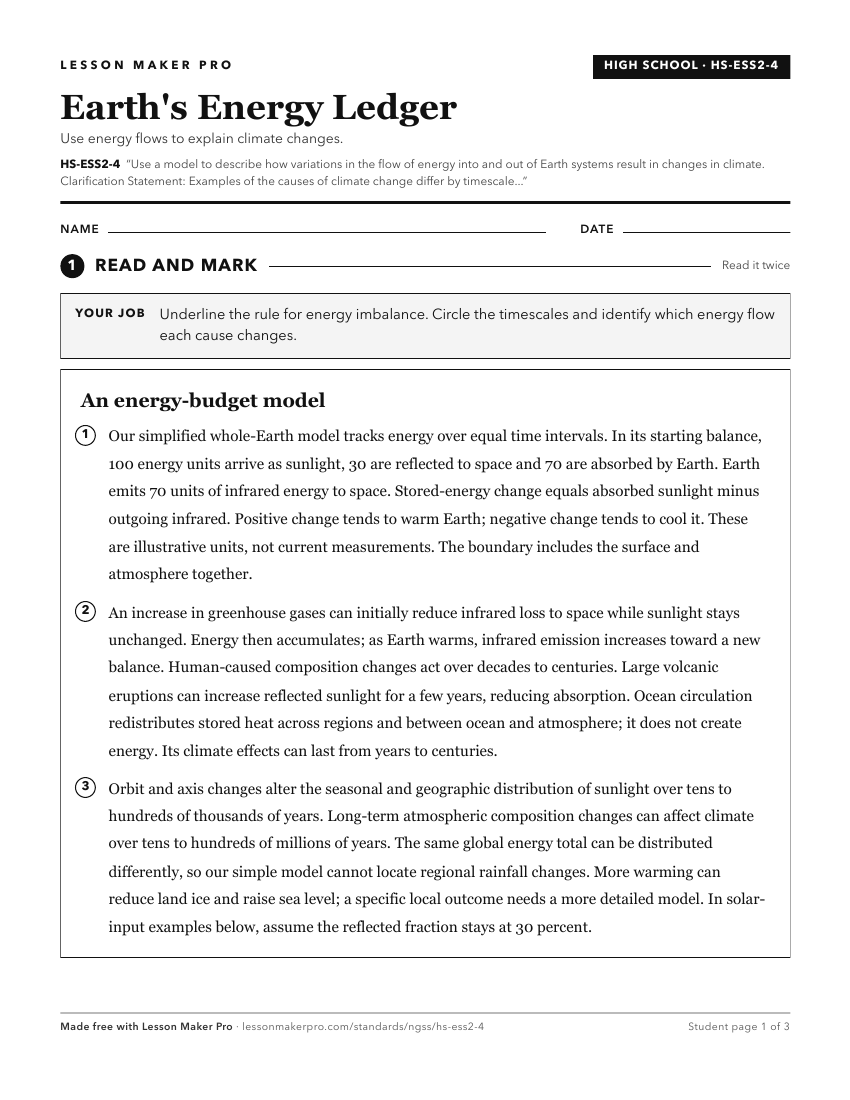
A ready-to-print activity worksheet aligned to HS-ESS2-4, with an answer key for the teacher on its own page. No account needed.
PDF, US Letter, prints cleanly in black and white.
Download the worksheetLearning progression
Where This Standard Sits
See the whole path on the Earth & Space Science progression map.
Before This Standard
If students are struggling here, check these first.
- MS-ESS2-2
Understanding Earth processes across time and space supports modeling how changing energy flows alter Earth systems and climate.
- MS-ESS2-1
Modeling Earth as interacting systems with energy flows supports explaining how changed energy inputs and outputs affect climate.
- MS-ESS2-6
Middle school circulation models carry into high school modeling of energy flow changes that drive climate patterns and change.
- MS-ESS2-5
Understanding air masses and weather changes supports modeling how energy flow patterns drive broader climate changes over time.
Keep exploring
Related Standards
Turn this exact standard into a lesson
Grade, subject, topic, and the complete standard are prefilled. Create one free, no account needed.
Also for this standard:Make a WorksheetMake a QuizMake a Sub Lesson