NGSS MS-ESS2-1
The Standard
Develop a model to describe the cycling of Earth's materials and the flow of energy that drives this process.
Next Generation Science Standards
Teacher's field guide
What This Standard Means
What Students Need to Do
- Students build and revise a labeled model showing how rock material changes form and moves through Earth's systems. They connect melting, crystallization, weathering, deformation, and sedimentation to energy from sunlight, gravity, and Earth's interior.
What Mastery Looks Like
- Students can trace several valid pathways through their model and explain what happens at each arrow. They distinguish cycling matter from flowing energy and connect surface processes to sunlight and gravity, and deep processes to internal heat.
Common Misconceptions
- Students often draw one fixed loop and assume every rock follows the same path. They may confuse melting with weathering or claim that energy cycles along with matter. Some assign sunlight to deep melting instead of energy from Earth's interior.
How to Assess It
- Give students a blank rock cycle diagram. Ask them to add five process arrows, trace two possible pathways, and label each pathway's energy sources.
Lesson moves
Ways to Teach It
Shave, layer, press, melt, and cool crayons to model weathering, sedimentation, deformation, melting, and crystallization.
Write how one rock fragment could become part of two different rock types, naming each process and energy source.
Give groups process and material cards, then challenge them to build three valid pathways and defend every connection.
Analyze photos of a riverbed, road cut, and lava flow, then identify the processes and energy sources visible in each.
Free download
Printable MS-ESS2-1 Worksheet
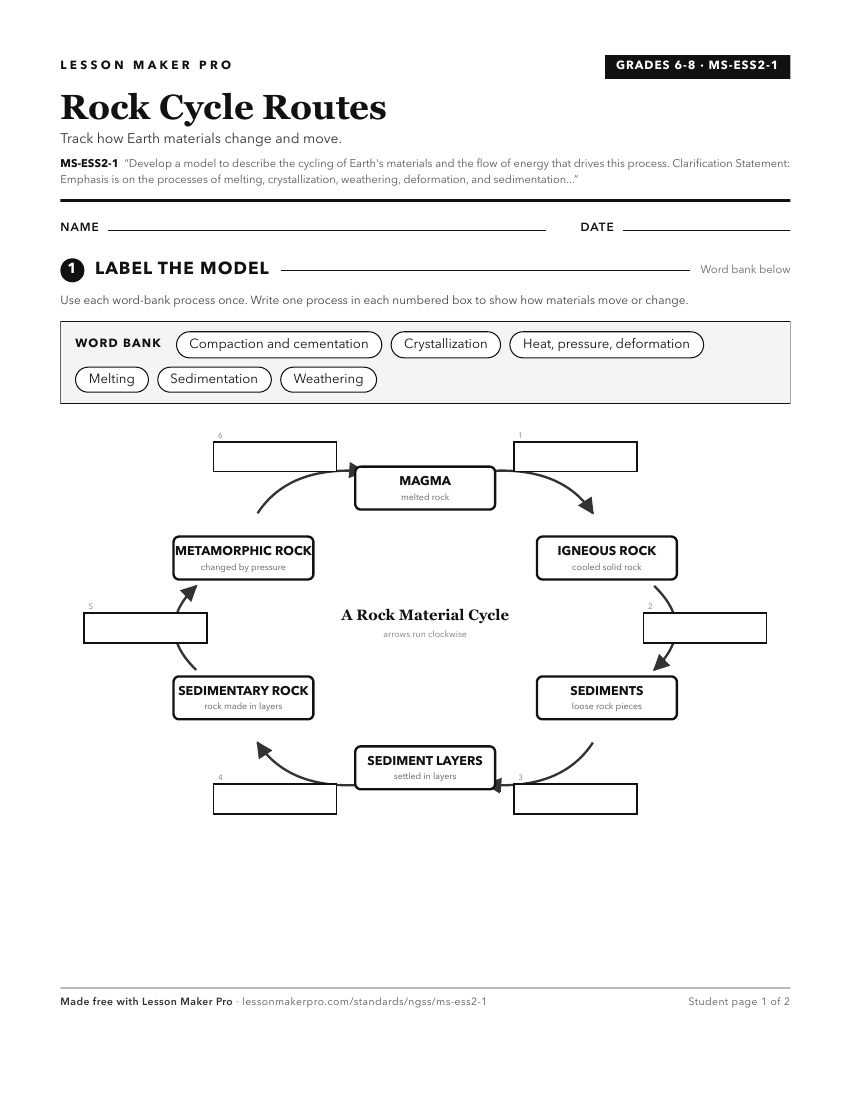
A ready-to-print activity worksheet aligned to MS-ESS2-1, with an answer key for the teacher on its own page. No account needed.
PDF, US Letter, prints cleanly in black and white.
Download the worksheetLearning progression
Where This Standard Sits
See the whole path on the Earth & Space Science progression map.
Before This Standard
If students are struggling here, check these first.
What This Unlocks
Mastery here sets students up for these next.
- HS-ESS2-4
Modeling Earth as interacting systems with energy flows supports explaining how changed energy inputs and outputs affect climate.
- HS-ESS2-3
Students carry forward modeling Earth material cycling and energy flow, then focus that model on evidence for mantle convection.
- HS-ESS2-2
Understanding Earth's material cycles and energy flows helps students interpret how surface changes propagate through connected Earth systems.
- HS-ESS2-1
Understanding Earth material cycling and energy flow supports modeling how tectonic and surface processes create features over varied scales.
Keep exploring
Related Standards
- MS-LS2-3
Develop a model to describe the cycling of matter and flow of energy among living and nonliving parts of an ecosystem.
- MS-ESS2-4
Develop a model to describe the cycling of water through Earth's systems driven by energy from the sun and the force of gravity.
- HS-ESS2-6
Develop a quantitative model to describe the cycling of carbon among the hydrosphere, atmosphere, geosphere, and biosphere.
Turn this exact standard into a lesson
Grade, subject, topic, and the complete standard are prefilled. Create one free, no account needed.
Also for this standard:Make a WorksheetMake a QuizMake a Sub Lesson