NGSS HS-ESS2-6
The Standard
Develop a quantitative model to describe the cycling of carbon among the hydrosphere, atmosphere, geosphere, and biosphere.
Next Generation Science Standards
Teacher's field guide
What This Standard Means
What Students Need to Do
- Students build a numerical model that tracks carbon stored in the atmosphere, oceans, rocks and soil, and living things. They label transfer rates and units, calculate how reservoir amounts change, and explain how human activity alters the cycle.
What Mastery Looks Like
- A student can turn a data table into a box-and-arrow model with correct reservoirs, flux directions, values, and units. They use inputs minus outputs to predict changes and show that carbon is conserved across the model.
Common Misconceptions
- Students often confuse a carbon stock with a yearly flux, or compare values with different units. They may reverse photosynthesis and respiration arrows, leave humans outside the biosphere, or treat carbon as disappearing when it moves.
How to Assess It
- Exit ticket: Four reservoirs begin with atmosphere 100, ocean 200, biosphere 50, and geosphere 300 carbon units. Using yearly transfers of 10 atmosphere to biosphere, 4 biosphere to atmosphere, 8 atmosphere to ocean, 6 ocean to atmosphere, 5 biosphere to geosphere, and 1 geosphere to atmosphere, draw the model and calculate each ending amount.
Lesson moves
Ways to Teach It
Give groups four labeled bins, 100 counters, and transfer-rate cards; students move counters for five rounds and graph each reservoir.
Ask students to explain how burning fossil fuels changes two reservoir totals, using arrows, numbers, and conservation of matter.
Run a carbon-budget relay where teams calculate each reservoir's new total from stock and flux cards, then check units.
Use local electricity-use data to estimate carbon emissions, then add that flux to a class carbon-cycle model.
Free download
Printable HS-ESS2-6 Worksheet
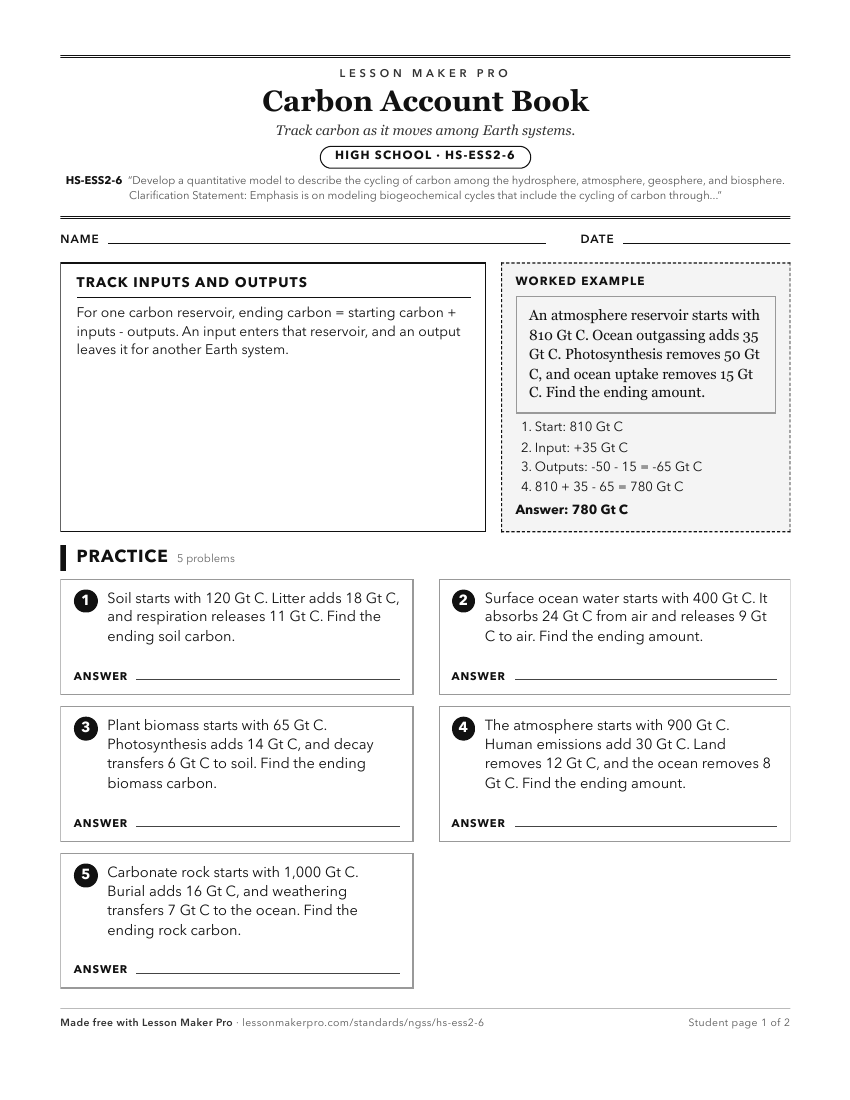
A ready-to-print activity worksheet aligned to HS-ESS2-6, with an answer key for the teacher on its own page. No account needed.
PDF, US Letter, prints cleanly in black and white.
Download the worksheetKeep exploring
Related Standards
- MS-LS2-3
Develop a model to describe the cycling of matter and flow of energy among living and nonliving parts of an ecosystem.
- HS-LS2-5
Develop a model to illustrate the role of photosynthesis and cellular respiration in the cycling of carbon among the biosphere, atmosphere, hydrosphere, and geo...
- MS-ESS2-4
Develop a model to describe the cycling of water through Earth's systems driven by energy from the sun and the force of gravity.
- MS-ESS2-1
Develop a model to describe the cycling of Earth's materials and the flow of energy that drives this process.
Turn this exact standard into a lesson
Grade, subject, topic, and the complete standard are prefilled. Create one free, no account needed.
Also for this standard:Make a WorksheetMake a QuizMake a Sub Lesson