NGSS HS-LS2-5
The Standard
Develop a model to illustrate the role of photosynthesis and cellular respiration in the cycling of carbon among the biosphere, atmosphere, hydrosphere, and geosphere.
Next Generation Science Standards
Teacher's field guide
What This Standard Means
What Students Need to Do
- Students build a model showing how carbon moves among air, water, living things, soil, and rocks. They label how photosynthesis stores carbon and respiration releases it.
What Mastery Looks Like
- A student can build a model with accurate carbon reservoirs, labeled arrows, and clear process names. They can trace one carbon atom and predict how changing photosynthesis or respiration affects other reservoirs.
Common Misconceptions
- Students may think plants photosynthesize but do not respire, or that carbon is converted into energy. They may also show carbon disappearing instead of moving into another reservoir.
How to Assess It
- Give students four labeled boxes: atmosphere, ocean, living things, and rocks or soil. Ask them to add and explain arrows for photosynthesis and respiration.
Lesson moves
Ways to Teach It
Set up labeled reservoir trays and have students move carbon tokens according to photosynthesis, respiration, decomposition, and ocean exchange cards.
Ask students to trace a carbon atom from atmospheric carbon dioxide into a tree, an animal, and back to the atmosphere.
Give teams a flawed carbon cycle diagram and award points for finding, correcting, and explaining each error.
Use a seasonal atmospheric carbon dioxide graph and have students explain rises and falls using photosynthesis, respiration, and carbon storage.
Free download
Printable HS-LS2-5 Worksheet
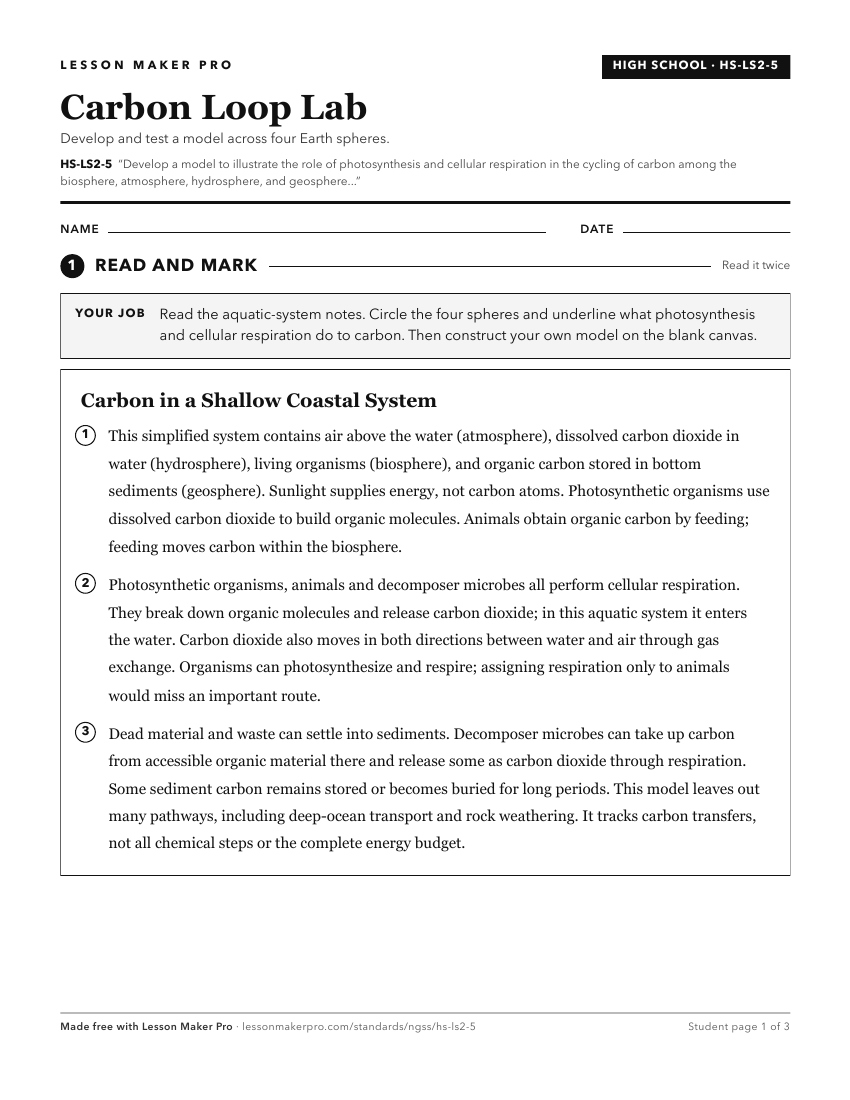
A ready-to-print activity worksheet aligned to HS-LS2-5, with an answer key for the teacher on its own page. No account needed.
PDF, US Letter, prints cleanly in black and white.
Download the worksheetBefore This Standard
If students are struggling here, check these first.
- MS-LS1-6
Understanding photosynthesis as matter cycling and energy input is essential for modeling how carbon moves between organisms and Earth systems.
- MS-LS2-3
Students carry forward ecosystem matter cycling models to explain carbon movement through photosynthesis, respiration, and Earth systems.
- MS-LS1-7
Understanding food molecules rearranged in respiration supports modeling how photosynthesis and respiration move carbon through Earth systems.
Keep exploring
Related Standards
- MS-ESS2-1
Develop a model to describe the cycling of Earth's materials and the flow of energy that drives this process.
- HS-ESS2-6
Develop a quantitative model to describe the cycling of carbon among the hydrosphere, atmosphere, geosphere, and biosphere.
- 5-ESS2-1
Develop a model using an example to describe ways the geosphere, biosphere, hydrosphere, and/or atmosphere interact.
Turn this exact standard into a lesson
Grade, subject, topic, and the complete standard are prefilled. Create one free, no account needed.
Also for this standard:Make a WorksheetMake a QuizMake a Sub Lesson